Showing posts with label French life. Show all posts

Monday, 5 September 2011

Just another manic Monday

Kalba to Lapeyre: Oi, where's my stuff? Your driver is a plonker. And I've wasted two whole days waiting for him to arrive at the times he has promised. Do something. (Or words to that effect).

Lapeyre to Kalba: Not my problem, madame. I have put you in touch with our driver. That's my job finished.

Kalba to Lapeyre: I'm desolated but I am not in agreement. I have paid you an arm and two legs for this shower screen, plus a small mortgage for the delivery. It was promised for early July. It's now early September. It's your responsibility. Get on with it.

Lapeyre to Kalba: C'est impossible.

Kalba to Lapeyre: No, no, no, I am not at all in agreement. I think it's perfectly possible, and your moral responsibility.

SILENCE.

Lapeyre to Kalba: I'll think about it and phone you back.

Kalba to Lapeyre: I'll hold on.

Lapeyre to itself: Sigh. Rustling of paper.

Lapeyre to Kalba: As an honourable exception, madame, I will contact the driver and phone you back.

Kalba to Lapeyre: You have five minutes.

THREE MINUTES PASS. PHONE RINGS.

Driver to Kalba: It wasn't my fault. Lapeyre didn't load it onto the van.

Kalba to driver: How strange. It was there at lunchtime when I last spoke to you. You will be here in the morning, non?

Driver to Kalba: Oh, well, I'm not sure ..... maybe Wednesday.

Kalba to driver: C'est impossible. Tomorrow morning, before noon. I'll expect you. That's guaranteed, non?

Driver to Kalba: Oui mais non mais .... [sigh] d'accord.

Kalba to driver: So just to confirm - tell me again when you're coming ....

Driver (in small voice): tomorrow, Tuesday, before noon.


Bets, anyone?

Wednesday, 22 June 2011

La Fête du Tonnerre

Yesterday being the summer solstice (already! I'm sure the last one was only 4 months ago), it was also the occasion for La Fête de la Musique - a much anticipated event in this household as it marks the first opportunity of summer to get out there and dance till late.

The previous two days had been hot and cloudless. Tuesday dawned still hot, though much more humid and slightly hazy: by noon some ominous looking clouds were appearing from the west. Metéo France, on the ball as always, hurriedly changed its forecast to 'risk of storms'. At 2pm the thunder started. For the next 4 hours, it rumbled and groaned and banged in almost continuously and in spectacular fashion, but without a drop of rain.

At 6pm we came in to shower and change and by 6.30 were ready to go. Just as I stepped outside, I was almost knocked off my feet by the loudest clap of thunder I've ever heard, and someone up there in the sky started emptying buckets of water (and I mean buckets. I've never seen anything like it). It was suddenly as dark as night - all the better to watch the now almost continuous lightning that streaked around in all directions. The rain suddenly turned to hailstones the size of large pebbles. It was awesome.

We ran around with buckets. The storm continued at the same level of intensity for a whole hour before the rain slowly eased off, although the thunder continued in an almost continual rhythm. Then: bugger it, we said, no self-respecting Ariégeois is going to let a bit of a storm get in the way of a good fête. So we got in the car and made our way to St Girons.

We were right. People were arriving in droves. And though the thunder and lightning continued unceasingly, a hint of blue appeared in the sky. Unsurprisingly, what laughingly calls itself the timetable (if you live, or have ever travelled in France, you'll understand exactly what I mean by that ...) had been thrown into disarray, which was A Good Thing as it meant we could still catch the early gig by five young jazz musicians from Marciac, who'd decamped from their open stage to a smaller space under the arches outside the church while volunteers baled out the stage and tried to salvage the sound system ...

We wandered around sampling the usual mélange of thunder, rock, Cajun, punk, flamenco, chanson, blues, classical, Occitan, reggae and all the rest and were just about to sit down with a glass of something, some street food and some salsa when once again the heavens opened. All around us people grabbed their food and drinks and looked for shelter, of which there was nowhere near enough for the two or three thousand revellers. Most, like us, just put up their umbrellas, shrugged, and got on with it. I felt sorry for those eating 'properly' on the terraces of the various restaurants as tout d'un coup their plates were awash with water.

And still it thundered. And still the lightning tore and danced around the sky, often in several directions at once.

A few bands, those playing on open stages, simply had to abandon; some found rudimentary shelter and played acoustically instead. The rest just carried on regardless. As did the rain. We joined the huge crowd gathered around the Guinguette Ludique to hear and dance to the Celtic band Finnan; they're a multicultural (Canadian, French, German and English) mix and always highly popular. And when you're wet, you can't get wetter, so what to do but ditch the umbrellas and dance madly in the rain ............


PS The thunder finally moved away just before 1 in the morning. It had continued for eleven hours ....

Friday, 22 October 2010

On progress, and the revolting French

This is a bit of a sad week for me: yesterday was my last day (for this year at least) working at the yoga centre, which is about to close for holidays until next May. I've done some lovely stuff with some lovely people from all over the world, met some other folk living locally who came, through word of mouth, for regular sessions, and reclaimed a bit of me that's been filed under 'pending' in a cupboard for the last eight years. Much as I'd love to have carried on working with my local clients over the winter, reality (as in a seriously unfinished réno and a long suffering partner who'd probably kill me) has set in and so it's back on with the blue overalls seven days a week, head down, and full on with all the outstanding bits of work.

Have you ever noticed how things that you set up in your mind as terminally difficult actually turn out to be relatively straightforward (and vice versa)?. Just a week ago, we started to put up the bookshelves in the new dining room, which on its mezzanine level has an alter ego as a library. We swiftly discovered that the wall consisted of plasterboard dotted and dabbed onto hollow brick ... some 10 centimetres away from it. Now why oh why oh why would you do that?? The dots (or is it the dabs?) were dabbed (or dotted) at random, so no chance of screwing the shelves through them. And a brief attempt to fix through the placo and into the brick was not exactly successful - it chewed up the placo then fell out of the brick, in spite of the biggest wall plug in the world. Clearly there was nothing for it but to build a made-to-measure shelving system from scratch - a solution we'd hoped to avoid because of the bizarre dimensions of the space. Sigh. So with heavy hearts, a design was swiftly put together - to accommodate sloping walls, sloping ceiling and sloping floor - wood was duly bought, and over the week the carcasses were duly made (by John), lasured (by me), and hoisted up to the mezzanine (by both of us),

And it worked.


(Yes, I know there are no shelves. Be patient. There will be.)

I'm beginning to think that creating this dining room is just about the most dramatic, and rewarding, thing that we're doing: not only does it give us a whole new room and link up the two previously separated bits of the house, it really opens up a sense of space and light as you walk into the hallway from the front door: whereas once you saw this


now you see this:


Which is just a great step forward, and gives us both the courage and the wherewithal to go on. So the next month (maybe more) will see us putting up a spiral staircase to the library area, building new oak steps down from the hall, fitting oak windowsills and skirting boards, repairing and sanding and finally painting the balustrade and window frames and doors, deep cleaning and oiling the terracotta tiles and building cupboards across the back wall using some reclaimed shutters we found in a local depôt vente.

Meanwhile, unless you've had your head in a paper bag this last week or so you'll know that the French are revolting: ostensibly at the proposed pension reforms but also I think, underneath, out of sheer despair at Sarkozy, his style of leadership and the general unfairness that his policies engender in so many levels of society. Schools are closed, transport is affected, fuel is desperately short with a quarter of petrol stations empty and millions of people, including large numbers of students, have taken to the streets. Life as we know it has been inconvenienced but do you know what? I'm proud to live in a country where people care, and are willing to show outwardly that they care rather than living in depressed apathy and/or finding a scapegoat to kick. The French, I believe, feel no differently from those living in other European countries where policies increasingly ask 'the people' (for want of a better phrase) to pay while capital continues to accumulate in the hands of the few: they're just more accustomed to showing it. And so the protests have my support, as well as that of over 70 per cent of the population, who clearly feel the way one protester on Saturday did:


The placard reads: "Carla, on est comme toi, on se fait niquer par le chef d'état" ...

 Look it up!

Tuesday, 7 September 2010

Taking the Slow Road to the Gorges de la Frau: Part One

So, last Friday we decided to head east, over to the other side of Ariège - almost into Aude, in fact. We wanted to test out one of our new potential Slow Roads to see how it felt to actually follow and hence whether it would make it into the Slow Road collection. What's a Slow Road? Well, it's a term we've coined (along with Snail Trails for our walking paths) to describe some of the itineraries we're putting together here at Grillou for our future guests. A Slow Road will always be scenically beautiful (not difficult here), unhurried, quiet, a bit off the beaten track and sometimes slightly quirky; it will always offer interesting stops, a Slow Walk or two, at least one place to sit and just be, and somewhere interesting to eat and/or drink: in other words it will encompass all the different bits and pieces of the Slow philosophy.

We set off via Foix on the road to Lavalanet, but instead of continuing on the 'fast' road we turned off at Celles (don't be fooled by the grimy bit on the main road; behind that is a surprisingly pretty village with a lovely arcade of plane trees), from where a single track road starts to climb up towards the Col de la Lauze. Well before the Col, though, our attention was taken by a sign towards a chapel on the left: Notre Dame de Celles, site of an apparition. Never ones to turn down the prospect of a miracle, we followed it, up a steep road where there's a little parking area and an even steeper, stony pedestrian path through the trees. To be honest, the chapel is nothing much to write home about, unless you're a fan of Catholic neo Gothic, though the situation is beautiful. But I do like the story, although I had to dig it out when I got home as there's no mention of it on site when the chapel's closed: in 1686 (note that date well - nearly two centuries before the apparitions at Lourdes) a young paysan was coming back from the fields when a dove led him to a spring where it promptly turned into a young girl and told him not to be afraid because she was the Blessed Virgin (stop sniggering at the back, you heathens - I said 'the', not 'a' ...).

The people of Celles, she told him, needed to repent and it was his job to ensure that they did. Some time later, post-repentance, she appeared to him again and told him that the spring would be 'good'. After that dozens of people reported miraculous healings there; the place became a place of pilgrimage, and a chapel was built. However, the complex historical circumstances that prevailed at that point in time meant that the results of a religious enquiry that confirmed the miracles remained locked in a treasure chest in Pamiers; as a result the Vatican never got to 'pronounce' on the apparitions (if it had, Celles could have been Lourdes ... merde alors) and few people have ever heard of the place, although there is an annual pilgrimage and the chapel has very recently been restored.

Here's the chapel ...


in a lovely verdant setting


and the spring ...


Looks like the BV left her shampoo bottle behind ....

Saturday, 15 May 2010

Parcel Farce

Being the gentle, easy going soul that I am ;-) there aren't many things in life that I can claim to hate. But I hereby announce, loudly and to anyone who's listening, that I hate, loathe, and detest parcel delivery services.

Living as we do in the middle of nowhere, it's often much more convenient, and almost always cheaper, to buy stuff online. Twas ever thus: it was the same in our Norfolk years. All the wine for our restaurant, for example, came to us from our various suppliers via courier. Our front door was a good 100 metres down a cobbled pedestrian-only loke (narrow alleyway); did any of them have sack barrows or trollies? Did they hell. No, every box had to be carried, painfully and with accompanying moans, down the loke. One used to refuse to do it, claiming back problems. And did any of them ring the blatantly obvious house door bell? Er - no. They would always knock - ineffectually - on the restaurant door, which is not especially useful when you're blasting away in the kitchen three rooms away. And then drive off and report a 'failed delivery'. Or occasionally leave a dozen boxes of wine outside the door, for everyone and his wife to help themselves to ....

That's assuming, of course, that they'd turned up, in the right place or, indeed, at all. On the Friday before one Bank Holiday weekend our Neal's Yard Dairy cheese order simply didn't arrive, leaving us running frantically round the county at 6pm looking for enough small-producer cheese to see us through the four or five days until it could be replaced. (It turned up, smellily, six days later in the barn of someone's (unoccupied) second home at the other end of the village. "Well, the courier couldn't find the right place, could he?" was the response from the delivery company. Ah. Of course not. Silly me).

And it's not a lot better here (did I really think it would be?). Invariably we get a phone call from the driver, who's parked outside La Poste in Rimont. Occasionally we even manage to pick the phone up, though not often as it's not terribly easy when, for example, you've got a bucketful of rapidly going off plaster. But assuming we do, the conversation usually takes one of three forms.

1. "Can you give me directions?". That's easy. But it is unnecessary: we're clearly marked on all the main maps, Google maps, Google Earth, Geoportail and all the SatNav systems. "Don't you have SatNav?" I asked someone last week. Apparently not. "Well, what about a map?" No, no map. Useful.

2. "I'm at La Poste. Can you come and get your parcel? Now?" Er, no. I'm paying you to deliver it. "But it's too difficult / too far / there's an R in the month". Tant pis. "Bof putain de bordel de merde fait chier ...".

3. "I'm stuck in the mud on a footpath that goes to a lake". Yes (sigh), you have got a SatNav, and you've asked it for the shortest route. (Listen, all ye who rely on such things. SatNavs are NOT intelligent beings ...).

This week however has offered up a new form of courier entertainment. A package I'd been expecting for some time had still not turned up, so I decided to use the tracking service. Address unknown! Failed delivery! Await clarification from customer!!! it screamed. Ignoring the question of just how said customer was supposed to know that, eventually I managed to track down the name of the offending courier. Heart sinks: it's Chronopost, known throughout France for their ineptitude, their bloody-mindedness, and their premium rate telephone number for all enquiries - yes, that would be one, for the entire country. Having pressed the required 72 buttons to get to speak to a living, breathing entity, I was informed that I had 'only' twenty-eight and a half minutes to wait to do so. (It was actually 32, which I suppose is close).

And the outcome? They had, it transpires, been attempting to deliver to my telephone number.

Saturday, 24 April 2010

Asperges syndrome

If there's one thing that finally tells me that the earth has turned and winter has gone it's asparagus. Part of that glorious sequence of firsts that marks the transition from spring into summer, along with the first broad beans, the first peas, the first strawberries, it's a classic example of seasonal eating: something to be longed for, gorged on, and then mourned for … all in the space of a few weeks. It’s a bit like a holiday romance: all the sweeter because you know it can’t go on.

In our restaurant days asparagus was a Big Thing: Norfolk was one of the UK's prime producers, and we had several of the best within five or ten kilometres. For six or seven weeks, barely a day would go by without asparagus making an appearance somewhere on the menu; indeed, many people would travel and book specifically to eat it. Here at Grillou, at the moment it's just us, but oh, it was still a happy day when I saw the first proper asparagus at Saint Girons market last week.

The French, for some reason I just can't fathom, traditionally despise green asparagus. Ditto the Dutch, the Belgians, the Spanish, the Germans ... and for all I know the rest of the world. Except, of course, we Brits, who worship it, even if it does make our pee smell. But for everyone else it's the fat white stuff that gets them going. Heaven knows why; it's watery, slimy, tasteless and invariably overcooked (whoops, there goes another pile of street cred ...), and you have to peel it. But at this time of year the markets are stuffed with it, and every stall is besieged.


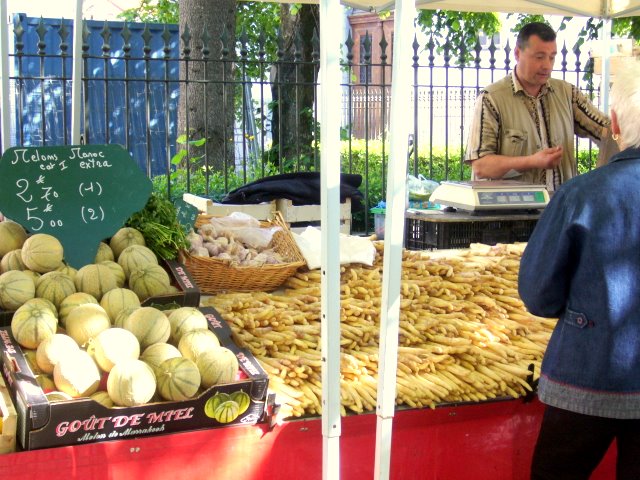
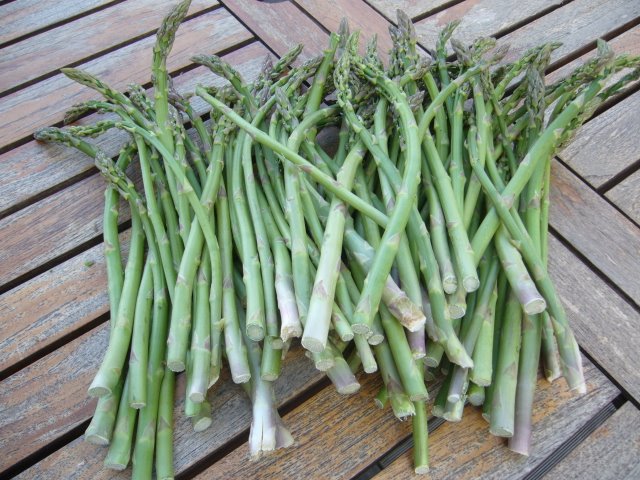
The green stuff, on the other hand, is not easy to get hold of. To be honest, it's been one of the few food disappointments since moving here. Even the green asparagus I have managed to find has been monstrously fat like its white cousin. But ... this year we have a new producer at our market. And they're selling no less than 9 varieties and grades of asparagus, including - oh deep joy - two sorts of green: the fat stuff, and real, proper thin spears. No carefully weighed, neatly trimmed bunches here: there are great mounds of it, lying loose for the picking, for only 2.80 euros a kilo. We bought some last week and it was so good we went back for more - lots more - today. As I was shovelling handfuls of it into a piece of newspaper a French woman, curious at my buying habits, asked me what it tasted like. Now that's not an easy question. In the end I broke her off a piece of try raw. Her eyes lit up. She bought four kilos. The revolution is here ...


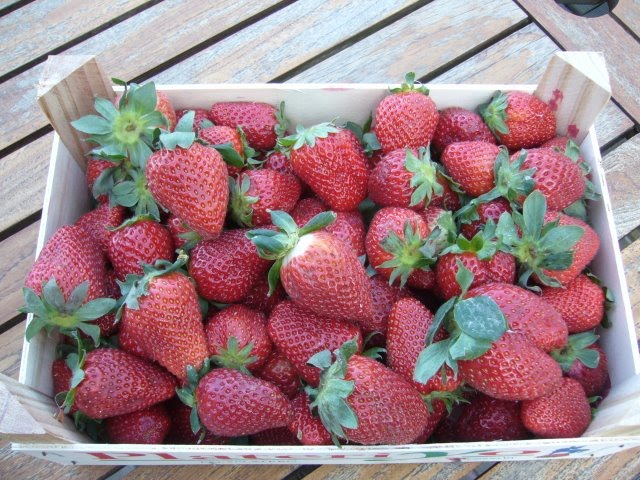
Tonight we ate asparagus with penne, lardons, crème fraîche and parmesan. We followed it with these:


Well, maybe not quite all of them. The rest, and another 2 kilo box like them, will be transformed into jam tomorrow. The first year we moved here, I couldn't understand why I couldn't find any strawberries in June. I was too late: although there are a few varieties around later on in small (and expensive) quantities, the main crop comes at the end of April and very beginning of May. No tennis strawberries here ... But as you read this, jam will be being made in humungous quantities all over the south of France - which leads on to one of life's great unanswered questions: just what do French households do with the vast amount of jam that they all seem to make each year?

Tuesday, 2 March 2010

There but for the grace of Gaia ...

The winds and hurricane of Saturday night passed by and left us completely unscathed. In fact we bathed in ridiculously high Foehn effect temperatures (it was 25 degrees at 10.30pm), and enjoyed a truly spectacular flare at sunset:


Other areas weren't so lucky. Like the rest of France, we've been watching, with a mixture of horror and disbelief, the daily TV coverage of the floods in Vendée, where 28 people have died in the communes of L'Aiguillon sur Mer and La-Faute-sur-Mer alone, surprised in their beds by the storm surge that devastated the walls built to keep the sea away from the huge bungaloid estates that have sprung up over the last 20 years. At least 10 per cent of all the agricultural land in neighbouring Charente Maritime has been invaded by the sea; the Ile de Ré (where 'only' two people died) has been split by the sea into its original three islands, and entire villages are still cut off.

This stretch of coastline is remarkably similar to that of north Norfolk, where we lived for 8 years before coming to France. Our house was barely 2 centimetres above sea level and a few metres away from hectares of salt marsh; like the rest of our street we were front line in the flood zone, and our house was one of many that had been flooded to nearly three metres high in 1953 (over 50 years later, salts were still coming out of the wall and so like our neighbours' houses, all our inside walls remained boarded). Although a new (and ugly) concrete sea defence had been built between us and the marshes, we remained at risk; the local council regularly delivered sandbags, our flood board was always at the ready, the flood warning siren was tested without fail on the first Saturday of the month, and we would get occasional phone calls from the Environment Agency requiring us to get "ourselves and our livestock" to higher ground. In the back of our minds was always the question: what should I save? It was somewhat discomforting; we all knew that one day another huge surge would come. And so it will, of that I have no doubt.

Probably because of that experience, I find myself being particularly affected by the flooding in Vendée. What I see every night on my TV screen is what we all, at an almost unconscious level, feared in Cley in our everyday lives. And yet there are some huge differences. The early warning system in north Norfolk is well developed, if not especially well thought out (many of the phone alerts, for example, came in the form of voicemail messages in the early hours of the morning ...), but there seems to be no warning system at all in place in the Vendée and Charente Maritime in spite of the fact that huge swathes of the land has been reclaimed from the sea and lies at - or below - sea level. Last night I listened to the President of the Conseil Général explaining how the flooding "could not possibly have been foreseen" because it was a result of a combination of events which had never happened before: high winds, spring tides, and an atmospheric depression that caused a further increase in the height of the tide. Er - yes ... that's exactly what happened in the floods of 1953 ...

It seems that many of the sea walls date back to the Napoleonic era when the land was first reclaimed from the sea, and have been slowly falling into a state of disrepair. Even more disturbing, though, is the number of homes that have been built in flood zones - and I'm talking at, and below, sea level - since 1999, the year of the two successive hurricanes that caused untold damage to much of France: 100,000. Many of these are, like those on the estate at L'Aiguillon, single storey 'pavillons' (in fact at L'Aiguillon, two storey houses are not permitted ...). There are, of course, huge incentives to classify land, however unsuitable, as constructible, and it's well known that many a town or village maire has done very nicely thank you over the years by doing just that. Rightly, the merde has begun to hit the ventilateur about all of that today, and hopefully we may find that this particular stable door is, if not shut, now pushed a little further closed.

Fat lot of good that'll be though to those who discovered, one Saturday night in February, that while you can build walls and banks and barriers and defences of all kinds, Gaia will, one day, have her way.

Saturday, 9 January 2010

Getting down and dirty

This has been floor sanding week.

Monday. Go to brico shed in Saint Girons to collect drum and edge sanders we've booked. But no - desolé madame, but they are both en panne (broken down; bust; buggered), thanks to last hirer. I've been here long enough now to simply shrug. Come home and phone friendly hire company in Foix that we've used before (and should have used in the first place) to book sanders for tomorrow.

Tuesday. John drives to Foix at - or rather before - the crack of dawn to collect sanders and ten thousand sanding sheets. Struggle upstairs with them - big machine weighs in at over 65 kilos. Set it up. Switch it on. Oh joy - it has a solid dust compartment, not a bag like the ones I've used before, so makes almost no dust. Ah ... this is going to be easy. One complete pass over the floor - and it stops dead. The drive belt has gone. Broken down, bust, buggered. Shout, swear, shrug. We decide to carry on with the edge sander (with which we have to sand the entire 20 metre mezzanine area as we've just put a semi spiral staircase in and can't get The Brute up it) and exchange the other one tomorrow. Edge sander, however, has a mind of its own, and is not inclined to do anything we want it to. It leaps manically across the floor, with one (and occasionally both) of us attached and clinging for dear life as it threatens to throw us off the mezzanine edge. I give up on it and go back to my belt sander. John persists. And so the day passes, and the evening too, and in fact half the night.


Wednesday. Back to Foix and hire company at 7.30am, exchange machine, home. Struggle upstairs. I pass a happy morning walking up and down with Brute Number Two, who turns out to be rather pleasant, and efficient, company, though not exactly entertaining on the conversation front. John's back on the edge sander, which has the bizarre attribute of having a dust bag with the opening at the bottom. Spend afternoon and evening polishing out edge sander marks with random orbital, appropriately called excentrique here.


Thursday. Back to Foix. Again. Planned trip onwards to Toulouse to hit the sales is postponed because we're on a vigilance orange - severe weather warning - for snow and ice. Buy floor finishing essentials and come home. It starts to snow heavily just as we drive up our track. Carry on sanding.

Friday. Wake to 25 centimetres of snow. Power up and down and on and off like yoyo. It takes two of us nine hours - nine hours! - to clear up all the wood dust. Commune's snow plough reaches us by lunchtime, amazingly, but still too much snow to think about going anywhere. Prepare to be here until next Thursday, when cold snap is supposed to end. Minus 8 tomorrow, apparently.


Happy days.

Sunday, 27 December 2009

So how was your Christmas?

I don't really do Christmas. Nor, it must be said, does France, where it's a bit of a one day wonder; traditionally, a long réveillon dinner on Christmas Eve, after which presents are exchanged, followed by an only slightly less demanding Christmas Day lunch. Then it's back to work as usual on the 26th - no Boxing Day here. It's all pretty low key, marked mainly by the absence of special promos and a sudden hike in the price of oysters. Presumably because we're all used to shops not being open 24/7, there's no panic fuelled filling of chariots - while tills rattle with more euros than usual, it's quality not quantity that is the order of the day - foie gras, seafood, goose, capon, champagne, good wine (and hey - it's only a week until the food fest starts all over again with the Réveillon Saint Sylvestre - New Year's Eve ...).

This year I didn't do Christmas even more than I usually don't do it. If you see what I mean.


What I didn't do:

Go to a Christmas market. No time.
Eat and drink too much. Ditto.
Go for a Christmas Day walk. Ditto again.
Send any Christmas cards. Except online.
Buy a Christmas tree. Surrounded by them right outside the window.
Buy loadsa Christmas presents. Bah humbug.
Watch interminable quiz shows and 'best of' programmes on TV. No TV.
See anyone except John. Miserable antisocial creature that I am.


What I did:

Painted 45 square metres of ceiling in La Petite Maison's bedroom.
Played with my one Christmas present. Which was - wait for it - a new stepladder (oh, but what a ladder ...).
Ate a sandwich in the sun at lunchtime.
Prepared some pigments and a bucket of lime wash for the next day.
Paid some bills and got excited when I discovered that my stamps smelt of chocolate (how could you not love a country that produces stamps that look and smell like a chocolate bar?).
Cooked a magret for dinner, a rare treat for two infrequent meat eaters.
Looked anxiously out of the window at 5pm to see if the days are getting longer ...

And do you know what? It was a perfectly joyeuse fête.

Monday, 14 December 2009

Hex your ex ...

Just in case you're still looking for that elusive Christmas present, I may have found you just the thing. This week's pub (that's as in publicité - the stuff that drops into our postbox every week regaling us with the best bargain buys) tells me that La Foir'Fouille is selling voodoo dolls, complete with pins. There are dolls to represent your boss, your ex-partner, and ... your mother in law. ("She harasses you on the phone? Regales you constantly with a thousand and one useless bits of information? Criticises your lifestyle, the way you cook, the way you bring up your kids? A great present for anyone who wants to wreak vengeance on their mother in law").

Each voodoo point is labelled with a 'vengeful wish': by judicious pin sticking, you can apparently cause your MIL to lose her voice, fall down the stairs, suffer permanent memory loss or choke on her dinner, amongst other things (none of them pleasant). "Warning" says the blurb for these things, "This is not a toy or game". Hmm. Nice.

Mind you, voodoo dolls are not new here. Last year, a publishing firm started to sell a voodoo doll of Nicolas Sarkozy. He was so - er - needled by the doll that he took the company to court, claiming was that every citizen in France owned the rights to their own image ... and he lost. The court's ruling was that the doll fell within the 'boundaries of freedom of expression and the right to humour'. The irony is that before he took legal action, nobody had heard of the dolls, but the whole affair became big news and sales rocketed.

Now I'm all for freedom of expression, but I'm not sure I'd describe what's going on here as 'humour'. But then France moves in mysterious ways ...

Merry Christmas, belle mère.

Saturday, 28 November 2009

Solidarité

One of the very few things I miss from England is its plethora of charity shops, which for many years kept me supplied with books and clothes and all sorts of weird and wonderful things, most of which eventually found their way back again to whence they'd come. One of the things I don't miss, however, is the concept of charity that lies behind them.

I don't think of myself as being a particularly uncharitable - as in mean spirited or ungenerous - being. But nevertheless I do have huge problems with the notion of 'charity'. It's divisive: it divides those who have the means to give from those who receive. It creates a distance. It creates inequality, and therefore classes. It sets up a situation where I do something for you, not with you or alongside you; in doing so I fail to offer you the chance to be an equal partner in our encounter and therefore I disempower you. And so it encourages and perpetuates paternalism: something which, however well meant, I find intolerable.

To me the concepts of justice and equality, of exchange, and of mutuality and reciprocity are the crucial ones. So, for example, I don't offer a concessionary rate to therapy clients, but because I see money as simply a form of energy, I do offer the opportunity to take sessions on the basis of energy exchange, as in 'I offer you therapy, you offer me gardening or woodwork or produce from your land or whatever skill you have that I can use'. That way, I don't turn into the magnanimous bestower of favour and the power balance between us starts, and stays, equal. (Interestingly, and to my surprise, very few people have ever taken me up on it, although I'm frequently asked for concessions ...).

And then of course there's the particularly French notion of solidarité. Not the same as the much more political (and oft-maligned) use of the word in the UK, la solidarité is not only a much-used word but also an accepted part of day to day community life here. But what is it? Strangely enough one of the best attempts I've found to define it comes from Martine Aubry, the president of the Parti Socialiste, who isn't, it has to be said, one of my favourite politicians, if using those two words together isn't too much of a contradiction in terms. But she writes:

"Solidarity is first and foremost a behaviour that we can all embody in our everyday lives. It's supporting other people when they need it. But then it's also a collective value. So that we can all live better together, and so that each one of us feels comfortable in our society, we need to help each other on a mutual basis. To be in solidarity with someone is to be 'with' that person; to feel their problems and their pain as if they were our own. And solidarity is also doing our best to live better together as a part of our country; to accept the other person as they are, whatever their origin, their neighbourhood, their differences".

Heavens. You could almost believe she's been reading Carl Rogers ...

And so (finally getting to the point ...), now you'll understand why I was truly delighted to encounter the new espace non marchand - non-trade area - at the market in Saint Girons this morning. Basically, the espace non marchand is a higgledy piggledy collection of trestles, stands and simple tarps laid out on the ground, covered with all manner of goods from books to boots to bottles of apple juice, from surplus produce to craftwork to clothes to tools. And people are also there milling around (it's a very convivial spot) offering their services on the same basis. The philosophy here is that you take whatever you need or want when you need or want it, and/or leave whatever you no longer need or want. Need some new working boots? Take them. Fancy a cup of tea? Pour yourself one. But - and here's what makes it radical - no money is involved. At all. Ever. Period. Nor is a tit for tat on the spot exchange required. It all works on the concept of there being sufficient resources for everybody, and it works on responsibility and trust: it's Freecycle (without the begging emails) and freeganism all rolled into one and then some. You don't have to prove your pitiful income or be a - gulp - 'person in need' to be able to benefit, nor is there any monetary value - even in the LETS / SEL* sense - put onto your giving or your taking. It's all very karmic, in the simplest sense of what goes around comes around. All that's expected of you is your willingness to engage in the process, and with the other people involved in the process, as a person.

Charity it ain't. So if this sounds like your thing ... the last Saturday of every month, at St Girons market. See you there.


* LETS: local exchange trading scheme. SEL is the French equivalent, système d'échange local.

Thursday, 19 November 2009

Labels are for jam ...

I have an identity problem.

As the loose-bowelled Pigeon of Time swoops low over the unsuspecting Tourist of Destiny, and the flatulent Skunk of Fate wanders into the Air-Conditioning System of Eternity (anyone else a ISIHAC fan?), I notice that I can at last see the end of the renovation in my distant line of sight, and that means I have to get my act together to start describing and promoting what we're offering at Grillou to the world.

And that's not as simple as it could be. Because the world of guest accommodation seems to be rigidly divided into this or that: self-catering or serviced, gîte or chambre d'hôte. You book a gîte: you arrive on a Saturday, hand over your security deposit, get your keys, make up your beds, do your thing for a week; then a week later you clean up, hand back the keys and go home, possibly having seen nothing of your hosts, who may not even live on site. You book a chambre d'hôte: you spend time as a part of your hosts' household - you talk with them, get to know them, you may eat with them, effectively share their lifestyle for a night or several ... but although you may be invited to share their living area your own space is usually limited to a bedroom and bathroom.

In France, as indeed in England when we lived there, the entire culture of domestic scale tourism revolves around this distinction. I'm supposed to choose which side of the line I fall on and which particular mould I fit, following which it will be decreed what I offer (or not), how I describe what I offer, what I advertise as, how I legally frame and register my business, how I select my tax régime and what expenses I'm permitted to deduct. And therein lies my problem. I don't do labels, I don't do moulds, and I don't do either-or. And so neither I, nor Grillou, will ever sit happily in a one-of-two-sizes-fits-all system.

We've been here before, in our restaurant days. "Are you a vegetarian restaurant?". "Er - no". "But you don't serve meat or fish ...". "Er - no". "So you must be a vegetarian restaurant then ...". "Er - no". (Okay, I wasn't quite as obtuse as that, but you get my drift). And here in France, where things are as they are just because they are, I suspect it's going to be pretty hard to break the mould. It is, after all, no accident that one of the favourite expressions here is "c'est comme ça" (that's how it is), accompanied of course by the famous shrug of the shoulders.

So when you're offering a chambre d'hôte that actually isn't a chambre but a whole tiny house, with its own hallway and a proper salon and a bedroom with a mezzanine, along with a huge two level gîte-apartment where you can arrive any day you like, stay for three days or fourteen, take breakfast or not, and where your bed will be made up for your arrival and your accommodation cleaned every other day ... well, it's pretty hard here to find yourself a meaningful tag. And that's without throwing into the pot the fact that each unit is designed, in spite of its size, for one couple without children (or four adults, if both are booked together) - and that in itself is going to be challenging to many French people, who are happy to cram as many people/kids/dogs as they can find into the tiniest space when on holiday and seem never to travel without at least two blow up beds for just that eventuality ... not to mention the fact that dinner will indeed be an option two or three times a week, but not every day; smoking will never be an option; and we don't take dogs (or cats, or hamsters, or ferrets).

Oh dear. I think I've just pretty much written myself off.

Friday, 11 September 2009

The little prince is saving his planète

So he's done it. Unless you've had your head in a paper bag for the last couple of days you'll know that Nicolas Sarkozy has put his money (or rather, our money) where his mouth is and introduced a carbon tax. From the beginning of next year, businesses and households will pay for the privilege of using carbon-emitting fuels at the starting rate of 17 euros a tonne.

Assuming, of course, he manages to steer his proposals unchanged through both houses of parliament by then. And that, from my armchair vantage point, is not looking entirely likely. Because although in theory politicians from all parties agree with ecologists that a carbon tax is necessary (Nicolas Hulot, France's tame popular ecologist, famously managed to extract a pre-presidential election promise from all the candidates that they would introduce a carbon tax if elected), now that push has come to shove most of them are finding reasons to disapprove: it's the wrong time; it will penalise the poorest families; it goes too far; it doesn't go far enough; it's too unwieldy to work; it's never going to change behaviour.

Now I'm no great fan of our president - people as hyper as he is scare me - but I have to concede a sneaking admiration for him on his determination to integrate green thinking into day to day politics. Not being one to underplay his own importance, Nicolas Sarkozy sees himself as a 'leader in the fight to save the human race'. And in spite of all the criticism and hyperbole flying round, I do actually believe he is genuine on this one. France is now committed to reducing carbon emissions to a quarter of the 1990 figures by 2050, and for several years now we've had decent financial incentives (and now interest-free loans) to install energy saving measures and renewable energy systems. For our petit prince, the new carbon tax is not 'just another tax', but a whole new way of looking at taxation - the first step in a fiscal revolution which will lead France into a post-petrol economy: he wants to shift the burden of taxation from labour towards polluting goods and services.

That's a pretty tall, and radical, order. The nitty gritty is that we'll all pay around 4 or 5 centimes more per litre of petrol, diesel and heating oil; a little less on gas; nothing on electricity, because it's almost all produced in nuclear power stations. All the money thus raised will then be returned to us: every household will benefit from a tax reduction (non tax payers will receive a 'green cheque') which will vary according to family composition and whether people live in the town or the country. Urban dwellers who use public transport to get around, and electricity for all their energy needs will therefore do nicely, thank you. People like us, in the middle of nowhere? Not so well.

There's a certain, rather comical, irony in all of this for us at Grillou. As some of you who knew us in our restaurant days may remember, we were pretty active in campaigning on the whole issue of carbon emission: we were England's first - and then only - carbon neutral restaurant, and we ran a carbon offset scheme for our guests and customers to balance the carbon emitted in their journey to us. And now, here we are living in a house with - yes, oil-fired central heating! We have become the polluters, and we shall pay. Don't get me wrong, of course we should pay. And one day, when (or rather, if) finances allow, we intend to replace our (German, and very efficient) orange monster of a boiler with an all singing all dancing wood pellet model. But carbon neutral we're not, nor will we be.

If I have one criticism of Nicolas Sarkozy's scheme it's that behaviour change needs more than willingness; it also needs resources - in this case, financial ones. And financial resources are in pretty short supply for the average rural household in France: people here simply don't have pots of savings into which they can dip to finance new heating systems, or less polluting cars, or photovoltaic or thermal energy; nor do they have spare disposable income to pay back loans, whether interest-free or not. Not only that, but if you already do all you can to minimise your energy use not so much from green conviction but because you can't afford not to, where's left to go?

Perhaps that's why two thirds of people here profess themselves to be 'largely unhappy' with the new scheme. Perhaps if they also saw hefty tarifs on food that's travelled 6000 kilometres to get here, or on air travel (which, bizarrely, remains exempt), or on goods imported from 'dirty' carbon countries; perhaps if they saw the building regulations for new build houses altered to require the use of renewable energy sources; perhaps if they saw their politicians and Eurocrats living and travelling more modestly: perhaps then they might feel less picked upon.

We shall see.

Sunday, 30 August 2009

Cows en fête

The Builders are coming back this week after their summer break (huh!), so we're rushing round like the proverbial mouches bleues trying to prepare (which I guess is a bit like cleaning your house ready for the cleaner to come in, but as I've never had a cleaner, so to speak, I wouldn't know ...). This afternoon, however, we prised ourselves away from our respective tasks - John from wirebrushing beams, me from weighing up and sourcing various heating options - to go and look at some cows.

Yes, I know we've got cows down the track, and very nice ones they are too - Gascon and Limousin, if you want to know. But the annual Foire Agricole at Le Mas d'Azil, 15 minutes away through the cave (yes, really), is a must-do. As its publicity puts it, it's a day where ruralité is put in the forefront - not as folklore, but as real, day to day agricultural life, with its economic and social difficulties as well as its successes. I like that. And it was a good day. Here's some of it, in pictures ...


We got cows in profusion:


Most of them came complete with panels showing which butcher we'd be able to buy them from when they pass into their next life. One of the things that I like about butchers here is that a lot of them have pictures in their window of the animals they're selling bits of inside. Yes, okay, it's a bit uncomfortable, at least for me; but it's straight, and honest, and it honours the animal that was killed for food. And (beware, soapbox mode coming up) one of the things I bang on about is that those of us who eat meat - even if, like me, it's not every day - need to recognise and accept that real live animals, with pretty faces and melty eyes, are killed for that sole purpose or in the service of it. But it's not for those who want to go on thinking that meat grows on polystyrene trays, perhaps ...


We also got some rather splendid pigs and piglets, for whom the day seemed just that bit too much like hard work ...


There were sheep and goats and rabbits and turkeys and ducks and geese and chickens and donkeys and horses too, naturally. Not to mention some rather fetching underwear:


I suspect their owners may have been eating too much of this:


It's millas, a local dessert traditionally served to celebrate the killing of the family pig. It's made from fine corn meal, wheat flour, raw milk, sugar, butter and orange flower water; it's made in a similar way to polenta: cooked, and stirred with a long wooden paddle, for at least an hour, then poured into trays to cool, after which it's cut up into squares and fried in butter until golden. It is, I warn you, more addictive than it looks ...

There was what in England would these days be called a farmers' market (here, it's just a market, because what else would a market be ...). This bread was being baked from scratch in a wood fired oven set up in a van:


This guy, from the delightfully named village of Camarade - between Grillou and Le Mas d'Azil - makes some of the best Tomme de Vache des Pyrénées: it's really yellow, and like eating new mown grass:


I'm very fond of Le Mas d'Azil. We're there quite a lot: at the Wednesday market, or for a coffee as we're driving through, or occasionally to eat at the pizzeria or the local hotel-restaurant, Le Gardel. It has some lovely squares, shaded by plane trees, and some equally lovely medieval columbage houses, many with gardens running right down to the Arize river, which runs through the middle:


And yet there are still corners of the town (village? I'm never sure) that we're discovering. Today, for instance, we stumbled upon an old house which was actually rather forlorn, but redeemed by this lovely old shutter, with its patina of bleu pastel (woad) and linseed oil:


And then, of course, there are the caves, and the dolmens. Another blog, another time ...

Saturday, 22 August 2009

50 good reasons ...

It's exactly two years since we signed on the dotted line and Grillou became ours. Two years! How is that possible? We've done the bottle-of-something-with-bubbles bit, and now I feel a list coming on to celebrate. So sit back and brace yourselves for, in no particular order, 50 good reasons to love living in France, and in Ariège.

1. The Pyrénées. Of course.
2. Seasons - all different, all defined.
3. The scenery. It always, always, takes my breath away.
4. Lizards. Small, huge, brown, bright green - always there, always curious.
5. The apéro. Breathing time between day and evening, work and play.
6. The night sky. So clear ...
7. Patisserie. Just looking at it is (nearly) enough..
8. Markets. Shopping at its most colourful and convivial; produce from down the road.
9. Wine. Languedoc Roussillon starts less than an hour away from here; some of its wines are up with the best in the world. And some aren't (but en vrac, at a euro a litre, who cares ...).
10. Silence. Absolute.
11. La saison. Summer - a period of time when everyday life stops, and pleasure takes over.
12. Depôts ventes. A cross between junk shop, antiques warehouse and rummage sale; I never tire of rooting around for bargains. I even find one, sometimes.
13. Butterflies. So many different species ... even in February.
14. Bof! An expression as indispensible as it is untranslatable.
15. Geographical diversity. Even across our small department, we range from orchards and wheat fields and pretty country lanes, to plains with expansive views, to rolling pastureland dotted with foothill farms and cows, to steep sided valleys where hamlets cling precariously on south facing slopes, to wide verdant mountain valleys, to rocky peaks, mountain lakes, beech forests ....
16. Shutters. Such a clever invention - they keep your house warm, they keep your house cool, they look wonderful.
17. Cheese. France produces around 1000 different types. I'm getting there, slowly.
18. Sunflowers. A summer cliché, but stunning anyway.
19. Driving. A pleasure, here in France, where roads are uncrowded, French drivers notwithstanding.
20. Architecture. And how it changes as you travel regions, departments and even villages.
21. The two hour lunch closure. Much maligned by some Brits, but not by me.
22. Blue virgins. They're everywhere.
23. Thermalism. So many spas, so little time ..
24. Pétanque, or boules. Not that I'm any good at it ...
25. The smell of wood smoke in winter.
26. Free food. Otherwise known as foraging.
27. The French language.
28. Tradition. Still alive, well, and and celebrated.
29. Bonjour. More than just form, the obligatory greeting of all and sundry in shops/before you do business/when you meet acquaintances/when you arrive at a group of friends is an unmissable - and pleasurable - ritual. People matter, it says.
30. Snow. Look at it, walk in it, ski on it.
31. Space. There's just so much of it - France is well over twice as big as the whole of the United Kingdom, for a similar population; Ariège is one of the least populated departments, with just 28 people per square kilometre.
32. Swimming in lakes and rivers. Beats the sea any day. And I won't even mention pools.
33. Festivals. From folklore to fiesta to funk, and nearly all free.
34. Oh la (la la la la la la la la...). Yes, the French really do say it. Frequently.
35. The Midi sun. Strong enough to sunbathe, and even pick up a tan, in winter.
36. The number of things you can do here with a pig.
37. Simple living.
38. The network of footpaths, both local and national, and the right to roam.
39. Tisanes.
40. Working to live, not living to work.
41. The French obsession with bandes dessinées (comic books, to you and me).
42. Being able to spend so much time, and eat, outside for most of the year.
42. Diversity: of accents, culture, appearance.
43. Body language - the French shrug, facial expressions, hand waving.
44. Things well used, re-used, and recycled. Consumerism doesn't rule, okay?
45. The lack of fashion victim-ness. Nobody cares what brand of trainers I wear; if I choose to wear my aging hippy outfits from the seventies, that's fine (everybody else does).
46. Spain. An hour and a half away: no ferries or planes required.
47. Our potager, and the sheer variety of things we can grow in it.
48. Toulouse: just over an hour away, and all the museums, opera, concerts and big city buzz you could wish for.
49. Organic. C'est normale, here in Ariège.
50. Pastis. There. It's out. I'm addicted to it.

Tuesday, 18 August 2009

Exposed beams

We're having a heatwave. It's official. Not quite official enough, here in Ariège, to trigger the government's canicule plan, brought in after nearly 20,000 people died in France during the 2003 heatwave; but official enough to be the ongoing subject of media coverage, not to mention many a conversation. And it is hot; afternoon temperatures are up to at least 36 degrees in the shade, dropping to a more comfortable 26 degrees or so at around 10pm. In the sun? Put it this way - my thermometer goes up to 50 degrees, and it's off the scale. Working is becoming increasingly taxing, and I keep having fantasies of diving into cool water.

So the timing was apt this week when a friend in England sent me the bizarre piece of news that the theme park Alton Towers has banned men from wearing Speedo-type swimming trunks 'on grounds of public decency'. I honestly thought this was a joke at first, but having followed up the links she sent it appears that it isn't: apparently "the style is not deemed public or family friendly" and is likely to "cause embarrassment".

Am I missing something here? Do most people not have bodies, and bits that stick out here and there, and - heaven forfend - body hair? And wasn't the whole Adam and Eve thing a long time ago, and just a fable and/or a lot of tosh (depending on your persuasion) anyway? When, and how, did we learn to be so ashamed and embarrassed about our physical form? Surely to goodness, in the twenty-first century, it's time to move on from the smutty seaside postcard ...

Here in France, if you're male and you want to swim in the vast majority of public pools you have to wear Speedos (and, usually, a swimming hat). No bermudas, no question. It's deemed unhygienic to bathe in a swimming pool in clothes that you could have been (and probably have been) wearing in the street all day. It would, the official line goes, simply turn the pool into a wash house. My friend's Alton Towers story reminded me of a story I read in our regional newspaper, La Dépêche du Midi, a few weeks ago.

Until this year, there have been two public pools in Toulouse which allowed the wearing of bermudas: a small pool, Castex, and the much larger one close by, Nakache. Castex has for some time been a favourite haunt of young people from the quartiers populaires - working class estates - in the area, and has had a reputation for being, shall we say, a bit on the lively side. Tensions between the teenagers and other pool users ran high; two years ago the entire pool area had to be evacuated when a pitched battle broke out between fifty or so teenagers and security guards, and then the police that were called to restore order. That kind of thing.

Clearly Something Had To Be Done. But what? Well, a bit of uncharacteristically creative thinking out of the box obviously took place: a solution has been found, and appears to be working. But it doesn't involve extra policing or heavy-handed rules or showcase arrests. Local officials have simply banned the wearing of bermudas at Castex, while continuing to allow it, by special dispensation, at Nakache.

As if by magic, the yoof has migrated to Nakache, which is much bigger and is a leisure pool as opposed to a swimming pool, as it were, whereas the swimmers have returned to Castex. Hanging out and joshing in a pair of Speedos and a swimming cap is simply not cool; besides, many of the teenagers are of Muslim origin and consider themselves to be too prudish to wear, as La Dépêche puts it, 'le maillot à poutre apparente' (lit: swimming costume with exposed beam' (!). Nakache has reported a high frequentation, good spirits and no problems. Castex swims peacefully. Problem solved.

Chapeau.

Thursday, 23 July 2009

Sequels 1

In the early hours of this morning, the bill to relax restrictions on Sunday trading was passed in the Senate, by just six votes - the lowest majority in the current term. There were no amendments; all the Senators' proposals were rejected, due largely to the ginormous pressure put onto the upper house by the government, which did not, it must be said, go down brilliantly with everyone: "The Senate's being transformed into a house of followers-on who just have one freedom: to say yes", commented one Senator.

There was no clarification forthcoming on the vexed issue of what constitutes an area of interest to tourists. The socialists argue that the new law will apply to the more than 6000 communes considered to be of tourist interest in the Code du Tourisme; the work minister believes that only the 500 communes listed as touristique in the Code du Travail will be affected. Can't you just see the famous French shrug of the shoulders ...

In spite of reassurances that the principle of le repos dominical remains inviolable, the opposition remains unconvinced. As one UMP renegade put it, "it's a change that dare not speak its name".

Sequels 2

So, Tuesday saw Claudine Louis in court in Foix, accused of offering assistance to a foreigner in an irregular situation (I wrote about her story here a few weeks ago). From its modest beginnings as a local news story, it was gradually taken up by the main news channels as word got around and the level of support for Claudine grew. Comments pages in national newspapers buzzed, generally (though not always, especially - unsurprisingly - in Le Monde) in Claudine's favour.

Nearly a hundred people were outside the courtroom on Tuesday. Before the hearing, the procureur announced a modification to her charges: although she was still being tried for aiding a clandestine, she would not, if found guilty, be fined or imprisoned. The trial, therefore, would go ahead to settle a point of law, not to penalise Claudine who, he accepted, had acted with the best of intentions.

The whole thing lasted for two hours and debate focused primarily on the fact that Obaï is a minor. The defence argued that a minor cannot be considered to be a clandestine or 'in an irregular situation', and that if she had failed to offer help, she could have laid herself open to the charge of 'non-assistance to a person in danger' - which is actually an offence here. The prosecution's argument is that if helping a young immigrant like Obaï is deemed to be legal and above board, it follows that equally no action could be taken against those who traffic children.

The verdict will be given on 8 September, after the arguments have been deliberated by three judges. Whatever the outcome, law will be made.

Tuesday, 21 July 2009

Is there more to Sunday than shopping?

Nicolas Sarkozy clearly doesn't think there is. When the Obama family visited Paris one Sunday earlier this year, he reported himself to be 'hugely embarrassed' that he had to make special arrangements for Michelle and the girls when they wanted to shop at an upmarket children's clothing shop. And of course loosening the restrictions on Sunday trading was part of his election manifesto. So just what's a bling bling president to do?

A quick run down of Sunday shopping in France as he is spoke: at the moment, food shops may open until midday (mais of course; how else would we all get our meat, our bread and tarts and the ready roast chickens that come complete with their roast potatoes?), but otherwise, basically, Sunday trading is verboten. Oh, unless, that is, you happen to have applied for a dérogation (dispensation), or you are a florist, or you hire out DVDs, or ... Or unless you're in an area designated as touristique, in which case you may sell books, or sporting goods, or 'items of a cultural nature', though not clothes or DIY stuff. Or unless it's one of the five Sundays that any commerce may open, given the authority of its maire. Or unless you're just a small, owner-run business with no staff, in which case you can open when the hell you like. Get the picture? Yes, it's a bit complicated. Some, though not I (more on that in a minute), would call it archaic and so consider that change was long overdue. Enter M. Sarkozy.

His first attempt was - how can I put it - not a success. There was massive opposition from both left and right, with large numbers of the ruling party decrying it as an attack on family values and the various socialist parties as an attack on workers' rights. It wasn't, however, wholly unsupported: one morning on Europe 1 breakfast news I heard a politician loudly proclaiming his inalienable right to take his family to IKEA on Sunday afternoons so that they could spend 'quality time' together. Hmm. Family love among the Billy bookcases and meatballs. Bet you're glad you don't live with him ...

So, another, watered down, version was cobbled together. Some would say compromise; many would say fudge. Shops in three of France's biggest metropolitan areas - Paris, Marseille, Lille (plus, originally, Lyon, until its UMP MPs kicked up a stink ...) - will be allowed to open on Sundays; employees will have to right to refuse to work, and employers will have to pay those who choose to work double time. In addition, local officials in areas deemed to be 'of interest to tourists' (which, let's face it, covers much of France) will be able to authorise Sunday opening - but in this case employers will be able to tell their employees which day they can take off and will be under no obligation to pay overtime. Very fair. Not.

Last week, the National Assembly voted in favour of the new bill. Just. Today, it's gone to Senate, the upper house. Debate is expected to last three days, with voting on Thursday. All the expectations are that it will go through, though this being France I wouldn't for one moment expect something as petty as a new law to be the end of the matter ...

According to opinion polls, the country is split pretty much down the middle. Interestingly, though, a quick trawl of a couple of Anglophone forums suggests that the vast majority of English speakers is hugely in favour of Sunday opening; two of the biggest grouses amongst Anglo Saxon immigrants seem to be not being able to shop till they drop on Sundays (and, in smaller towns, Mondays), and not being able to shop till they drop at lunchtime, when most shops, except the very largest grandes surfaces, close for two hours. What many immigrants may not know is that le repos dominical is regarded here as something of a divine right, acquired as it was in 1906 as part of a whole collective of workers' rights including paid holidays, state health insurance and the right to strike. Sundays are for family, and long lunches, and (for some) church, and for simply chilling. No wonder it provokes such passion: let it go, and you're on the slippery slope.

Personally, I like the fact that most shops aren't open on Sundays. I can't think of much worse than spending the day buying furniture or paint or, heaven forfend, clothes (I'm not exactly renowned for my love of buying clothes or indeed for my sartorial elegance, being happiest in shorts and tee shirt. And I cheerfully admit, much to the horror of friends, that although I've never set foot in a chic boutique, I'm not averse to scouring the rummage stalls in the markets and the rails at Emmaus ...). I don't have family, and I'm not a christian, but I see no good reason whatsoever why we shouldn't have one day a week without being faced with materialism and consumerism; I don't actually care which day of the week it is, so long as we all share the same one. Ah, but (M. Sarkozy would say) we need to stimulate the economy and increase growth. Well actually, I don't share that view either. My sympathies lie rather more with the décroissance movement - which is alive and flourishing here, and even sports its own monthly magazine. But best not get me started on that one.

Suffice it to say that you won't be finding me in the meatball queue on Sunday afternoons.

Monday, 22 June 2009

La Fête de la Musique

rock rap soul flamenco funk organ renaissance african reggae celtic mandolin orchestral chanson choral folk portuguese klezmer jazz pop string clarinet saxophone tzigane cuban irish rock'n'roll sevillian rumba punk alternative dance electro-acoustic hypnogroove country blues post-rock metal piano guitar latino brazilian ...

... just a snapshot of last night's Fête de la Musique in Saint Girons (and the reason why we finally made it home well after 2am. And by implication the reason why the cement mixer was just a little late in starting up this morning ...).

I'd vaguely heard of La Fête de la Musique before we moved here, but I hadn't really grasped it, if you see what I mean. A nutshell resumé: the first one took place in 1982, when the renowned Jack Lang was Minister for Culture; it was officially declared a public festival in 1983. The idea was simple: that on the night of the summer solstice, there should be music of all kinds (both amateur and professional) everywhere, and that it should be always remain 'popular' - that is, free and open to, and patronised by, all.

It took off. It's reckoned that one in five French people attend the Fête de la Musique every year, and that one in ten have at some point taken part. It's also been a major factor in the flourishing of the summer music festivals that are now such a part of cultural life here. And it's been emulated, to some degree, in other countries around the world, though nowhere with the sheer vibrancy of the French festival, and not, sadly, in England.

The Fête held in our local town, Saint Girons (population: 6552), has a reputation for being one of the best not just in the department but in the entire Midi-Pyrénées region. And I believe it. More than fifty groups, playing well over 60 gigs; plus a whole gaggle of spontaneous music makers (like the four guys playing fantastic blues in a tiny gallery at 2am). The entire town centre closed to traffic and filled with 'happenings', stages, bars, bodegas, makeshift restaurants, co-operative games (well, this is Ariège ...); bar and restaurant tables spilling out into the streets; and, of course, the sound of music everywhere. And people. Thousands of people. Mostly they (we) just drift around, led from one set of sounds to another, and another, until they find themselves drawn to one that they just can't leave. The smells of barbecuing lamb and suckling pigs mingling with those of chicken colombo mixed with churros and accras de morue and galettes and barbe de papa and patchouli and marijuana (as I said, this is Ariège ...). Oh, and I only saw two gendarmes all night, and they were listening to some Celtic rock.

Fancy it, next year?