Yesterday being the summer solstice (already! I'm sure the last one was only 4 months ago), it was also the occasion for La Fête de la Musique - a much anticipated event in this household as it marks the first opportunity of summer to get out there and dance till late.
The previous two days had been hot and cloudless. Tuesday dawned still hot, though much more humid and slightly hazy: by noon some ominous looking clouds were appearing from the west. Metéo France, on the ball as always, hurriedly changed its forecast to 'risk of storms'. At 2pm the thunder started. For the next 4 hours, it rumbled and groaned and banged in almost continuously and in spectacular fashion, but without a drop of rain.
At 6pm we came in to shower and change and by 6.30 were ready to go. Just as I stepped outside, I was almost knocked off my feet by the loudest clap of thunder I've ever heard, and someone up there in the sky started emptying buckets of water (and I mean buckets. I've never seen anything like it). It was suddenly as dark as night - all the better to watch the now almost continuous lightning that streaked around in all directions. The rain suddenly turned to hailstones the size of large pebbles. It was awesome.
We ran around with buckets. The storm continued at the same level of intensity for a whole hour before the rain slowly eased off, although the thunder continued in an almost continual rhythm. Then: bugger it, we said, no self-respecting Ariégeois is going to let a bit of a storm get in the way of a good fête. So we got in the car and made our way to St Girons.
We were right. People were arriving in droves. And though the thunder and lightning continued unceasingly, a hint of blue appeared in the sky. Unsurprisingly, what laughingly calls itself the timetable (if you live, or have ever travelled in France, you'll understand exactly what I mean by that ...) had been thrown into disarray, which was A Good Thing as it meant we could still catch the early gig by five young jazz musicians from Marciac, who'd decamped from their open stage to a smaller space under the arches outside the church while volunteers baled out the stage and tried to salvage the sound system ...
We wandered around sampling the usual mélange of thunder, rock, Cajun, punk, flamenco, chanson, blues, classical, Occitan, reggae and all the rest and were just about to sit down with a glass of something, some street food and some salsa when once again the heavens opened. All around us people grabbed their food and drinks and looked for shelter, of which there was nowhere near enough for the two or three thousand revellers. Most, like us, just put up their umbrellas, shrugged, and got on with it. I felt sorry for those eating 'properly' on the terraces of the various restaurants as tout d'un coup their plates were awash with water.
And still it thundered. And still the lightning tore and danced around the sky, often in several directions at once.
A few bands, those playing on open stages, simply had to abandon; some found rudimentary shelter and played acoustically instead. The rest just carried on regardless. As did the rain. We joined the huge crowd gathered around the Guinguette Ludique to hear and dance to the Celtic band Finnan; they're a multicultural (Canadian, French, German and English) mix and always highly popular. And when you're wet, you can't get wetter, so what to do but ditch the umbrellas and dance madly in the rain ............
PS The thunder finally moved away just before 1 in the morning. It had continued for eleven hours ....
Showing posts with label St Girons. Show all posts
Showing posts with label St Girons. Show all posts
Wednesday, 22 June 2011


Saturday, 23 April 2011
The end of the line
A couple of days ago, at dusk, we were buzzed twice by a helicopter that was flying so low over Grillou that I thought it was going to land in the willow garden. It's not unusual to see helicopters around here: they have myriad uses in the mountains, from delivering telegraph poles and pylons to dropping food supplies for shepherds and refuge huts to attending accidents to taking aeriel pictures. Our neighbour tells me that the gendarmes also use them regularly to check out isolated houses for cannabis farming; this, I assumed, was the explanation, although I didn't really see why they had to get so close I could count the hairs growing out of the pilot's nose.
The next morning, returning from an early morning dash to the brico shop for woodworking supplies, I encountered three soldiers in the village, all dressed in commando-type gear, one crouching behind the kids' swings, the others behind the little hut that passes for the telephone exchange, pointing their weapons at the Mairie. This, I must point out here, is pas normale. However, nobody seemed perturbed, and the aînés who spend all day sitting outside their houses were just ... sitting outside their houses. As we didn't seem to be in the middle of an invasion, I drove on.
The next day, I discovered that the Ariège was hosting a big military exercise involving students of an elite officer training school in Brittany alongside officers from a couple of local regiments and the Foreign Legion: 250 in total. The trainee officers had been divided into two units: one group were the renegades, whose task was to make their way, in small groups and under cover, from Lavelanet in the east of the department right across to St Girons, from where they could cross the Pyrénées into safety. They were encouraged to undertake a sabotage operation or two en route, of course, and to enlist the help of local residents wherever possible. The other unit had the job of apprehending the renegades before they could either reach St Girons or blow up any pylons or bridges.
Bit of a familiar feel to all of this, non? (Well, okay, maybe there isn't unless you live, as I do, in an area that was at the heart of Resistance action during the Second World War). But the irony was clearly not lost on the militaires, who named their exercise Opération O'Leary.
Pat O'Leary was the cover name of the Belgian Major-General Albert Guerisse, who ran one of the biggest and most successful escape lines during the war: the O'Leary line. The O'Leary line started out leading escapees towards Marseilles, but as time went on many of those helped by the O'Leary network were routed down through central France, through Toulouse and into Ariège. Escapees were passed from one member of the Resistance to another, each one of whom formed a link in a vast, secret but highly organised human chain that sheltered, fed and clothed the escapees on their journey towards the Pyrénées and into Spain. St Girons was the gathering point at the end of the O'Leary line: people would be hidden in secret collecting areas and formed into groups ready for a night-time ascent over some of the most difficult terrain in the mountains: La Chemin de la Liberté. The journey could take several days, and escapees were often ill-prepared for the extreme icy temperatures and the sheer difficulty of the trek - hard enough in daylight, but treacherous in complete darkness. Perilous ledges, steep ravines and mountain peaks stood between them and safety in Spain, and the mountain guides who sheltered and led the escapees across the mountains did so at great risk to themselves and their families. According to official statistics, 782 people escaped over the mountain peaks between 1940 and 1944; in reality there were undoubtedly many more than that. Today, St Girons hosts an association and a (fascinating) museum dedicated to the Chemin, there's a commemorative walk every July, and Le Chemin de la Liberté itself is a waymarked path..
I sometimes wonder if Grillou was used as a safe house; whether escapees were hidden in the greniers before their final push over the border into Spain. I'd like to think it was, but it's hard to find a tactful way of finding out. Rimont is still, after more than 60 years, a village split between collaborating and resisting families. Because of its unique history, the old wounds run deep, even after all this time and through several new generations. Although we've met two daughters of the family that farmed Grillou at the time, I've no idea on which 'side of the fence' the family lay. And just how does someone like me - foreign, incomer, and pacifist - find the words to ask someone whose family has had roots in Rimont for generations whether they collaborated or resisted?
Saturday, 24 April 2010
Asperges syndrome
If there's one thing that finally tells me that the earth has turned and winter has gone it's asparagus. Part of that glorious sequence of firsts that marks the transition from spring into summer, along with the first broad beans, the first peas, the first strawberries, it's a classic example of seasonal eating: something to be longed for, gorged on, and then mourned for … all in the space of a few weeks. It’s a bit like a holiday romance: all the sweeter because you know it can’t go on.
In our restaurant days asparagus was a Big Thing: Norfolk was one of the UK's prime producers, and we had several of the best within five or ten kilometres. For six or seven weeks, barely a day would go by without asparagus making an appearance somewhere on the menu; indeed, many people would travel and book specifically to eat it. Here at Grillou, at the moment it's just us, but oh, it was still a happy day when I saw the first proper asparagus at Saint Girons market last week.
The French, for some reason I just can't fathom, traditionally despise green asparagus. Ditto the Dutch, the Belgians, the Spanish, the Germans ... and for all I know the rest of the world. Except, of course, we Brits, who worship it, even if it does make our pee smell. But for everyone else it's the fat white stuff that gets them going. Heaven knows why; it's watery, slimy, tasteless and invariably overcooked (whoops, there goes another pile of street cred ...), and you have to peel it. But at this time of year the markets are stuffed with it, and every stall is besieged.

The green stuff, on the other hand, is not easy to get hold of. To be honest, it's been one of the few food disappointments since moving here. Even the green asparagus I have managed to find has been monstrously fat like its white cousin. But ... this year we have a new producer at our market. And they're selling no less than 9 varieties and grades of asparagus, including - oh deep joy - two sorts of green: the fat stuff, and real, proper thin spears. No carefully weighed, neatly trimmed bunches here: there are great mounds of it, lying loose for the picking, for only 2.80 euros a kilo. We bought some last week and it was so good we went back for more - lots more - today. As I was shovelling handfuls of it into a piece of newspaper a French woman, curious at my buying habits, asked me what it tasted like. Now that's not an easy question. In the end I broke her off a piece of try raw. Her eyes lit up. She bought four kilos. The revolution is here ...

Tonight we ate asparagus with penne, lardons, crème fraîche and parmesan. We followed it with these:

Well, maybe not quite all of them. The rest, and another 2 kilo box like them, will be transformed into jam tomorrow. The first year we moved here, I couldn't understand why I couldn't find any strawberries in June. I was too late: although there are a few varieties around later on in small (and expensive) quantities, the main crop comes at the end of April and very beginning of May. No tennis strawberries here ... But as you read this, jam will be being made in humungous quantities all over the south of France - which leads on to one of life's great unanswered questions: just what do French households do with the vast amount of jam that they all seem to make each year?
In our restaurant days asparagus was a Big Thing: Norfolk was one of the UK's prime producers, and we had several of the best within five or ten kilometres. For six or seven weeks, barely a day would go by without asparagus making an appearance somewhere on the menu; indeed, many people would travel and book specifically to eat it. Here at Grillou, at the moment it's just us, but oh, it was still a happy day when I saw the first proper asparagus at Saint Girons market last week.
The French, for some reason I just can't fathom, traditionally despise green asparagus. Ditto the Dutch, the Belgians, the Spanish, the Germans ... and for all I know the rest of the world. Except, of course, we Brits, who worship it, even if it does make our pee smell. But for everyone else it's the fat white stuff that gets them going. Heaven knows why; it's watery, slimy, tasteless and invariably overcooked (whoops, there goes another pile of street cred ...), and you have to peel it. But at this time of year the markets are stuffed with it, and every stall is besieged.
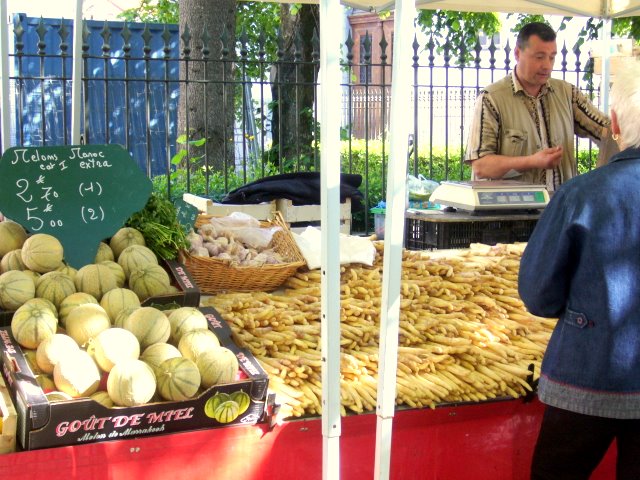
The green stuff, on the other hand, is not easy to get hold of. To be honest, it's been one of the few food disappointments since moving here. Even the green asparagus I have managed to find has been monstrously fat like its white cousin. But ... this year we have a new producer at our market. And they're selling no less than 9 varieties and grades of asparagus, including - oh deep joy - two sorts of green: the fat stuff, and real, proper thin spears. No carefully weighed, neatly trimmed bunches here: there are great mounds of it, lying loose for the picking, for only 2.80 euros a kilo. We bought some last week and it was so good we went back for more - lots more - today. As I was shovelling handfuls of it into a piece of newspaper a French woman, curious at my buying habits, asked me what it tasted like. Now that's not an easy question. In the end I broke her off a piece of try raw. Her eyes lit up. She bought four kilos. The revolution is here ...
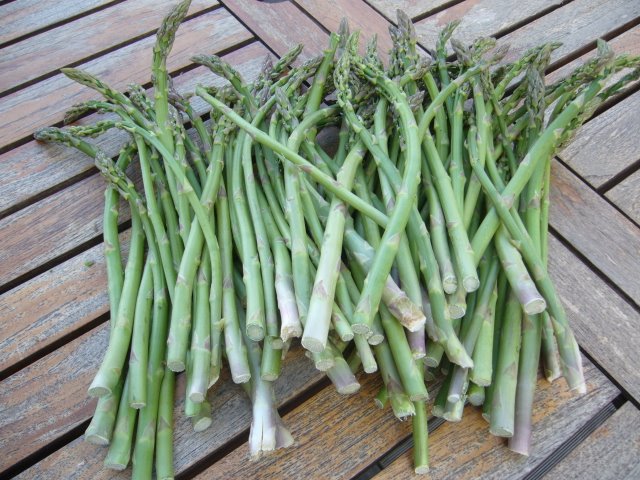
Tonight we ate asparagus with penne, lardons, crème fraîche and parmesan. We followed it with these:
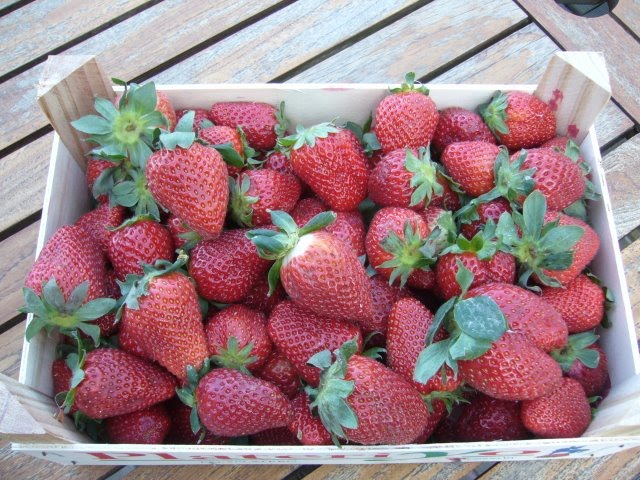
Well, maybe not quite all of them. The rest, and another 2 kilo box like them, will be transformed into jam tomorrow. The first year we moved here, I couldn't understand why I couldn't find any strawberries in June. I was too late: although there are a few varieties around later on in small (and expensive) quantities, the main crop comes at the end of April and very beginning of May. No tennis strawberries here ... But as you read this, jam will be being made in humungous quantities all over the south of France - which leads on to one of life's great unanswered questions: just what do French households do with the vast amount of jam that they all seem to make each year?
Saturday, 11 July 2009
Saint Girons pushes the bike out
Our local town - or at least what passes for one in this part of the world - is Saint Girons, whose moniker is 'Capital of the Couserans'. When we first visited several years ago we were not, it has to be said, immediately wowed. It was a very hot and thundery afternoon, we'd been travelling for hours, and it was Monday, a day which much of rural France has not yet recognised. We wandered the old town, strolled along the river under the plane trees, admired the pink marble pavements, sat with a long apéro in the Bar de L'Union, and ate well at Le Bouchon. And yet. We moved on the next day as planned with something of a 'yes, but'.
Returning some time later, we began to find out that Saint Girons is a place that, if you give it half a chance, will get its hooks into you slowly. (Which it did, and continues to do, to both of us.) It doesn't have the medieval cuteness of, say, Mirepoix, nor a landmark chateau like that of Foix, or the lovely romanesque art and architecture of Saint Lizier just a couple of kilometres away. It does have some lovely old corners, complete with peeling stucco and ancient shutters, plus some wonderful and unreconstructed shopfronts (as a Francophile friend from England said "It's just so - well, French ..."); it has some surprisingly good shops, once you've found them; it attracts a bunch of more-than-usually interesting people; it has three rivers and views of the mountains. But more than all this, it has atmosphere.

And today it had atmosphere redoubled in trumps, because for the first time it hosted the finish a Tour de France stage finish. The Tour passes through Ariège pretty much every year; last year we watched it at our local col. Saint Girons has previously hosted two stage departures, but never a finish, so it was a Very Big Thing Indeed for our little town. We had, of course, to be there. As I think did everyone from within a hundred kilometre radius ...

We eventually found ourselves a spot about a hundred metres upstream, as it were, from the finishing line, and within site of one of the big screens so that we could watch the race as it progressed. It was not yet 3pm; we still had over two hours to go, but very soon the crowd was three deep. The temperature rose; we all took turns cooling off in a tiny strip of shade just behind us. We were entertained by a continuous stream of sponsors roller-skating up and down, plying us with their promotional stuff; I'm ashamed to report that we came away with five hats, four coasters, three pom poms, a flag, a bandeau, a rattling balloon and six sachets of washing liquid. Most prized of all, however, were the bottles of Vittel water that fortunately were being distributed in abundance.
The caravane, of course, was as ridiculously kitsch as ever:


Hmm. Nice - er - view.

It was almost a French victory but sadly Sandy Casar broke too early and was passed almost in front of our eyes by a Spaniard - all in the blink of an eye. Two minutes later the peloton arrived, and then it was all over. Well, almost. A Basque rider arrived 46 minutes late, to great applause. Then the poor guy was disqualified because the maximum permitted delay is 45 minutes ...
Obviously the official post mortems are yet to come, but it seemed to my amateur eye that our little town acquitted itself rather well, something that although we've only been here for two years makes me feel absurdly proud. The France Télévision broadcast of the race as it made its way through Ariège, seen from the helicopters, was utterly delicious - all rich greens and blues and staggering views - and can have done no harm at all to our department's reputation: if I didn't live here already it would have had me packing my gear into a removal van tomorrow.
But I do live here. And I love it. Can you tell?
Returning some time later, we began to find out that Saint Girons is a place that, if you give it half a chance, will get its hooks into you slowly. (Which it did, and continues to do, to both of us.) It doesn't have the medieval cuteness of, say, Mirepoix, nor a landmark chateau like that of Foix, or the lovely romanesque art and architecture of Saint Lizier just a couple of kilometres away. It does have some lovely old corners, complete with peeling stucco and ancient shutters, plus some wonderful and unreconstructed shopfronts (as a Francophile friend from England said "It's just so - well, French ..."); it has some surprisingly good shops, once you've found them; it attracts a bunch of more-than-usually interesting people; it has three rivers and views of the mountains. But more than all this, it has atmosphere.

And today it had atmosphere redoubled in trumps, because for the first time it hosted the finish a Tour de France stage finish. The Tour passes through Ariège pretty much every year; last year we watched it at our local col. Saint Girons has previously hosted two stage departures, but never a finish, so it was a Very Big Thing Indeed for our little town. We had, of course, to be there. As I think did everyone from within a hundred kilometre radius ...
It was a gorgeous, sunny, hot, tar-melting day. You couldn't walk a pace in the town centre without falling over a bicycle in some form of other:

After a Napolitaine and a pichet of rosé under the awning of our favourite pizzeria, we joined the throng making its way to the arrival area. As we crossed the bridge over the river, my jaw dropped: in front of us was the biggest media circus I've ever seen. It must have covered tens of hectares, with TV channels from round the world vying for the title of biggest microphone, most powerful dish, longest broadcasting van, fattest lens, loudest mouth, least tasteful kit. Then there were the team headquarters and vehicles, hospitality tents, sponsors' stalls and all the rest ...
We eventually found ourselves a spot about a hundred metres upstream, as it were, from the finishing line, and within site of one of the big screens so that we could watch the race as it progressed. It was not yet 3pm; we still had over two hours to go, but very soon the crowd was three deep. The temperature rose; we all took turns cooling off in a tiny strip of shade just behind us. We were entertained by a continuous stream of sponsors roller-skating up and down, plying us with their promotional stuff; I'm ashamed to report that we came away with five hats, four coasters, three pom poms, a flag, a bandeau, a rattling balloon and six sachets of washing liquid. Most prized of all, however, were the bottles of Vittel water that fortunately were being distributed in abundance.
The caravane, of course, was as ridiculously kitsch as ever:


Hmm. Nice - er - view.

And then we heard, and saw, the helicopters which announced the imminent arrivals of the riders; four riders had broken away from the peloton and it seemed likely that we were in for a sprint finish. We weren't disappointed.
It was almost a French victory but sadly Sandy Casar broke too early and was passed almost in front of our eyes by a Spaniard - all in the blink of an eye. Two minutes later the peloton arrived, and then it was all over. Well, almost. A Basque rider arrived 46 minutes late, to great applause. Then the poor guy was disqualified because the maximum permitted delay is 45 minutes ...
Obviously the official post mortems are yet to come, but it seemed to my amateur eye that our little town acquitted itself rather well, something that although we've only been here for two years makes me feel absurdly proud. The France Télévision broadcast of the race as it made its way through Ariège, seen from the helicopters, was utterly delicious - all rich greens and blues and staggering views - and can have done no harm at all to our department's reputation: if I didn't live here already it would have had me packing my gear into a removal van tomorrow.
But I do live here. And I love it. Can you tell?
Monday, 22 June 2009
La Fête de la Musique
rock rap soul flamenco funk organ renaissance african reggae celtic mandolin orchestral chanson choral folk portuguese klezmer jazz pop string clarinet saxophone tzigane cuban irish rock'n'roll sevillian rumba punk alternative dance electro-acoustic hypnogroove country blues post-rock metal piano guitar latino brazilian ...
... just a snapshot of last night's Fête de la Musique in Saint Girons (and the reason why we finally made it home well after 2am. And by implication the reason why the cement mixer was just a little late in starting up this morning ...).
I'd vaguely heard of La Fête de la Musique before we moved here, but I hadn't really grasped it, if you see what I mean. A nutshell resumé: the first one took place in 1982, when the renowned Jack Lang was Minister for Culture; it was officially declared a public festival in 1983. The idea was simple: that on the night of the summer solstice, there should be music of all kinds (both amateur and professional) everywhere, and that it should be always remain 'popular' - that is, free and open to, and patronised by, all.
It took off. It's reckoned that one in five French people attend the Fête de la Musique every year, and that one in ten have at some point taken part. It's also been a major factor in the flourishing of the summer music festivals that are now such a part of cultural life here. And it's been emulated, to some degree, in other countries around the world, though nowhere with the sheer vibrancy of the French festival, and not, sadly, in England.
The Fête held in our local town, Saint Girons (population: 6552), has a reputation for being one of the best not just in the department but in the entire Midi-Pyrénées region. And I believe it. More than fifty groups, playing well over 60 gigs; plus a whole gaggle of spontaneous music makers (like the four guys playing fantastic blues in a tiny gallery at 2am). The entire town centre closed to traffic and filled with 'happenings', stages, bars, bodegas, makeshift restaurants, co-operative games (well, this is Ariège ...); bar and restaurant tables spilling out into the streets; and, of course, the sound of music everywhere. And people. Thousands of people. Mostly they (we) just drift around, led from one set of sounds to another, and another, until they find themselves drawn to one that they just can't leave. The smells of barbecuing lamb and suckling pigs mingling with those of chicken colombo mixed with churros and accras de morue and galettes and barbe de papa and patchouli and marijuana (as I said, this is Ariège ...). Oh, and I only saw two gendarmes all night, and they were listening to some Celtic rock.
Fancy it, next year?
Sunday, 7 June 2009
A spot of Saturday afternoon retail therapy ...
Once upon a time, I recall, Saturday afternoons used to involve hitting the High Street with a wad of notes and a determination to come home with carrier bags full of clothes I was never likely to wear more than once and shoes in which I could barely stagger from one side of the room to the other. Remember those days? Yes, I thought you did.
Although having wads of notes is now naught but a fond memory, yesterday afternoon I decided to hit what passes for the retail superstores in Saint Girons (no, don't laugh) for a spot of retail therapy. As an indication of how times have changed, however, it wasn't high fashion I was searching for. It was - and I can scarcely believe I'm writing this - a new pair of safety boots. Oh, how the mighty are fallen ..... but when your old ones are well and truly crevées, and you've dropped the thousandth piece of rock, or plaster, or tile, or brick, onto what once passed for your toes, well, what to do?
Amazingly - and I bet you can't do this in Clapham High Street - I walked straight in to one of our major shoe chains, La Halle, and found that not only did they sell safety boots in women's sizes, but also that I had a choice. Can you believe it? So here, gentle reader, is a sample of the latest fashion, Grillou style:

Aren't they lovely?
Thursday, 21 August 2008
Once upon a time ...
I want to tell you a story, about our village, Rimont. Are you sitting comfortably? I hope so, because you might not be afterwards.

The picture above is of Rimont, taken last year. An attractive and peaceful bastide village built on a mound (le mont riant: laughing hill) in the foothills of the Pyrénées, surrounded by hills and farms. The village dates back to the thirteenth century. So, a mystery. Why do so few medieval houses remain? Here is its story.
Early in 1943, the Vichy government instituted a work scheme. Those born between 1920 and 1922 would henceforth be required to go and work in Germany to replace Germans who’d been drafted into the Wehrmacht. Unsurprisingly, many young people refused; instead they left home and hid deep in the country, in particular in the forests. Ariège (which by this time was, like the rest of the south of France, occupied by the Nazis) became a magnet for these early refugees because of its sheer wildness and isolation. Together with others - political activists, trade unionists, those who’d escaped from internment camps and Jews - they formed the first organised resisters - the maquis.

Over the next year, the three maquis groups in and around Rimont became increasingly active and organised various guerrilla actions: sabotaging factories, ambushing railways and Nazi troops as they moved through the department. Travelling the main road between Foix and St Girons became more and more hazardous for the occupiers. Things really began to hot up after the Normandy landings in June 1944; guerrilla actions were now happening every few days, and in turn both the Germans and the local French milice cracked down even harder: repression and reprisal became the official orders of the day. In Saint Girons, for example, an industrialist and prominent member of the fascist Parti Populaire Français created his own commando group, which according to one source “sows terror, tortures, plunders, burns, assassinates with impunity and often exceeds the Gestapo itself in effectiveness”.
At the little Chateau de Vignasse in the centre of Rimont lived Paul Laffont, a politician and one of Ariège’s great and good: member of parliament, senator, Secretary of State for Post, Telegraph and Telephone, President of the Conseil General (county council) … Like most radical-socialists of his day, Paul Laffont originally gave 100% support to Marshal Pétain and the Vichy government. And like most radical-socialists of his day, he remained pétainist for only a few months: unhappy at the racist and increasingly brutal collaborationist regime of the Vichy government, he decided to withdraw from political life. Refusing all the posts offered to him by Vichy, he was then ‘relieved’ of his position as president of the Conseil General. Many of his friends, such as the mayor of Rimont, suffered the same fate. Gradually, he attempted to engage in the Resistance movement – not entirely successfully as the majority of resisters found it hard to forgive his original support of collaboration. He did, however, succeed in giving a large sum of money to the local maquis. All the while, Laffont was under observation by both the German police and the French milice, some of whom apparently believed that he could be the chief instigator of the resistance that they feared yet knew little about. Early in the morning of the 13 July 1944, a Franco-German commando arrived at Laffont’s home in Rimont, seized him, took him away in a van to an unknown destination, then ransacked and vandalised his house. His close friend, Doctor Charles Labro, heard the commotion and ran towards the chateau; he too was brutally seized and taken away. Their bodies were found, separately, several days later, that of Doctor Labro very close to Grillou (now marked by a memorial). Both men had been tortured before being killed.
Two days later, the local maquis made a list of suspected collaborators, arrested some twenty people then summarily tried and executed 11 of them at nearby col de la Crouzette. It was found afterwards that some of these were malicious denunciations and that some of those executed weren't collaborators at all - a story repeated around France.

The price of liberation for Rimont was a high one: the village plus several farms and hamlets were burned almost in totality. 236 buildings were destroyed, including 152 houses, the schools, the Mairie, and all the village archives with it. 231 Rimontais were made homeless. Grillou survived, untouched.
As you enter the village today, you’ll see a chilling epitaph: ‘Rimont, village martyr’. The village was rebuilt afer the war, as closely as possible in style and construction to the original, and the 'village ressuscité' was inaugurated by the Minister for Reconstruction in 1950. As you walk the streets of Rimont, Saint Girons and the other local towns and villages, you’ll come time and time again across streets named after the men in these, and other, stories. The battle of Rimont may not have made the heroic war films of my childhood, but it lives on, here.


The picture above is of Rimont, taken last year. An attractive and peaceful bastide village built on a mound (le mont riant: laughing hill) in the foothills of the Pyrénées, surrounded by hills and farms. The village dates back to the thirteenth century. So, a mystery. Why do so few medieval houses remain? Here is its story.
Early in 1943, the Vichy government instituted a work scheme. Those born between 1920 and 1922 would henceforth be required to go and work in Germany to replace Germans who’d been drafted into the Wehrmacht. Unsurprisingly, many young people refused; instead they left home and hid deep in the country, in particular in the forests. Ariège (which by this time was, like the rest of the south of France, occupied by the Nazis) became a magnet for these early refugees because of its sheer wildness and isolation. Together with others - political activists, trade unionists, those who’d escaped from internment camps and Jews - they formed the first organised resisters - the maquis.

Over the next year, the three maquis groups in and around Rimont became increasingly active and organised various guerrilla actions: sabotaging factories, ambushing railways and Nazi troops as they moved through the department. Travelling the main road between Foix and St Girons became more and more hazardous for the occupiers. Things really began to hot up after the Normandy landings in June 1944; guerrilla actions were now happening every few days, and in turn both the Germans and the local French milice cracked down even harder: repression and reprisal became the official orders of the day. In Saint Girons, for example, an industrialist and prominent member of the fascist Parti Populaire Français created his own commando group, which according to one source “sows terror, tortures, plunders, burns, assassinates with impunity and often exceeds the Gestapo itself in effectiveness”.
At the little Chateau de Vignasse in the centre of Rimont lived Paul Laffont, a politician and one of Ariège’s great and good: member of parliament, senator, Secretary of State for Post, Telegraph and Telephone, President of the Conseil General (county council) … Like most radical-socialists of his day, Paul Laffont originally gave 100% support to Marshal Pétain and the Vichy government. And like most radical-socialists of his day, he remained pétainist for only a few months: unhappy at the racist and increasingly brutal collaborationist regime of the Vichy government, he decided to withdraw from political life. Refusing all the posts offered to him by Vichy, he was then ‘relieved’ of his position as president of the Conseil General. Many of his friends, such as the mayor of Rimont, suffered the same fate. Gradually, he attempted to engage in the Resistance movement – not entirely successfully as the majority of resisters found it hard to forgive his original support of collaboration. He did, however, succeed in giving a large sum of money to the local maquis. All the while, Laffont was under observation by both the German police and the French milice, some of whom apparently believed that he could be the chief instigator of the resistance that they feared yet knew little about. Early in the morning of the 13 July 1944, a Franco-German commando arrived at Laffont’s home in Rimont, seized him, took him away in a van to an unknown destination, then ransacked and vandalised his house. His close friend, Doctor Charles Labro, heard the commotion and ran towards the chateau; he too was brutally seized and taken away. Their bodies were found, separately, several days later, that of Doctor Labro very close to Grillou (now marked by a memorial). Both men had been tortured before being killed.
The battle of Rimont
Resistance was hotting up, and the Allied landings in Provence in August 1944 gave added impetus to the maquis of Ariège, which by now was playing a prominent part in the increasingly organised push towards liberation. On 20 August 1944, a long column of soldiers from the Legion of Turkestan, an adjunct to the German army made up of Central Asian prisoners from the Soviet war, was making its way from Saint Gaudens to Saint Girons; on arrival, there was fierce fighting in which the charismatic leader of one of Rimont’s maquis groups, Réné Plaisant, was killed; the maquis reluctantly decided to withdraw from the town to avoid carnage. That night was a rough one: hostages were taken, fires lit, shops and houses pillaged and women raped.
The next day, 21 August, the column set out towards Rimont – around 15 kilometres. Around 9am that morning, the local garage owner, who was on observation duty, saw it approaching. He counted 44 trucks without seeing the end of the column. Things were serious: there were at least 2000 men. The order to evacuate was given and many of Rimont’s inhabitants hid in the countryside. In the way of such things, however, the gendarmes – who were not on the best of terms with the résistants - had just received a message that a group of 15 Germans were approaching. The gendarmes went around all the houses asking those remaining not to leave but just to lock themselves in their houses. Many of the elderly preferred to sit it out at home, and complied. At the same time, the maquis managed to hold off the column until 11am, long enough for most of the population to flee, at which point they retreated, vastly outnumbered.
The German soldiers surrounded Rimont; the commander gave the order to burn the village to force a passage through it. Soon Rimont was engulfed by flames, the German and Turkestan soldiers screaming in a mad folie of rage, egged on by the French milice. The Rimontais could only flee to the surrounding hills, from where they watched helplessly as the medieval bastide village, along with everything they owned, went up in smoke. Those who lingered were attacked by German police dogs. Women were raped in their houses. All in all eleven Rimontais died in the combat, mainly elderly, one while he peeled potatoes outside his front door. Several groups of hostages were taken; the women were freed at midday, while one group of men were lined up along the wall of the local wine merchant. Realising that they were going to be shot, one of them, François Sentenac, made a break for it and escaped through the open hallway of the house behind him and through into the gardens beyond. The German soldiers gave chase, never returning. Other men were forced to lie face down in the middle of the battle until nightfall. This is how one of them described the experience:
“No idea what time it is. Not for a minute are we hungry or thirsty or cold. We feel nothing. And the battle rages around us while we serve as shields as the maquis kill opposite. And just over there, our village burns …”.
The column eventually moved through Rimont and on towards our neighbouring village of Castelnau Durban, which it occupied that night; the next day it continued its march but by that time large numbers of maquis fighters had arrived from Aude and Haute Garonne. Finally the Germans realised that they’d lost; they capitulated at Ségalas, defeated by 400 maquis.

The battle of Rimont, which took place exactly sixty-four years ago today, put an end to the Occupation in Ariège. Remarkably, the department was liberated entirely through civilian fighting – no regular armed forces were involved. But in France, the Second World War had become not just a fight against the Germans, but also one against the Vichy government. Those who had actively helped Vichy, whether by helping the Milice, denouncing the maquis or organising deportations, were arrested and tried: immediately following the liberation, France was swept by a wave of executions, public humiliations, assaults and detentions of suspected collaborators, known as the épuration sauvage (lit: wild purge); many dozens of people were shot in Ariège alone.

The price of liberation for Rimont was a high one: the village plus several farms and hamlets were burned almost in totality. 236 buildings were destroyed, including 152 houses, the schools, the Mairie, and all the village archives with it. 231 Rimontais were made homeless. Grillou survived, untouched.
As you enter the village today, you’ll see a chilling epitaph: ‘Rimont, village martyr’. The village was rebuilt afer the war, as closely as possible in style and construction to the original, and the 'village ressuscité' was inaugurated by the Minister for Reconstruction in 1950. As you walk the streets of Rimont, Saint Girons and the other local towns and villages, you’ll come time and time again across streets named after the men in these, and other, stories. The battle of Rimont may not have made the heroic war films of my childhood, but it lives on, here.
Note: my thanks to two French sites for the detail in this account: www.histariege.com, and this one. As far as I know, this is the first account in English of the battle of Rimont.
Monday, 4 August 2008
Ariège en fête
Since early July, Ariège has been en fête in a big way, and will be until la rentrée on 2 September, when the streets will empty, the pace will slacken and life becomes (a little) more serious again. When I was a mere traveller in France, I always wondered at and about the national obsession with the summer: why, for instance, does the entire world and his poodle want to travel south for their holidays on exactly the same day every year, causing traffic jams of over 800km on the autoroute system? Why are just two months of the year so full of life and activity, while in much of rural France - not here, admittedly - you'd be forgiven for thinking that the population had been evacuated during the remaining ten? Where do French villagers go in the winter? What's the big deal about la rentrée anyway and why does everybody, from plumbers to politicians, go on about it?
I confess that throughout my whole working life in England, I avoided school holidays like the plague, taking my own summer breaks in June or September when anyone under 16 was safely incarcerated in school and out of my way, and staying home to do the cleaning or something equally exciting - and crowd-free - on Bank Holidays. Apart from vacations spent working here as a student (which don't count, because I was - er - working), the first summer I'd spent in France was last year ... and that was in a village near Castelnaudary, which I do have to tell you is not one of my favourite places - though that's another story. To be honest, it was a bit of a culture shock, and at first we took our Anglo-Saxon view that July and August were to be strenuously avoided at all costs. But the summer sense of joie de vivre and what-the-hell-let's-have-a-good-time soon crept up on us, and before long we were out there fêting with the best of them, although we did give the 'pig's leg roast and piano disco' in the village where we lived then (population 76, mostly older than that) a miss. And it's true - there is a kind of magic in the air in the summer months here. It's as if you enter a kind of time warp - a different culture, almost a different universe, in which the so-called 'normal' rules of engagement with life are suspended. It becomes a perfectly normal thing, for example, to find yourself sitting in a café at 2.30am after an open air concert alongside what feels like an entire townful of other people, of all ages, from 1 to 101, all doing the same thing, or promenading, or just standing talking to friends. Or sharing a long table with twenty-plus strangers at lunchtime. Or staying at Lac Mondély until after midnight just because it's a beautiful night and the moon is full.
Over the last two weeks we have, amongst other things:
... danced ourselves half to death at Terre de Couleurs, where I haven't smelt quite so much patchouli and dope since the seventies. Toumani Diabaté was fantastic but so were the other bands, especially Anakronic Electro Orkestra (sic), who are from Toulouse and play new wave Jewish music (known, I can now reveal, as new electro klezmer. But you already knew that, didn't you?). And watched a seriously awesome pyrotechnic show:

... danced ourselves slightly less than half to death (bodies getting back into it now!) at the Louis Bertignac concert at St Girons. Who? No, I didn't know either until I read about him in our regional rag. He's a rock guitarist, France's answer to Keith Richards and something of a cult figure here, having been around pretty continuously since the seventies and now playing as part of the group Power Trio. For me, a (middle-) aging hippy of the same era, it was pure bliss - Stones meets Led Zep meets Hendrix. They played, without a breather, for three hours, and I turned back into a groupie. I haven't been to such a loud and intense rock gig since the days of Hammersmith Odeon. I'm not sure that St G has ever heard anything quite like it either ...

... discovered an exciting new African band, Les Espoirs de Coronthie, at the festival Ingénieuse Afrique in Foix. Great music, a bit Mali, a bit Senegal but not quite either (they're from Guinea), great sound and great energy.

As does the whole three day festival. We had huge fun processing round the town with some drummers and dancers:

... and (now for something completely different) travelled back in time at Autrefois les Couserans at St Girons, which for the last 15 years has been putting on a major celebration of the heritage and the 'olden days' of life in our local valleys. It was heaving! Apparently it attracts around 25,000 visitors every year; we were there yesterday, and I think all the 24,998 others were as well, enjoying / enduring temperatures well into the thirties. It's a really good 'do': a huge procession lasting nearly two hours in which 600 people, 50 vintage tractors and more animals than I can count take part, endless stalls and demonstrations, even a farmyard set up in one of the local squares. At lunchtime every square centimetre of space is taken over by tables and chairs as restaurants and cafés both temporary and permanent face up to the daunting task of feeding the twenty-five thousand, all between the sacred hours of twelve and two, naturally. John (bless) got very excited by the (working) steam-driven threshing machine that apparently looked just like the one that used to turn up on his family farm when he were a lad; I got excited by the food market, where I got into a somewhat heated discussion with a militant Ariégeois about bears. Not perhaps the most sensible thing to do, given that the reintroduction of bears into Ariège-Pyrénées a few years ago is probably just about the most contentious issue round here and raises more steam amongst sheep farmers than the afore-mentioned steam engine ...
Here's a glimpse of St Girons (I took this yesterday. Not bad weather, huh?):

... and a part of the procession:

The costumes are for real (including the clogs), and are a feature of the valley of Bethmale. These days they're only worn on ceremonial occasions though. There's still a clog-making workshop in the valley.
This is for John - the famous threshing machine:

Phew. Time for a break. So after our festival fest (can I say that?), something approaching normal life will be returning to Grillou this week - shutters will be sanded, the potager hoed, kitchen cupboard doors stripped and painted, and thousands of kilos of plums (okay, so I exaggerate. But only slightly) will be picked, bottled, jammed, crumbled, compôted and given away. Allez ....
Sunday, 4 May 2008
Seriously hot hoeing
Wow. What a fantastic weekend it's been - real summer temperatures and dawn-to-dusk sunshine since Thursday. This afternoon I decided that I really ought to hoe the hot potager (that's the one where I plan to grow my French beans, aubergines, tomatoes, peppers and such like, as opposed to the cool potager where John grows radishes, spinach, cavalo nero, carrots and everything else that likes a slightly lower soil temperature). I wouldn't have been so foolish if I hadn't come home from the market in St Girons yesterday with - er - quite a lot of vegetable plants. We grow most things from seed, but when you see so many growers' stalls stuffed full with an unbelievable variety of healthy, robust plantlets ... well, what to do? (St Girons market is something else again and deserves a post here all to itself, so watch this space). The hot potager certainly lived up to its name today, with the shade temperature hovering around 28 degrees at 4.30, but by the look of the storm clouds predictably gathering over Mont Valier this evening my new plants (looking a bit shell-shocked at the moment) will get a good soaking tonight or tomorrow . And meanwhile, what was John doing on the hottest afternoon of the year so far? Yes, he had a bonfire. Incredible, but true.


On Friday we went walking for the first time in several weeks (why oh why do we leave it so long?). We parked in the blink-and-you-miss-it hamlet of Bidous, in the lovely Ustou valley, followed the footpath along the river, then took the path that trails up towards the Cirque de Cagateille, through some beautiful beech woodland. Suddenly, the woodland opens and there it is - three quarters of a near perfect circle, with at least nine impressive cascades (not always so dramatic, but it's major snow melt time). In true Slow walking fashion we spent nearly two hours over lunch, stretched out on the rocks overlooking the cirque, so that any vain hope we may have entertained of carrying on to Etang de la Hillette was quickly discarded. But it was very hot, it's a very steep gradient, and with a view like this to gaze at, what would you have done?


We did walk to the base of the cirque to get a closer look at the waterfalls. This is one of them:

And then there was nothing else to do but stop in Seix, one of my favourite villages, for an early apéro, which stretched into a late apéro, and then an oh-why-the-hell-not dinner at one of Seix's two restos, La Gourmandine. Which was very, very good: small, friendly, unstuffy, excellent value, and with a great vibe; cuisine du terroir with a contemporary twist, good local sourcing, and a female owner-chef (I felt quite at home in fact). And the entrée was just as good as the plat was just as good as the dessert. It's only half an hour or so from home, and we'll be back. Oh yes.
Subscribe to:
Posts (Atom)