... les papillons.
Two days after my last post, the sun came out. Incontrovertible proof that anti-cyclones not only can read, but read this blog. (Delusions? Moi?).
And with the sun came literally hundreds of butterflies, all making a - um - bee-line for the big buddleia bush next to our top terrace. I've never before seen so many in the same place at the same time. We have several buddleia bushes, some wild, some planted, and all attract scores of butterflies when the flowers are out; what we're seeing at the moment though is a first. (I wish I could take a decent photo but all you get to see are flying blobs ...). Scarce swallowtails, commas, painted ladies, peacocks, red admirals, white admirals, southern white admirals, tortoiseshells, small coppers, swallowtails, several different fritillaries, marbled whites, purple emperors, ringlets, various blues, large whites, small whites, plus a few unidentified little brown jobs are all jostling for position through most of the day. Wonderful.
And reason number 687 for planning a trip to Grillou next summer ..... :-)
Showing posts with label wildlife. Show all posts
Showing posts with label wildlife. Show all posts
Sunday, 31 July 2011


Monday, 22 November 2010
Silver linings
Yesterday was a thoroughly unpleasant day: cold (very cold), wet (very wet) and dark (very dark). There's a wonderful French word, much loved by weather forecasters: maussade. It means dull and dismal; it also means sullen. (Don't you just love the idea of the weather being sullen? Perfect word.) And the fact that I was putting the seven hundredth and fifty-ninth coat of paint on yet another of our panelled glazed doors did nothing to assuage my mood.
But there was a silver lining: cranes. Halfway through the afternoon a strange and loud trumpeting noise drew my attention. Wah! Geese! yelled the ex-Norfolk me to anyone who'd listen, before realising that the only geese you're likely to see in Ariège are on your dinner table. Flocks of hundreds, even thousands, of flying geese - we'd get them over the house almost daily in the wnter - are about the only thing I miss from the Norfolk days, especially the Brents with their growly 'rruckk' call. I racked my paint-befuddled brain and realised that they must be cranes.
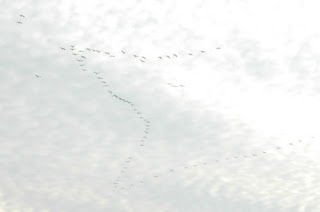
And cranes they were. Huge V shapes of them, common cranes (grues cendrées) on their way across the Pyrénées to spend their winter in warmer climes. Ariège is not on the main crane route, which is much farther west, but birding friends here have told me that we can expect to see them every so often. To see a big flock flying over our house was a huge treat. To see a second flock following at dusk was an even bigger one. But to hear, and then glimpse, a third, flying right over the chimney pots at midnight on the night of the full moon, was something unforgettable: in spite of the bitter cold, in spite of the lashing rain, in spite of being half undressed for bed, I ran outside to the track and watched, and listened.
The picture is not, I confess, mine. But this is what I saw:
And today I stumbled upon this video, captured by a local person at St Lizier, just a few kilometres down the road.
An ah -so moment.
But there was a silver lining: cranes. Halfway through the afternoon a strange and loud trumpeting noise drew my attention. Wah! Geese! yelled the ex-Norfolk me to anyone who'd listen, before realising that the only geese you're likely to see in Ariège are on your dinner table. Flocks of hundreds, even thousands, of flying geese - we'd get them over the house almost daily in the wnter - are about the only thing I miss from the Norfolk days, especially the Brents with their growly 'rruckk' call. I racked my paint-befuddled brain and realised that they must be cranes.
And cranes they were. Huge V shapes of them, common cranes (grues cendrées) on their way across the Pyrénées to spend their winter in warmer climes. Ariège is not on the main crane route, which is much farther west, but birding friends here have told me that we can expect to see them every so often. To see a big flock flying over our house was a huge treat. To see a second flock following at dusk was an even bigger one. But to hear, and then glimpse, a third, flying right over the chimney pots at midnight on the night of the full moon, was something unforgettable: in spite of the bitter cold, in spite of the lashing rain, in spite of being half undressed for bed, I ran outside to the track and watched, and listened.
The picture is not, I confess, mine. But this is what I saw:

And today I stumbled upon this video, captured by a local person at St Lizier, just a few kilometres down the road.
An ah -so moment.
Thursday, 7 October 2010
House of ladders
Blog silence has reigned for a couple of weeks while we've been ... up ladders. Not 'a' ladder, you'll notice; no, the plural is deliberate.
We've been (finally, and only two years later than originally scheduled ...) lime washing the walls of the goat-shed-turned-office-now-turned-dining-room. It's - er - five metres high. Hmm. Plans to use the scaffold that The Perfectionist had brought in were quickly scuppered when it had, rather suddenly, to move on to another project. We were left high and dry - or rather, dry but not high. We considered our options. Short of attaching a rope to the central beam and swinging backwards and forwards, or turning the highest wall into a climbing wall, there was only one: another scaffold. The grapevine swung into gear, and within a couple of days we'd borrowed a tower from some friends. Another couple of days (and much swearing, ranting, cursing, foot stomping and crockery smashing) later, it was up.
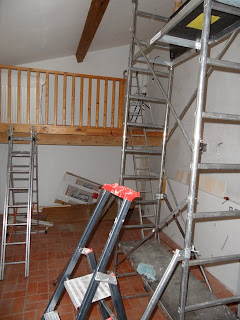
The problem is that the dining room is a room of lots of different heights. We've built a mezzanine gallery, which is going to house a library; there's a central beam; and the ceiling slopes down towards the windows at the front of the house, where the height of the wall is only four metres or so. And so we needed not one, but many ladders, which is why for the last fortnight the room has looked like this:

We've been (finally, and only two years later than originally scheduled ...) lime washing the walls of the goat-shed-turned-office-now-turned-dining-room. It's - er - five metres high. Hmm. Plans to use the scaffold that The Perfectionist had brought in were quickly scuppered when it had, rather suddenly, to move on to another project. We were left high and dry - or rather, dry but not high. We considered our options. Short of attaching a rope to the central beam and swinging backwards and forwards, or turning the highest wall into a climbing wall, there was only one: another scaffold. The grapevine swung into gear, and within a couple of days we'd borrowed a tower from some friends. Another couple of days (and much swearing, ranting, cursing, foot stomping and crockery smashing) later, it was up.
The problem is that the dining room is a room of lots of different heights. We've built a mezzanine gallery, which is going to house a library; there's a central beam; and the ceiling slopes down towards the windows at the front of the house, where the height of the wall is only four metres or so. And so we needed not one, but many ladders, which is why for the last fortnight the room has looked like this:

Six days, seventeen thousand colour tests, and four coats of lime wash later, the room looks like this (don't panic, the orange pine will disappear very soon, as will the white painted walls at the far end ...)
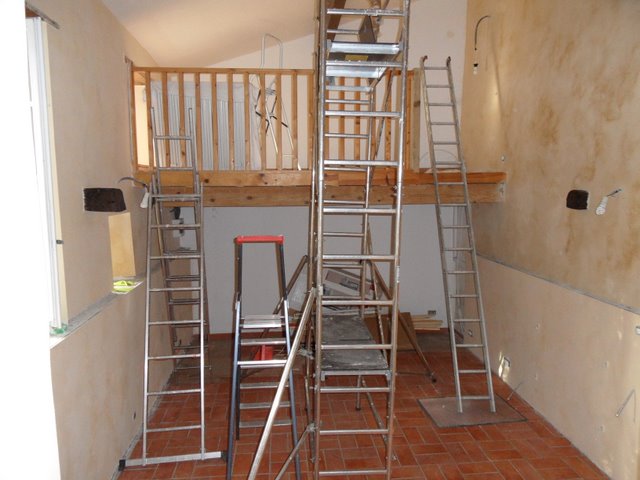
and we've got quite fond of the scaffold (yes, the same one that we spent six hours trying to fit eight bolts into to hold the two platforms ...) and will be sorry to see it go. It's made a long job hugely easier, so a big thanks to the mob at Camping Le Montagnou at Ustou for lending it to us - we owe you one!
All we have to do now is to take it apart. So don't expect to see either of us any time soon ....
PS ... look who dropped in to visit today:


It's a praying mantis. Isn't he lovely?
PS ... look who dropped in to visit today:
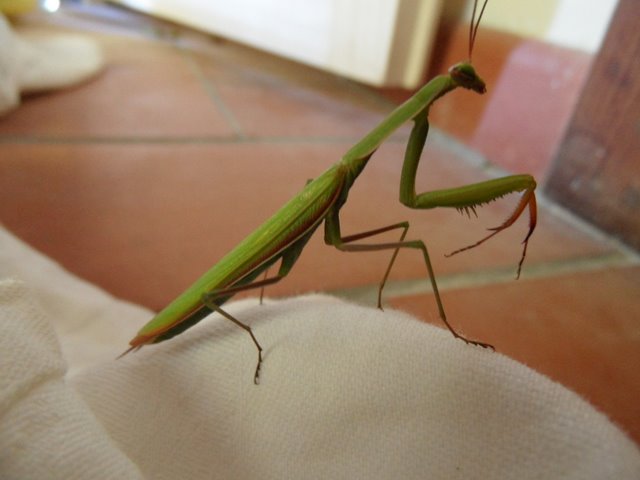

It's a praying mantis. Isn't he lovely?
Friday, 2 July 2010
Butterflies and other animals
In true capricious 2010 fashion, the weather has this week finally caught up with the fact that it's summer and has been teetering on the brink of a full-blown canicule, with shade temperatures hitting the upper thirties and staying there until well after dark. Maybe not the best for heavy outside work, but pretty nice nevertheless (and there's always a worthy substitute, like lounging around on a sun bed with a book. Oh, all right then - like getting on with the inside work ...). The loveliest thing about it though has been the absolute explosion in the butterfly population that we've seen over the last few days.
Ariège is well known for its butterflies, and living here, up at 500 metres in the woods, we seem to get more than our fair share. To be honest, I wish I was better at identifying them - I know of people who are perfectly well able to point at something 50 metres away and name it as a Small Pink-Spotted One-Legged Maui Dancer Thrice Removed, but I'm not (yet) one of them. Having said that, I've got to know the more common (in Ariège terms, that is) ones over the last couple of years. What follows is a quick-and-dirty list of the ones I've seen flying around Grillou over the last 48 hours, partly so that I can show off my new found skills, but mostly so that (shameless plug number 73/10) you can see just how rich nature is here in our little woodland clearing:
Scarce Swallowtail, Swallowtail, Marbled White, Clouded Yellow, Purple Emperor, Common Blue, Purple Hairstreak, Holly Blue, Brown Argus, Red Admiral, White Admiral, various Ringlets, various Fritillaries, various Skippers, Peacock, Black-Veined White, Small White, Large White, Orange Tip, Brimstone, Cleopatra, Wood White, Small Copper, Common Blue, Chalk Hill Blue, Comma, Small Tortoiseshell, Large Tortoiseshell, various Graylings ... plus various others so far unidentifiable.
This is the Scarce Swallowtail, one of my favourites:

And this: not a butterfly, and not a hummingbird (though it sounds like one) ...

It's a Humming Bird Hawk Moth, with the coolest proboscis on the planet.
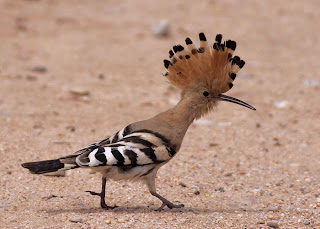
And while I'm at it, I can't resist this picture of the only bird I know that speaks its name: the upupa epops (hoopoe). This one has taken up residence just down our track, from where it spends its day yelling 'oop-oop-oop' (or 'poo-poo-poo' as my French bird book would have it) at anyone who'll listen ... and it's hard not to. Just recently it's taken to walking in front of my car as I come home from work, and after we've travelled the requisite 100 metres together it always flies up to the same branch to let me pass ...
Aren't they just ridiculously wonderful?
Ariège is well known for its butterflies, and living here, up at 500 metres in the woods, we seem to get more than our fair share. To be honest, I wish I was better at identifying them - I know of people who are perfectly well able to point at something 50 metres away and name it as a Small Pink-Spotted One-Legged Maui Dancer Thrice Removed, but I'm not (yet) one of them. Having said that, I've got to know the more common (in Ariège terms, that is) ones over the last couple of years. What follows is a quick-and-dirty list of the ones I've seen flying around Grillou over the last 48 hours, partly so that I can show off my new found skills, but mostly so that (shameless plug number 73/10) you can see just how rich nature is here in our little woodland clearing:
Scarce Swallowtail, Swallowtail, Marbled White, Clouded Yellow, Purple Emperor, Common Blue, Purple Hairstreak, Holly Blue, Brown Argus, Red Admiral, White Admiral, various Ringlets, various Fritillaries, various Skippers, Peacock, Black-Veined White, Small White, Large White, Orange Tip, Brimstone, Cleopatra, Wood White, Small Copper, Common Blue, Chalk Hill Blue, Comma, Small Tortoiseshell, Large Tortoiseshell, various Graylings ... plus various others so far unidentifiable.
This is the Scarce Swallowtail, one of my favourites:

And this: not a butterfly, and not a hummingbird (though it sounds like one) ...

It's a Humming Bird Hawk Moth, with the coolest proboscis on the planet.
And while I'm at it, I can't resist this picture of the only bird I know that speaks its name: the upupa epops (hoopoe). This one has taken up residence just down our track, from where it spends its day yelling 'oop-oop-oop' (or 'poo-poo-poo' as my French bird book would have it) at anyone who'll listen ... and it's hard not to. Just recently it's taken to walking in front of my car as I come home from work, and after we've travelled the requisite 100 metres together it always flies up to the same branch to let me pass ...

Aren't they just ridiculously wonderful?
Tuesday, 30 June 2009
Halfway house
We're builder-less. Having reached the halfway point in the main project, they've bogged off for the summer, bless their little cotton socks, leaving Grillou unaccustomedly quiet. I can honestly say that it's the first time in my life that I've actually missed my builders. And having four - or more - of us here every day for the last two months has just confirmed my feeling that this house really loves to have people in and around it. As, in fact, do I. Well, most of the time, anyway.
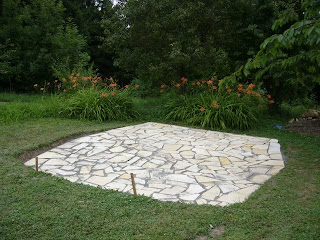
So in the absence of good company and exciting events like walls coming down there's nothing for it but to get on with the grafting. And this is where, much as I hate everybody else's smug, look-what-I've-done-aren't-I-clever blogs, I'm going to inflict a bit of one on you now. Just a tiny bit, I promise. If this offends you, look away now. But I've just done something I've never done before, and it's worked. I've laid a terrace, out of random stone.
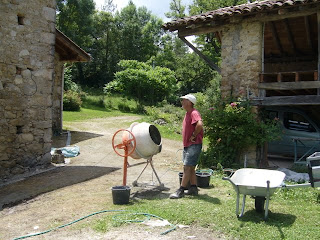
Originally, John was going to take charge of all the outside work to create terraces and steps and paths and things while I acted as his labourer. But, well, you know how it is. Being anybody's labourer is not my strong point. I much prefer to be out there, leading from the front. John, meanwhile, is much more easy going and is quite happy to do things my way ... which is probably why he's tolerated living with me for longer than anyone else has, or would :-). So he's been overcoming a surprise phobia about mortar by manning the cement mixer, while I get to clamber around on my hands and knees laying screeds and trying to piece strangely shaped bits of stone together in such a way as they look as though they've always been there.
Here's the man himself, working hard over the cement mixer ...
The terrace, in progress ...

... and finished (well almost; I still have the jointing to do):
Not bad, eh?
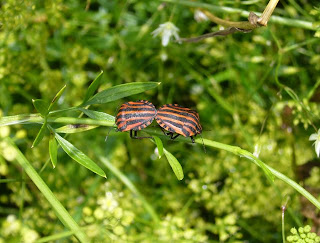
There are unforeseen advantages to spending four days with your nose against the ground. One early morning (it was so hot that we had to start work at 6.30 to avoid the mortar going off before I could work with it) I encountered these two striped shield bugs in a compromising position on some parsley stalks:
And I made a surprising discovery about butterflies. They love cement. Every afternoon, as the temperature hit the late thirties, the pools of waste mortar on the ground would swarm with dabs of flying colour, including marbled whites, silver washed fritillaries, white admirals, clouded yellows, various coppers, blues, ringlets, and this gorgeous purple emperor:

Apparently, it's the minerals and salts in the cement that attract them. Bizarre but true. So if you want to attract butterflies to your garden, forget the buddleia. Just get the cement mixer out.
Remember, you read it here first.
So in the absence of good company and exciting events like walls coming down there's nothing for it but to get on with the grafting. And this is where, much as I hate everybody else's smug, look-what-I've-done-aren't-I-clever blogs, I'm going to inflict a bit of one on you now. Just a tiny bit, I promise. If this offends you, look away now. But I've just done something I've never done before, and it's worked. I've laid a terrace, out of random stone.
Originally, John was going to take charge of all the outside work to create terraces and steps and paths and things while I acted as his labourer. But, well, you know how it is. Being anybody's labourer is not my strong point. I much prefer to be out there, leading from the front. John, meanwhile, is much more easy going and is quite happy to do things my way ... which is probably why he's tolerated living with me for longer than anyone else has, or would :-). So he's been overcoming a surprise phobia about mortar by manning the cement mixer, while I get to clamber around on my hands and knees laying screeds and trying to piece strangely shaped bits of stone together in such a way as they look as though they've always been there.
Here's the man himself, working hard over the cement mixer ...

The terrace, in progress ...

... and finished (well almost; I still have the jointing to do):

Not bad, eh?
There are unforeseen advantages to spending four days with your nose against the ground. One early morning (it was so hot that we had to start work at 6.30 to avoid the mortar going off before I could work with it) I encountered these two striped shield bugs in a compromising position on some parsley stalks:

And I made a surprising discovery about butterflies. They love cement. Every afternoon, as the temperature hit the late thirties, the pools of waste mortar on the ground would swarm with dabs of flying colour, including marbled whites, silver washed fritillaries, white admirals, clouded yellows, various coppers, blues, ringlets, and this gorgeous purple emperor:

Apparently, it's the minerals and salts in the cement that attract them. Bizarre but true. So if you want to attract butterflies to your garden, forget the buddleia. Just get the cement mixer out.
Remember, you read it here first.
Tuesday, 12 May 2009
Feathery tales
For anyone fascinated by birds (and how can you not be?), early May is a particularly awesome time to be at Grillou. The Main Attraction, of course, is the almost continuous song, from dawn to dusk and beyond: blackbirds, thrushes, robins, blackcaps, various finches and warblers, nightingales, tits, wrens and dunnocks are the prima donnas, whereas the chorus is provided by the cuckoos, woodpeckers, turtle doves and hoopoes, and sporadic acts of drama by buzzards, black and red kites, the occasional eagle and other raptors. At this time of year it's all very in your face, to use that inelegant expression: the wrens have a habit of sneaking up behind you and suddenly bursting into energetic song; every morning, from before dawn, a blackbird sings just a couple of metres from our bedroom; and I opened the bathroom windows yesterday morning to be confronted by a nightingale in full flood in the maple tree less than an arm's length away (he just looked at me, grinned, and carried on as if I wasn't there ...). And so on.

A black kite in motion
I've always enjoyed watching birds - caught it, I think, from my mother, who would sit quite literally for hours watching the tits at the feeders just outside our living room window (much to the incomprehension of my dad who could never understand why she didn't want to be 'doing something'). But I'm not a twitcher. When we lived in Cley next the Sea, on the marshes of the north Norfolk coast, we'd encounter endless twitchers, busy with their bird lists and their special pagers alerting them to sightings and more kit than I'd take on a month's camping holiday. It's all a bit close to trainspotting for my liking, and it certainly doesn't do anything to bring you into relationship with particular birds so that you can find out what makes them tick. Because if I've learned one thing from my years of watching birds, it's that birds - like people, or dogs, or horses - are individuals.
Take, for example, one of our male blackbirds - the one who (now) sings outside the bedroom. Whereas most blackbirds here start to sing properly in early March, this one remained resolutely mute, to the point where we decided that he had a speech impediment. While all the others around him were practising what would become this year's fave phrases, he would sit silently and listen: head tilted, mouth open, looking quizzical, as if to say "how do you do that?" One day we found him under a bush, engaged in a hugely complex subsong - an unstoppable under-the-breath stream of twitters, babbles, hums, calls, and good old blackbird operatics. Several days of subsong ensued. Spring advanced. And then finally, as it was getting dark one evening, I spied him sitting in a branch close to the terrace, looking exactly as I remember feeling when I was eight years old and about to jump off the high diving board for the first time. (He did much better than me. I cowered on the top of that board for five hours ...). Sure enough, a few minutes later, he let rip with a song phrase.

An enlightened master
He did the same the next evening, and the next, graduating from one to several bars. After a week, he was unstoppable: he sang from the same tree and from dawn to dusk, his song incredibly complex and varied, barely stopping to find food. But then things started to change. A week ago, he began singing in what I can only describe as an obsessional way, repeating just the same 2 bar, 8 note phrase in a near continuous loop for 15 hours a day: perfect pitch, perfect timing, perfect rhythm. After a day or two it became tedious. After four or five, it became meditative, like a mantra. It's behaviour that you'll never find in a bird book. I reckon he's a reincarnated enlightened master.
I could also tell you endless stories about a manic depressive wren, or a female chaffinch who taught herself over several days to fly up to and cling on to a long-coveted fat ball, or a cuckoo who sings half the night and has such a loud, resonant call that he must surely come equipped with his own echo chamber, or Turdus Tedious, the Most Boring Thrush in the World. But they'll have to wait. Or better still - shameless plug for our forthcoming guest acommodation - come and stay with us in one of our Birdsong Weeks next May ...
Monday, 4 May 2009
An ordinary life
As I was ruminating on my sunbed late yesterday afternoon (yes, it finally stopped raining), I got to thinking about the kind of life that we've begun to settle into here. As you do. Or at least I do. And I realised one thing in particular. We're ordinary.
For many years living in England, I felt my own sense of What Really Matters becoming more and more out of kilter with the prevailing ethic. As a person-centred therapist, for example, I was - and remain - shocked and angry at, and disturbed by, the ceaseless moves towards statutory regulation of the practice of counselling and psychotherapy. (If you want to know why, you could do worse than visit The Alliance for Counselling and Psychotherapy and watch the video talk by Brian Thorne, who was my tutor and mentor. I can't put it better than he does. Never could, actually ...). As a restaurateur, I was saddened by the general belief that we must be motivated by, and in it for, profit ... and exhausted by continually having to explain that we didn't see things that way. I lost count of how many presumably well-meaning people told us how much more we could earn by opening on more days or for longer hours, or turning tables, or cramming more people in, or using wholesalers instead of small producers, or any number of so-called 'normal' trade tricks; explaining that we were simply interested in creating a life that sustained us and was sustainable usually led to (at best) disbelief and (at worst) pity. And as a person, the things that most inspire me - growing things, creating things, sharing things, community and communities, meditation, nature, creating space for people to be and discover themselves and others, living a simple but not a plain life - were certainly not those that surrounded me on a daily basis.
Here in rural France, and in particular in Ariège, I'm no longer counter-cultural. As everyone well knows, the French work to live rather than live to work; in spite of Nicholas Sarkozy's best efforts to get everyone to "work more to earn more", the nation remains singularly unconvinced: earning enough is what it's all about. Commuting is rare, and despised - a last resort, to be dispensed with as quickly as possible. Almost everybody grows their own vegetables. Credit cards are all but unknown: you want something, you pay for it, now. Houses are bought as homes, not as investments, and mortgages are strictly and legally regulated. The consumer society is muted: shops are closed for two hours at lunchtime, and on Sundays. Cars go on for at least twice as long as they do in the UK, other machinery even longer; there really is no pressure to have the latest equipment or the fastest PC or the trendiest trainers or spend the most on your child at Christmas or dress in the most stylish fashions (if you've visited a rural market and seen some of the clothes on offer, you'll understand what I mean and wonder why on earth the French have a reputation for being elegant ...). In spite of la crise, the essence of daily living continues to be dominated rather more by simple pleasures than by desire or by fear. What Really Matters here is living a life of quality not quantity; living well, and appropriately.
And so, blessedly and with a great sigh of relief, I find myself finally to be living an ordinary life, just one amongst countless others doing the same.
Friday, 13 March 2009
Yellow
Today was - well, just so gloriously yellow:
These were out in force ...
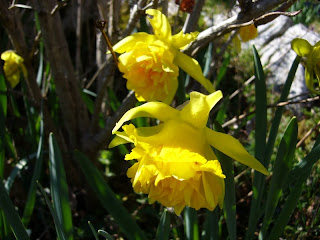
And these ...
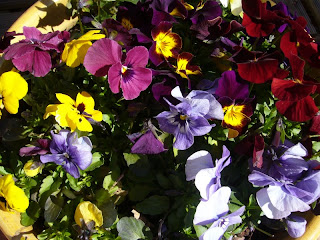
And this ...

He was singing his heart out all day ...

... while he (she?) and dozens like him (her? How do you tell?) flew in every direction ...

The first of these appeared ...

... and the sun shone, though I couldn't get a picture of that. But it was still 33 degrees Celsius in the sun at 5pm ...
These were out in force ...

And these ...

And this ...

He was singing his heart out all day ...

... while he (she?) and dozens like him (her? How do you tell?) flew in every direction ...

The first of these appeared ...

... and the sun shone, though I couldn't get a picture of that. But it was still 33 degrees Celsius in the sun at 5pm ...
Subscribe to:
Posts (Atom)