Showing posts with label immigration. Show all posts

Friday, 30 November 2012

Grillou crosses the Pyrenees (3)

While we were over on the other side of the Pyrenees we met a few people like us, who've upped sticks from their own country and settled somewhere new. There's often a kind of bond amongst such 'strangers' that has nothing to do with country of origin and everything to do with the shared experience of culture change. I'm always open to opportunities for such random conversations, which often take place on café terraces or in restaurants and are invariably fascinating.

But what comes up in these meetings, time and time again, is that there's one factor that seems to be number one in determining whether the move works out or not, and that's language - as in being able to speak it. Those who can't (and I include in that a French couple that we met over lunch in L'Ametlla de Mar) seem to feel like permanent holiday makers; those who can describe their adopted country as 'home'.

Although my French and Latin background means that I can understand a good deal of written Spanish and Catalan, my spoken command massacre of both doesn't bear description; it barely goes beyond being able to pass the time of day, book a hotel room or order lunch. Unfortunately it seems that my accent when I do manage to get out a few words must be reasonable, because invariably the other person comes back with a torrent of stuff at a million kilometres an hour that just goes right over my head; fortunately however it seems that my accent suggests me to be French and not English. I say fortunately for two reasons: firstly it's much more likely that the other person can cobble together a few words of French than English, and secondly because it's no secret that French visitors and holidaymakers are rather more respected than English ones.

And I have to tell you that I hated having a language barrier. Not just because of the shame I felt when I couldn't understand what people said to me, but also because there were so many things I wanted to ask different people at different times, like the incredibly helpful and knowledgeable woman who showed us round the Civil War Museum in Corbera d'Ebre. So it's decided: this year's Solstice resolution is going to be Getting To Grips With Spanish, at long last. But I'm left, once again, with the question of how people manage to live in a country without having at least a reasonable command of its language.

Tuesday, 6 April 2010

Swinging in Mirepoix

Hah! That got your attention, didn't it ...? But I'm talking about a jazz festival, dear reader, a jazz festival ...

For the last fifteen years the little Ariège bastide of Mirepoix has kicked off the festival season by hosting three days of New Orléans style swing each Easter. It's not the kind of music I'd travel halfway across the world for, but - weather permitting - it's always a good bash with lots of people and a great atmosphere. And this year, after two rainy years, the weather permitted. So, true to our promise to resume something of a more normal life, we went.


That's the omelette géante. As usual, we declined it on the grounds that it always turns out like the worst kind of scrambled egg: dry, solid, and cuttable with a knife. Yuk. (And anyway, it's only made with 1000 eggs, which is mere small fry compared to other Easter omelettes - at Bessières near Toulouse, for example, the Confrérie Mondiale de l'Omelette Géante et Pascale (!) use 15,000 eggs and 4 litres of oil to cook an omelette 4 metres across which ends up weighing, with its pan, more than two tonnes.) Instead we joined in the annual game of Trying To Get A Table at our favourite café, Le Saint Maurice. Which unfortunately happens to be everybody else's favourite too, because its tables are right in front of Les Halles where the music happens, the staff are great, and they cook a mean omelette-frites. It can be a protracted game, this one, because once installed people don't move on for several hours, but while I was attempting in vain to make a noise with a trumpet, John spied a prime table and unusually for him managed to leap on it before anyone else.

[An aside. He used - before he met me of course - to be terribly English, as in "after you" and "I'm really awfully sorry, but you've trodden on my foot", but living with me, and living in France, seem to have knocked the last bit of English reserve out of him. A few weeks ago, for instance, he picked up a gem of a CD in a local depôt vente and then left it with two or three other items ready to take to the till; when we came back to collect the pile, the CD had gone. Determined to get the CD back even though he'd not yet bought it, rather than being typically British-stiff-upper-lippish about it he tracked down the 'culprit' and (politely!) confronted her. She, it turned out, was desperate for the CD to play for her daughter who was about to leave for the States: what if, she suggested, she buy it; she could - ahem - copy it and then give it to him. Phone numbers were exchanged; she did, she did, and she did; and John got to practise some non-building French and make a new friend].

The weather was perfect ...


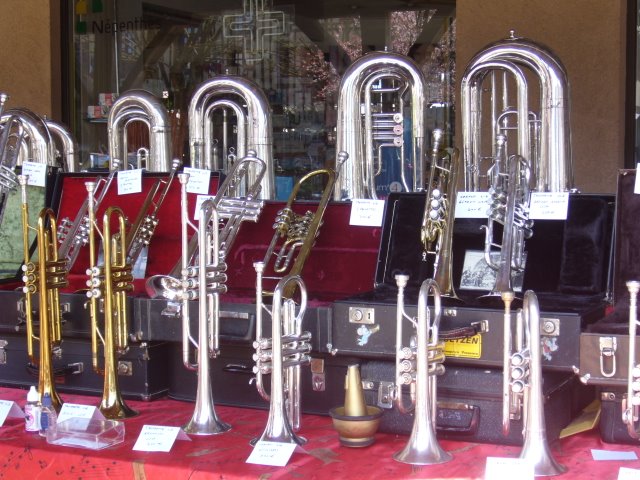
... and the square was full of people all afternoon, mostly doing what we were doing - drinking cold rosé or beer and enjoying the buzz and the music - though presumably there must have been some more serious musicians around as there were some serious displays of musical instruments too.


The square is surrounded by almost perfectly preserved medieval arcades and is almost impossibly pretty - one reason why a few years ago it saw a mini-invasion of retired Brits, attracted by the idea of cheap living in A Place in the Sun; many have now sold up and left or are in the process of leaving. I met one such recently and asked why: partly boredom, he told me, as in WTF shall I do now I've renovated my house; partly the realisation that France is no cheaper than the UK. Some, I gather, miss grandchildren; others miss - er - British supermarkets :-0 ... Yesterday I heard just one English voice over the whole day, an out and out record for Mirepoix. The French, I gather, are shedding no tears ...

For some, though, the day was clearly all too much ...


The music was pretty good too. Especially this lot, the Lulu Swing Quartet, who hail from Montpelier way and play fantastic gypsy jazz à la Stéphane Grapelli and Django Reinhart. Enjoy!


Thursday, 12 November 2009

Mother tongue

I read a fascinating snippet in La Dépêche du Midi the other day: according to the German medical anthropologist Kathleen Wermke, babies cry in the language their parents use.

She and her colleagues studied 60 two to five day old babies, 30 born into French-speaking families and 30 born into German-speaking families. They recorded 2,500 cries as mothers changed nappies, got the babies ready feeding or otherwise interacted with them. Acoustic measures allowed the researchers to identify 1,254 cries (a cry being 'a vocalisation produced with a single breath') that contained clear rising-and-falling arcs. German newborns’ cries tended to start out high-pitched and gravitate to increasingly lower pitches, whereas French newborns’ cries started out low-pitched and then moved higher. And those kind of intonation patterns, Wermke says, characterise words and phrases used by fluent speakers of German and French. Well yes, that certainly has a grain of truth in it. Take the word papa, for instance, found in both languages: the French pronunciation slightly stresses the final a so that the intonation rises, whereas a German will stress the first syllable so that it falls. And so on.

Apparently, in the last term of pregnancy, unborn babies become active listeners. Although the sense of hearing is the first to develop, the baby's sense of hearing while still in the uterus is restricted by the amniotic fluid - but what gets through are the melodies and sense of intonation of the mother's speech.

And although I have to admit to being at best ambivalent towards babies, never having had - or even for one moment wanted to have - one, that's the bit that fascinates the languageaholic in me. One thing I do know is that as a foreigner, it's much easier to make yourself understood if you have a good grasp of the 'music' of a particular language but a poorer grasp of its vocabulary and grammar than it is if you're ace at words and grammar but speak the language with the intonation of your own mother tongue.

For as long as I can remember I've picked up on the melodies of the accents of the areas I've lived in. I'm endlessly fascinated by them, and although I don't do it deliberately it takes me usually less than a week to subconsciously adapt my own speaking style to a local one. My Italian, for example, is despicable, but because I've spent more time in Tuscany than any other part of Italy I'm told that what little I can say I say with the Tuscan intonation. A week in South Shields earlier this year left me singing like a Geordie hinnie; and I can still slip into passable Narfock, Brissle, north Yorkshire, Sheffield and Dorset at a moment's notice given the right provocation.

So - rant coming up - why oh why oh why does the music of language continue to be largely ignored in foreign language teaching? Anyone?

Saturday, 22 August 2009

50 good reasons ...

It's exactly two years since we signed on the dotted line and Grillou became ours. Two years! How is that possible? We've done the bottle-of-something-with-bubbles bit, and now I feel a list coming on to celebrate. So sit back and brace yourselves for, in no particular order, 50 good reasons to love living in France, and in Ariège.

1. The Pyrénées. Of course.
2. Seasons - all different, all defined.
3. The scenery. It always, always, takes my breath away.
4. Lizards. Small, huge, brown, bright green - always there, always curious.
5. The apéro. Breathing time between day and evening, work and play.
6. The night sky. So clear ...
7. Patisserie. Just looking at it is (nearly) enough..
8. Markets. Shopping at its most colourful and convivial; produce from down the road.
9. Wine. Languedoc Roussillon starts less than an hour away from here; some of its wines are up with the best in the world. And some aren't (but en vrac, at a euro a litre, who cares ...).
10. Silence. Absolute.
11. La saison. Summer - a period of time when everyday life stops, and pleasure takes over.
12. Depôts ventes. A cross between junk shop, antiques warehouse and rummage sale; I never tire of rooting around for bargains. I even find one, sometimes.
13. Butterflies. So many different species ... even in February.
14. Bof! An expression as indispensible as it is untranslatable.
15. Geographical diversity. Even across our small department, we range from orchards and wheat fields and pretty country lanes, to plains with expansive views, to rolling pastureland dotted with foothill farms and cows, to steep sided valleys where hamlets cling precariously on south facing slopes, to wide verdant mountain valleys, to rocky peaks, mountain lakes, beech forests ....
16. Shutters. Such a clever invention - they keep your house warm, they keep your house cool, they look wonderful.
17. Cheese. France produces around 1000 different types. I'm getting there, slowly.
18. Sunflowers. A summer cliché, but stunning anyway.
19. Driving. A pleasure, here in France, where roads are uncrowded, French drivers notwithstanding.
20. Architecture. And how it changes as you travel regions, departments and even villages.
21. The two hour lunch closure. Much maligned by some Brits, but not by me.
22. Blue virgins. They're everywhere.
23. Thermalism. So many spas, so little time ..
24. Pétanque, or boules. Not that I'm any good at it ...
25. The smell of wood smoke in winter.
26. Free food. Otherwise known as foraging.
27. The French language.
28. Tradition. Still alive, well, and and celebrated.
29. Bonjour. More than just form, the obligatory greeting of all and sundry in shops/before you do business/when you meet acquaintances/when you arrive at a group of friends is an unmissable - and pleasurable - ritual. People matter, it says.
30. Snow. Look at it, walk in it, ski on it.
31. Space. There's just so much of it - France is well over twice as big as the whole of the United Kingdom, for a similar population; Ariège is one of the least populated departments, with just 28 people per square kilometre.
32. Swimming in lakes and rivers. Beats the sea any day. And I won't even mention pools.
33. Festivals. From folklore to fiesta to funk, and nearly all free.
34. Oh la (la la la la la la la la...). Yes, the French really do say it. Frequently.
35. The Midi sun. Strong enough to sunbathe, and even pick up a tan, in winter.
36. The number of things you can do here with a pig.
37. Simple living.
38. The network of footpaths, both local and national, and the right to roam.
39. Tisanes.
40. Working to live, not living to work.
41. The French obsession with bandes dessinées (comic books, to you and me).
42. Being able to spend so much time, and eat, outside for most of the year.
42. Diversity: of accents, culture, appearance.
43. Body language - the French shrug, facial expressions, hand waving.
44. Things well used, re-used, and recycled. Consumerism doesn't rule, okay?
45. The lack of fashion victim-ness. Nobody cares what brand of trainers I wear; if I choose to wear my aging hippy outfits from the seventies, that's fine (everybody else does).
46. Spain. An hour and a half away: no ferries or planes required.
47. Our potager, and the sheer variety of things we can grow in it.
48. Toulouse: just over an hour away, and all the museums, opera, concerts and big city buzz you could wish for.
49. Organic. C'est normale, here in Ariège.
50. Pastis. There. It's out. I'm addicted to it.

Tuesday, 18 August 2009

Exposed beams

We're having a heatwave. It's official. Not quite official enough, here in Ariège, to trigger the government's canicule plan, brought in after nearly 20,000 people died in France during the 2003 heatwave; but official enough to be the ongoing subject of media coverage, not to mention many a conversation. And it is hot; afternoon temperatures are up to at least 36 degrees in the shade, dropping to a more comfortable 26 degrees or so at around 10pm. In the sun? Put it this way - my thermometer goes up to 50 degrees, and it's off the scale. Working is becoming increasingly taxing, and I keep having fantasies of diving into cool water.

So the timing was apt this week when a friend in England sent me the bizarre piece of news that the theme park Alton Towers has banned men from wearing Speedo-type swimming trunks 'on grounds of public decency'. I honestly thought this was a joke at first, but having followed up the links she sent it appears that it isn't: apparently "the style is not deemed public or family friendly" and is likely to "cause embarrassment".

Am I missing something here? Do most people not have bodies, and bits that stick out here and there, and - heaven forfend - body hair? And wasn't the whole Adam and Eve thing a long time ago, and just a fable and/or a lot of tosh (depending on your persuasion) anyway? When, and how, did we learn to be so ashamed and embarrassed about our physical form? Surely to goodness, in the twenty-first century, it's time to move on from the smutty seaside postcard ...

Here in France, if you're male and you want to swim in the vast majority of public pools you have to wear Speedos (and, usually, a swimming hat). No bermudas, no question. It's deemed unhygienic to bathe in a swimming pool in clothes that you could have been (and probably have been) wearing in the street all day. It would, the official line goes, simply turn the pool into a wash house. My friend's Alton Towers story reminded me of a story I read in our regional newspaper, La Dépêche du Midi, a few weeks ago.

Until this year, there have been two public pools in Toulouse which allowed the wearing of bermudas: a small pool, Castex, and the much larger one close by, Nakache. Castex has for some time been a favourite haunt of young people from the quartiers populaires - working class estates - in the area, and has had a reputation for being, shall we say, a bit on the lively side. Tensions between the teenagers and other pool users ran high; two years ago the entire pool area had to be evacuated when a pitched battle broke out between fifty or so teenagers and security guards, and then the police that were called to restore order. That kind of thing.

Clearly Something Had To Be Done. But what? Well, a bit of uncharacteristically creative thinking out of the box obviously took place: a solution has been found, and appears to be working. But it doesn't involve extra policing or heavy-handed rules or showcase arrests. Local officials have simply banned the wearing of bermudas at Castex, while continuing to allow it, by special dispensation, at Nakache.

As if by magic, the yoof has migrated to Nakache, which is much bigger and is a leisure pool as opposed to a swimming pool, as it were, whereas the swimmers have returned to Castex. Hanging out and joshing in a pair of Speedos and a swimming cap is simply not cool; besides, many of the teenagers are of Muslim origin and consider themselves to be too prudish to wear, as La Dépêche puts it, 'le maillot à poutre apparente' (lit: swimming costume with exposed beam' (!). Nakache has reported a high frequentation, good spirits and no problems. Castex swims peacefully. Problem solved.

Chapeau.

Thursday, 23 July 2009

Sequels 2

So, Tuesday saw Claudine Louis in court in Foix, accused of offering assistance to a foreigner in an irregular situation (I wrote about her story here a few weeks ago). From its modest beginnings as a local news story, it was gradually taken up by the main news channels as word got around and the level of support for Claudine grew. Comments pages in national newspapers buzzed, generally (though not always, especially - unsurprisingly - in Le Monde) in Claudine's favour.

Nearly a hundred people were outside the courtroom on Tuesday. Before the hearing, the procureur announced a modification to her charges: although she was still being tried for aiding a clandestine, she would not, if found guilty, be fined or imprisoned. The trial, therefore, would go ahead to settle a point of law, not to penalise Claudine who, he accepted, had acted with the best of intentions.

The whole thing lasted for two hours and debate focused primarily on the fact that Obaï is a minor. The defence argued that a minor cannot be considered to be a clandestine or 'in an irregular situation', and that if she had failed to offer help, she could have laid herself open to the charge of 'non-assistance to a person in danger' - which is actually an offence here. The prosecution's argument is that if helping a young immigrant like Obaï is deemed to be legal and above board, it follows that equally no action could be taken against those who traffic children.

The verdict will be given on 8 September, after the arguments have been deliberated by three judges. Whatever the outcome, law will be made.

Thursday, 11 June 2009

Welcome, in Ariège ...

A few weeks ago, we went to see Welcome, Philippe Lioret's film about clandestine immigrants in Calais and in particular about a 17 year old Kurdish refugee, Bilal, who is determined to swim across the Channel to get to England, where he is hopes to rejoin his girlfriend (and play for Manchester United!). The film tells the story of how he is befriended by a swimming teacher, learns to swim, and eventually makes his attempt on the Channel. Meanwhile, his friend-teacher is arrested and charged with "offering assistance to a foreigner in an irregular situation" - a section of the penal code usually reserved only for 'people traffickers'. It was a truly excellent film, if upsetting, and not a little controversial. If it hits a cinema near you, see it. 

Little did we think that a not dissimilar, real life, situation would shortly unfold here, in our local town.

At the beginning of the year, a young Afghan guy, Obaï, joined the French language workshop that John attends at the Resto du Coeur in Saint Girons. Little was known about his background, and a few weeks ago he moved on, apparently to Pamiers, a larger town on the plain in the north east of the department. We thought no more of him. Until a couple of days ago, when a headline in our regional paper, La Dépêche du Midi, caught my attention: a Saint Girons woman is being charged with "offering assistance to a foreigner in an irregular situation". The foreigner is Obaï. 

The story goes like this. Claudine Louis had been for some time concerned with the plight of Afghan clandestine immigrants to France; last winter she heard that a family was living rough in a park in Paris amongst 50 other clandestines, and went to investigate with a view to taking some action on their behalf. The family had actually been accommodated in a hotel by the authorities, but while there she came across Obaï: 16 years old, cold, and ill. She brought him back to Saint Girons to stay with her, made sure he got medical treatment, began to teach him French and set out to get hold of his identity papers so that he could get the formal child protection that all minors in France are entitled to: support, accommodation within a children's home or foster family, and education. Having successfully got his identity documents, she then set off on an interminable round of just about every official body in the department, encountering procrastination and being passed from pillar to post over a period of nearly four months. Finally, and in desperation to alert the departmental authorities to the presence of her young friend, she took him to the Préfecture in Foix and deposited him there.

By the end of the day, Obaï had been placed in a foster home in Pamiers, and Claudine had been charged. She is due to appear in court on 21 July; if she is found guilty she risks 5 years imprisonment, and/or a fine of up to 30,000 euros. 

There is more than a certain irony in the fact that Claudine is being charged under a section of the code usually reserved for those who are hiding an illegal immigrant when she has spent four months trying, unsuccessfully through no fault of her own, to do just the opposite. Our department does in fact have a generally sympathetic approach to refugees - perhaps not surprising given that a large number of its residents were originally refugees from Spain in the Franco years - and the Préfecture has stressed that no blame or fallout will find its way to Obaï himself. Quite why they have chosen to bring this prosecution - the fourth such case in France - is beyond not only me but also the many other people who are coming together in support of Claudine. 

If, like me, you are shocked and upset by what's going on here, please think about writing to the prosecutor (Procureur) in Foix. There's a sample letter here, where you can also read an account of events in Claudine's own words. Whether you live in the department - or even in France - or not, we can make a difference.