Yesterday morning, I noticed that Noodles' tail looked a little odd - it was sticking out almost horizontally from his body for a few centimetres, then dropping down limply. And he wasn't wagging it, which is most unusual - he's the waggiest dog who's ever owned me as a pet, with a great line in 'helicopter' wags, generally when he wants something :-) As the day wore on, it became more pronounced, and he became more and more bemused, and more and more depressed, periodically looking round behind him with a disgusted-of-Rimont expression on his face.
The previous day had been the first day of the thaw, and our 30cm of snow was gradually reducing to the point where he could actually run across the nearby fields instead of disappearing under a pile of the white stuff. On his early evening walk he'd disappeared for almost half an hour, eventually coming back completely exhausted and flopping down into the snow to recover. He does this from time to time, usually when he's got an excess of energy to burn off; he knows the land around here better than we do and generally comes back from a direction entirely different from that in which he set off ... And after two weeks of enforced walk restriction from bitterly cold temperatures and thick snow, he had energy!
I wondered, naturally, whether he'd injured his tail somewhere on his jaunt, although there were no obvious signs of injury elsewhere; in fact I feared that he'd broken it, although he didn't appear to be in any pain. Before packing him off to our local vets though I Googled 'floppy dog tail' ... and lo and behold, found the answer. Noodles was displaying the classic symptoms of Cold Tail, also known as Limber Tail, Broken Wag and Dead Tail. Apparently it's a condition still unknown to many vets, brought on sometimes by vigorous exercise, sometimes by exposure to cold, wet weather, and sometimes by nothing obvious at all (too much tail wagging, maybe?). No treatment necessary - it resolves itself in a few days, with warmth and rest (rest? Huh!). Phew.
But how pathetic does he look! (He's banned me from taking a picture of his tail ...). The good news is that this afternoon there are already some signs of improvement, and even some miniscule wags. It'll be helicopters again before you know it.
Showing posts with label animals. Show all posts
Friday, 17 February 2012
Monday, 13 September 2010
Up among the orris
The swansong to our holiday week saw us making a very last minute decision to take our Quechua pop-up tent away for a couple of nights, to Vicdessos. It was the first camping trip of the year, as evidenced by the ridiculous amount of time and tantrums it took us to dismantle the infamous tent that takes only 15 seconds to put up; we go through this every year, along with half our fellow campers, before we realise that in spite of Decathlon's pretty pictures on the bag it's just not possible to put both blues to both browns before you do that funny twisting thing (if you have a similar tent you'll know exactly what I'm talking about) and you just have to wing it, or ask for help. Still, it's all good for campsite solidarité. At least it would have been, if we'd had any fellow campers to be solid with. This time, in spite of fantastic weather, we were alone, apart from a few semi-permanent caravanners who spent most of their time cleaning their cars and hosing their awnings (or was it the other way round?).
Vicdessos and its twin village Auzat sit up against both the Spanish and the Andorran borders, and at the foot of Montcalm, 3007 metres high and often known as the 'roof' of Ariège. Although only just over an hour from Grillou the scenery here is very different - the valleys are narrow, edged in by tall, rocky peaks, and habitation tends to be gathered together in hamlets, some of which, like Mounicou, remain very traditional indeed. A lot of the walking here is of the 'sportive' rather than the Slow variety - but not all. We chose to explore Le Chemin des Orris, up above the man made Etang de Soulcem.
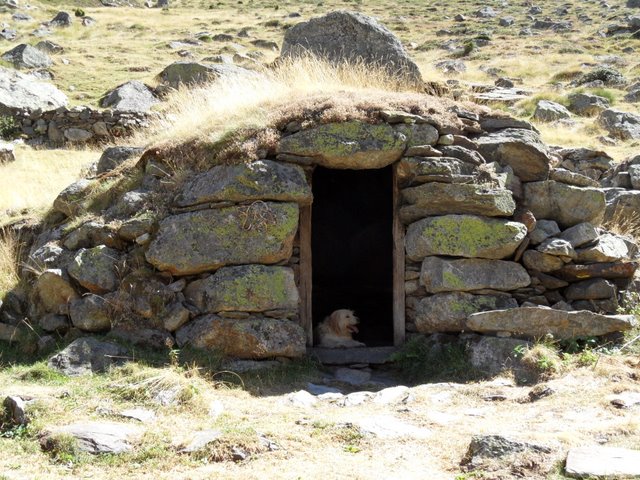
An orri is a low, round shepherds' hut found up on the estives - the summer high pastures - built entirely of dry stone (ie no mortar) and often topped with turf, or sometimes with slate. The design hasn't changed since the Middle Ages, when various confreries or guilds (some of which still exist today) were given the right to construct them on land owned by the local count, or king, or whoever; in some places - and we were in one of them - the orris were grouped into small hamlets, often around a communal courtyard. Until early last century, they would be occupied through the summer months not just by the shepherd but also by a part of his family, while the rest of the family remained down in the valleys to look after the crops; they would be used not just for habitation but also for cheesemaking, for the shepherd was also a fromager. Les Orris de Carla, closest to the lake at Soulcem, were in use until 1968.
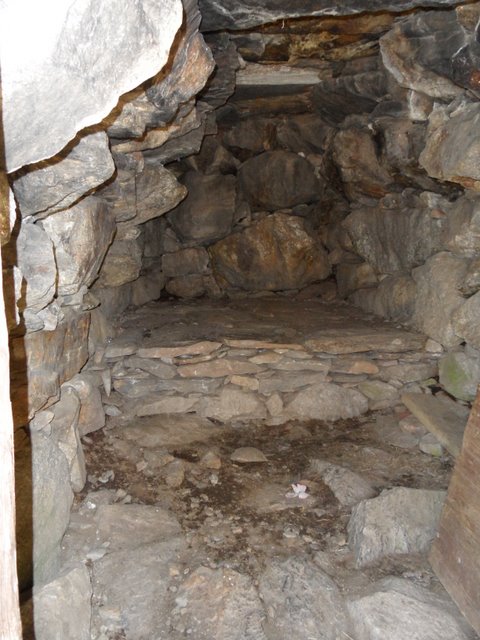
Inside one of the orris - the stone platform at the back would have been used for sleeping, covered in leaves and moss:
Vicdessos and its twin village Auzat sit up against both the Spanish and the Andorran borders, and at the foot of Montcalm, 3007 metres high and often known as the 'roof' of Ariège. Although only just over an hour from Grillou the scenery here is very different - the valleys are narrow, edged in by tall, rocky peaks, and habitation tends to be gathered together in hamlets, some of which, like Mounicou, remain very traditional indeed. A lot of the walking here is of the 'sportive' rather than the Slow variety - but not all. We chose to explore Le Chemin des Orris, up above the man made Etang de Soulcem.
An orri is a low, round shepherds' hut found up on the estives - the summer high pastures - built entirely of dry stone (ie no mortar) and often topped with turf, or sometimes with slate. The design hasn't changed since the Middle Ages, when various confreries or guilds (some of which still exist today) were given the right to construct them on land owned by the local count, or king, or whoever; in some places - and we were in one of them - the orris were grouped into small hamlets, often around a communal courtyard. Until early last century, they would be occupied through the summer months not just by the shepherd but also by a part of his family, while the rest of the family remained down in the valleys to look after the crops; they would be used not just for habitation but also for cheesemaking, for the shepherd was also a fromager. Les Orris de Carla, closest to the lake at Soulcem, were in use until 1968.
To make sense of orris you need to understand the concept of transhumance. The transhumance is the leading of livestock - cows, sheep and horses - from their winter homes in the valleys, along roads, paths and mountain trails, up to the high mountain pastures - the estives. The system evolved during the Middle Ages and is still widely practised here in Ariège today, where it's not only a part of the farming calendar but also now a form of pastoral tourism: many people gather each May or June to follow the transhumance journeys up to the estives, which have become festive and convivial occasions as well as serious work. These days, some farmers have grouped themselves into associations which hire seasonal shepherds and cowherds to look after the animals, whereas others merely pay occasional visits to their livestock, often on a shared rota basis with colleagues. Pretty much wherever you walk in the mountains in the summer you'll come across animals; a few of the estives are fenced, though mostly the animals roam semi-wild, simply being led from one grazing area to another every so often by the shepherd or farmer. The sound of bells is an integral part of any walk in the high pastures.
The pastureland above Soulcem is stuffed full of orris, some of which have been recently restored. Sadly, six more groups of them were flooded when the lake was formed by the creation of a huge barrage. A lovely, and simple, walk takes you from the parking area at the end of the étang - at around 1200 metres - along the valley, either on the piste on the east side of the water or boulder hopping along the streams on the other. Longer and more challenging walks take you up and over the peaks to either side (it's quite possible to walk to both the Andorran, and the Spanish, borders), or in a circle up to a grassy shoulder.
This is one of the Orris de Carla, complete with new occupant:
Inside one of the orris - the stone platform at the back would have been used for sleeping, covered in leaves and moss:
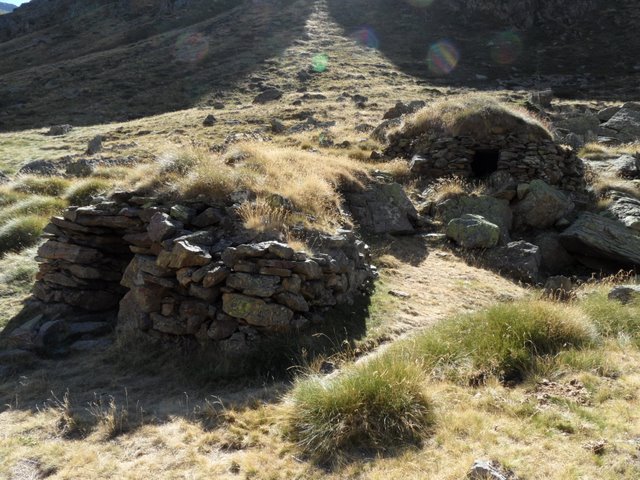
Part of a hamlet of orris higher up the valley. This one had an enclosure, and another piece of ground that looked as if it may have been used to grow things.
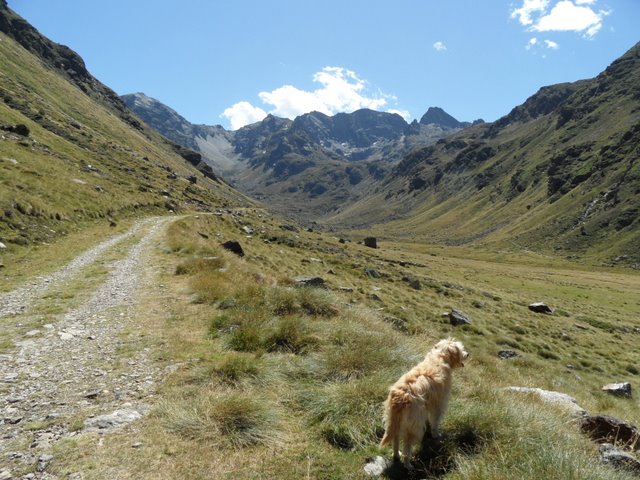
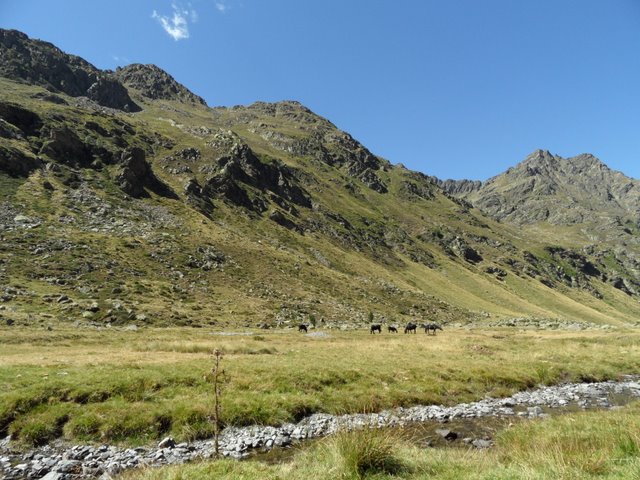
The piste leading from the étang is wide and accessible, though you still get a real feel of being in a high mountain area. Here it feels almost Alpine in character.
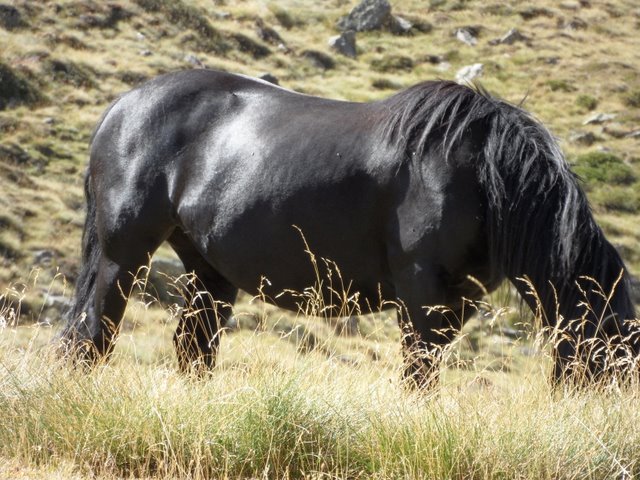
Down on the valley floor, where a herd of Mérens horses were grazing. Mérens are a native breed of Ariège, and are believed the be the closest descendants of the wild horses of prehistoric times.
They are beautiful creatures. Just down the road from Grillou, at La Bastide de Sérou, is the Centre National de Mérens, where you can discover the breed in every which way.
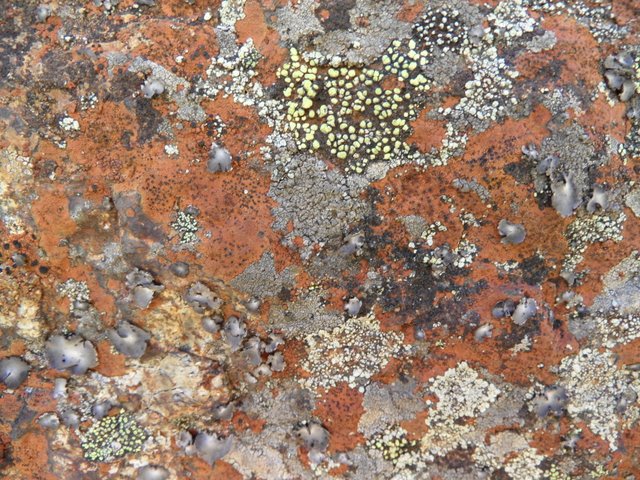
Fantastic lichen formations on the rocks ....
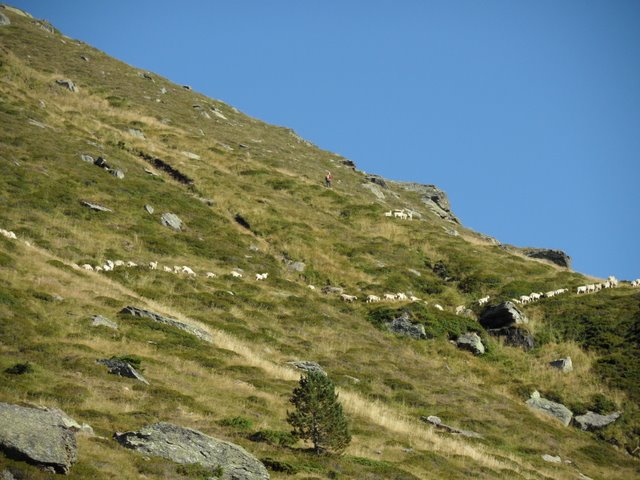
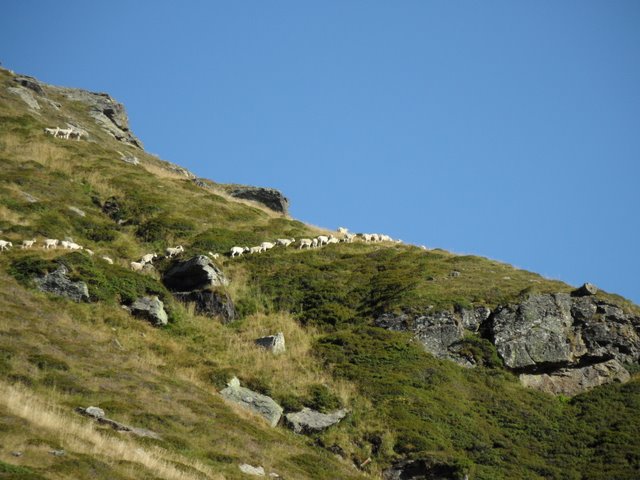
Much higher up the path on the grassy mountainside we encountered a shepherd moving a huge herd of sheep from one grazing area to another. We sat quietly and watched for a long time; the communication between him and his dog, a Border Collie, was almost mystical - none of the arm waving and almost constant yelling of One Man and His Dog (a series of TV programmes popular in the 1980s that set British sheep farmers and their dogs in competition with each other in various sheep dog-y exercises), but just eye contact and the occasional trill or other sound. If you click on the picture to enlarge it, you'll just see the shepherd standing on a rocky outcrop.
The other breed of dog that does this work is the Berger des Pyrénées. Our own dog is (mostly) one of these, though we've no idea whether he comes from a working family as he was originally taken in having been abandoned. However - and I'm aware that this may sound far fetched to some - when we were up in those high mountain pastures it was as if something was calling to him from a collective unconscious ... the way he looked, and listened, and thought ... a particular sort of alertness, a sort of intelligence, that was new. It was as if he was thinking "Hang on a minute ... I know something about this ... I've been here, before ...".
Monday, 9 August 2010
Absence makes the keyboard grow dustier ...
Feeling guilty about not having blogged for far too long, I was all set tonight to sit down and talk about the fantastic annual African festival in Foix - Ingénieuse Afrique - that has kept us out and dancing till late for the last three nights. That was until earlier this evening, when normal life was interrupted by our dog Nouille's encounter with - a wild boar? a wire fence? something else entirely? - in the woods at the other end of the track. He came back with a tiny nick in the end of his ear, which has somehow managed to bleed copiously for over two hours now.
So all I have to say tonight is this: isn't it just awesome how much a dog's ear can bleed? Phew.
Normal service will be resumed shortly.
So all I have to say tonight is this: isn't it just awesome how much a dog's ear can bleed? Phew.
Normal service will be resumed shortly.
Tuesday, 20 April 2010
Normal life
So, over the last month or so we have - against all odds - managed to resume something of a (more) normal life. That doesn't mean we've stopped the réno and are now swanning round like retired gin-swilling colonels (heaven forfend ...) but it does mean that we've actually left the premises on more than one occasion: to go to the market, to drink une noisette on a café terrace, to see friends. Seeds have been sown, plantlets have been planted. Birds have been watched and listened to. Sun beds have been sat upon. A few days break for each of us on our own, plus a camping holiday together, have been planned. And I've taken up a completely unexpected, out-of-the-blue opportunity to do some work that I love, away from Grillou but only a few minutes up the road, over the next few months.
We've spent much of the time outside, clearing and cleaning and laying another stone terrace. Not a whole lot has progressed inside the house. But ... I'm beginning to hear the spaces between the words again, and to see Grillou as the house that we fell for over three years ago, not just as The Project. The weather has helped: it's been truly glorious and springlike for much of the time. The garden has suddenly come to life, full of blossom and tulips; the grass is growing, the first leaves are just beginning to unfurl and the roses are in bud. In many ways this is the most delightful time of year here - the birds are singing their socks off, snow still covers the peaks, the hillsides are white with the blossom of wild cherry and plum and vibrant green with new growth, purple orchids are everywhere, the markets are bursting with asparagus and strawberries. The sun is warm enough that you know you're in the south of France, but not so hot that you can't walk in it or work in it. Layers of clothes are shed, and legs see the light of day. Chilled rosé and ice cold beer take over from warming reds and hot chocolate.
Enough already of the walking commercial. But you might just want a tiny peep ....
Blossom on the cherry tree that we planted last year ...
... and quince blossom, amazingly delicate and almost exotic.
Looking towards L'Atelier d'Artiste ...
... and its dining terrace.
Oh, yes, the hairy thing in the last photo is Nouille, or Noodles, the latest addition to the Grillou clan. We adopted him from a family who found themselves having to return to the UK after living many years here; they, in turn, had adopted him when he appeared one day at their village bins, apparently abandoned. He's three years old, bilingual, and a Labrit (a type of Pyrénéen sheepdog); we think he's far too independent (aka stubborn) to have been the working dog that he was bred to be, which is probably why he was abandoned - one of the less endearing traits of some French farmers. He's also completely eccentric, besotted with people, has a real sense of humour and is wonderful company. Look away now if you're not a dog person, but if you are ...
I'd forgotten: you can never disappear up your own seriousness when there's a dog around.
Sunday, 30 August 2009
Cows en fête
The Builders are coming back this week after their summer break (huh!), so we're rushing round like the proverbial mouches bleues trying to prepare (which I guess is a bit like cleaning your house ready for the cleaner to come in, but as I've never had a cleaner, so to speak, I wouldn't know ...). This afternoon, however, we prised ourselves away from our respective tasks - John from wirebrushing beams, me from weighing up and sourcing various heating options - to go and look at some cows.
Yes, I know we've got cows down the track, and very nice ones they are too - Gascon and Limousin, if you want to know. But the annual Foire Agricole at Le Mas d'Azil, 15 minutes away through the cave (yes, really), is a must-do. As its publicity puts it, it's a day where ruralité is put in the forefront - not as folklore, but as real, day to day agricultural life, with its economic and social difficulties as well as its successes. I like that. And it was a good day. Here's some of it, in pictures ...

We got cows in profusion:


Most of them came complete with panels showing which butcher we'd be able to buy them from when they pass into their next life. One of the things that I like about butchers here is that a lot of them have pictures in their window of the animals they're selling bits of inside. Yes, okay, it's a bit uncomfortable, at least for me; but it's straight, and honest, and it honours the animal that was killed for food. And (beware, soapbox mode coming up) one of the things I bang on about is that those of us who eat meat - even if, like me, it's not every day - need to recognise and accept that real live animals, with pretty faces and melty eyes, are killed for that sole purpose or in the service of it. But it's not for those who want to go on thinking that meat grows on polystyrene trays, perhaps ...

We also got some rather splendid pigs and piglets, for whom the day seemed just that bit too much like hard work ...


There were sheep and goats and rabbits and turkeys and ducks and geese and chickens and donkeys and horses too, naturally. Not to mention some rather fetching underwear:

I suspect their owners may have been eating too much of this:

It's millas, a local dessert traditionally served to celebrate the killing of the family pig. It's made from fine corn meal, wheat flour, raw milk, sugar, butter and orange flower water; it's made in a similar way to polenta: cooked, and stirred with a long wooden paddle, for at least an hour, then poured into trays to cool, after which it's cut up into squares and fried in butter until golden. It is, I warn you, more addictive than it looks ...
There was what in England would these days be called a farmers' market (here, it's just a market, because what else would a market be ...). This bread was being baked from scratch in a wood fired oven set up in a van:

This guy, from the delightfully named village of Camarade - between Grillou and Le Mas d'Azil - makes some of the best Tomme de Vache des Pyrénées: it's really yellow, and like eating new mown grass:

I'm very fond of Le Mas d'Azil. We're there quite a lot: at the Wednesday market, or for a coffee as we're driving through, or occasionally to eat at the pizzeria or the local hotel-restaurant, Le Gardel. It has some lovely squares, shaded by plane trees, and some equally lovely medieval columbage houses, many with gardens running right down to the Arize river, which runs through the middle:

And yet there are still corners of the town (village? I'm never sure) that we're discovering. Today, for instance, we stumbled upon an old house which was actually rather forlorn, but redeemed by this lovely old shutter, with its patina of bleu pastel (woad) and linseed oil:

And then, of course, there are the caves, and the dolmens. Another blog, another time ...
Yes, I know we've got cows down the track, and very nice ones they are too - Gascon and Limousin, if you want to know. But the annual Foire Agricole at Le Mas d'Azil, 15 minutes away through the cave (yes, really), is a must-do. As its publicity puts it, it's a day where ruralité is put in the forefront - not as folklore, but as real, day to day agricultural life, with its economic and social difficulties as well as its successes. I like that. And it was a good day. Here's some of it, in pictures ...
We got cows in profusion:
Most of them came complete with panels showing which butcher we'd be able to buy them from when they pass into their next life. One of the things that I like about butchers here is that a lot of them have pictures in their window of the animals they're selling bits of inside. Yes, okay, it's a bit uncomfortable, at least for me; but it's straight, and honest, and it honours the animal that was killed for food. And (beware, soapbox mode coming up) one of the things I bang on about is that those of us who eat meat - even if, like me, it's not every day - need to recognise and accept that real live animals, with pretty faces and melty eyes, are killed for that sole purpose or in the service of it. But it's not for those who want to go on thinking that meat grows on polystyrene trays, perhaps ...
We also got some rather splendid pigs and piglets, for whom the day seemed just that bit too much like hard work ...
There were sheep and goats and rabbits and turkeys and ducks and geese and chickens and donkeys and horses too, naturally. Not to mention some rather fetching underwear:
I suspect their owners may have been eating too much of this:
It's millas, a local dessert traditionally served to celebrate the killing of the family pig. It's made from fine corn meal, wheat flour, raw milk, sugar, butter and orange flower water; it's made in a similar way to polenta: cooked, and stirred with a long wooden paddle, for at least an hour, then poured into trays to cool, after which it's cut up into squares and fried in butter until golden. It is, I warn you, more addictive than it looks ...
There was what in England would these days be called a farmers' market (here, it's just a market, because what else would a market be ...). This bread was being baked from scratch in a wood fired oven set up in a van:
This guy, from the delightfully named village of Camarade - between Grillou and Le Mas d'Azil - makes some of the best Tomme de Vache des Pyrénées: it's really yellow, and like eating new mown grass:
I'm very fond of Le Mas d'Azil. We're there quite a lot: at the Wednesday market, or for a coffee as we're driving through, or occasionally to eat at the pizzeria or the local hotel-restaurant, Le Gardel. It has some lovely squares, shaded by plane trees, and some equally lovely medieval columbage houses, many with gardens running right down to the Arize river, which runs through the middle:
And yet there are still corners of the town (village? I'm never sure) that we're discovering. Today, for instance, we stumbled upon an old house which was actually rather forlorn, but redeemed by this lovely old shutter, with its patina of bleu pastel (woad) and linseed oil:
And then, of course, there are the caves, and the dolmens. Another blog, another time ...
Labels:
animals,
Ariège,
festivals,
French life,
Le Mas d'Azil,
shopping
Subscribe to:
Posts (Atom)