Showing posts with label recipe. Show all posts

Thursday, 9 February 2012

Comfort cooking: panforte

I was sorting out the food cellar and larder yesterday, as you do when it's minus 13 outside, you're snowed in, the paint you want to use is frozen solid in the workshop and it's too cold to mix up your tile cement or do any of the things marked 'desperately urgent' on your jobs list. (I even defrosted the freezer. Mad? No, not really - no worries about keeping stuff frozen - I just piled it all up on the snow outside the cellar door ...). Anyway, in the depths of the larder I came across a jar of lemon peel that I'd inadvertently (long story) candied last year and forgotten about. Idly wondering what to do with it, I switched on the laptop to check the mail and there was the latest blog post from David Lebovitz, one of my favourite food bloggers, with a recipe for panforte.

I love panforte. It's a speciality of Sienna: a kind of rich, dense, sweet and chewy dessert cake, with lots of fruit and nuts (and candied lemon peel!) and more than a hint of spices - perfect after dinner with a strong coffee and a glass of Strega. I've eaten it many times, during and after our winter trips to Tuscany in the restaurant days, but I'd never made it, nor had a clue to how to make it. The combination of David's blog, my jar of lemon peel and and sheer frustration at the way the weather here is holding up the jobs list big time propelled me into the kitchen for a spot of comfort cooking.

I discovered that panforte is not difficult to make, although you do have to work fast when you're mixing the melted chocolate and the honey syrup into the dry ingredients. This is my slightly amended version of David's recipe:

40g unsweetened cocoa powder, plus extra for dusting the tin
200g chopped nuts - I used almonds and the last of our own walnuts
100g chopped dried apricots
110g flour
200g chopped candied lemon peel
1 tablespoon ground cinnamon
2 teaspoons ground ginger
1 1/2 teaspoons freshly ground black pepper
1/2 teaspoon ground red chilli
1/2 teaspoon mixed spice 
85g dark chocolate, chopped
200g sugar
210g clear honey

1. Preheat the oven to 165ºC.

2. Line the bottom of a 22cm springform tin with parchment paper. Dust the inside, including the sides, with cocoa powder.

3. In a large bowl, mix together the cocoa powder, dried fruit, nuts, flour, candied peel, cinnamon, ginger, black pepper, mixed spice, and red chilli.

4. Melt the chocolate in a small bowl set over a pan of simmering water. Remove from heat and stir it into the nut mixture.

5. Gently heat the sugar and honey to115ºC.

6. Pour the hot honey syrup over the nut mixture and immediately stir it all well to mix. Scrape the batter into the prepared pan and smooth the top.

7. Bake the panforte for 30-35 minutes; the centre will feel soft, like just-baked custard, and if you touch it, your finger will come away clean when it’s done. Let it cool in the tin on a wire rack for 15 minutes, then run a knife around the edge to loosen it. Remove the springform carefully, then let cool completely.

Once it's cool, remove the bottom of the springform pan and peel away the parchment paper. Then wrap it up and put it away for a few days to bring out the flavours. When you're ready to eat it, dust the top with icing sugar and rub it in with your fingers.

Here it is just out of the oven:


And how it will look when it's dusted and cut (this is David's photo: mine's not at that stage yet!):


Right now it's wrapped up, maturing ....... though for how long I'll have the willpower to leave it there I don't know! If it's good it's likely to find its way onto our winter menus ...

My favourite weather forecaster, Laurent Cabrol on Europe 1, announced this morning that we would almost certainly see a change in the weather in the middle of the month ... though probably not for the better. All the forecasts seem to agree that the 'big freeze' is likely to continue until the end of the month, possibly through into March. Minus 16 predicted for us tonight (with a 'feels like' figure of minus 19 ...). We're still snowed/iced in, though rumour has it that our neighbour may attempt a breakout tomorrow. Watch this space.

Monday, 25 July 2011

Three-times cooked chips

So, by popular request, the nuts and bolts of frites maison Grillou:


1. Cut some floury potatoes into chips - I reckon mine were somewhere between half to three quarters of a centimetre thick.

2 .Put the chips into cold water with a teaspoon of salt, and bring to the boil. Simmer for one minute until they're just tender to the point of a knife. Drain, spread them out on a tea towel to dry, then chill in the fridge.

3. Heat the oil - mine's two thirds colza (rapeseed) plus one third sunflower - to 130 degrees and cook the chips for 6 minutes. They should be slightly dry on the surface but not browned at all. The idea of this stage is to cook them inside so that they end up fluffy. Drain, and if you have time cool/chill them again  (I cooled them but didn't have time to chill them).

4. Heat the oil again to 180 degrees and cook the chips for two to three minutes, until they're golden but not brown. Drain on kitchen paper and salt while really hot.

Enjoy!

Tuesday, 10 May 2011

Eat your weeds

When I was ten, I would do almost anything to get out of eating greens. Mind you, in retrospect I think I was displaying precocious good taste, my mother’s use of the word ‘greens’ being very probably an offence under the Trades Descriptions Act because green they certainly were not. No, given the kind of treatment that only my mother could inflict, they were a kind of dirty grey-brown, smelly and slimy. Appetising, non? All the more bizarre, then, that my mother’s whinging, foot-stamping daughter has turned into a green freak, mad about growing them, cooking them, eating them … and, er, gathering them (come on, if nature is going to provide me with food without me slaving away over hot soil or crawling round in the soil by moonlight picking off slugs, then who am I to argue?). 

Having been somewhat preoccupied with other matters, such as fitting The Most Complicated Shower Door In The Universe, we've been neglecting the potager somewhat of late, so that its lovely, pristine, dug over and manured state has turned into a field of weeds. But as I noticed this morning as I was standing nearby painting three concrete posts (don't ask), they're not just any old weeds. They're fat hen weeds. 


Also known as Lambs Quarters or by its botanical name Chenopodium Album (but you knew that, didn't you?), fat hen is apparently one of the most ubiquitous and widely distributed plants on earth: it’s been a staple in the diets of many countries for thousands of years. And it just loves potagers and allotments and vegetable gardens of all kinds - I think it sees them as a challenge. It can be used in the same way as spinach, and is good simply cooked with butter and nutmeg, or in a gratin or tart. In the resto days when I actually (sigh) had time to cook (and people paid me ... sigh again), I used to make fat hen gnocchi; at the end of a long hot réno day though that just felt like one fiddle too far, so tonight it found its way into a frittata with some local cheese, the last of last year's crop of butternut squash, a handful of left over corn and some crème fraîche. And tomorrow it will turn itself into a fat hen risotto, made using stock from the weekend's roast chicken (aaargh - I'm beginning to sound like Nigel Slater).

And then it will meet an unhappy end under the hoe.

Wednesday, 12 January 2011

From Facebook to Face Feeding .....

It's been an interesting few days. Firstly, I found myself back in contact with two friends who I lost touch with 15 years ago, after we lived together in an intentional community in Dorset. Quite how we lost touch I'm not sure; one is recently back from living in Eastern Europe, which might have something to do with it, while the other has ended up back not a million miles from where we left off. It was Facebook that dunnit, one of those infernal friends of friends of friends things that I usually ignore (I'm not big on FB, though maybe I need to pay better attention ....). And so I was transported back to the days of running dance retreats and camps and living in tent and tipi circles on the land for three months in the summer and smelling of woodsmoke and trying to work out how to survive in winter in a big but beautiful draughty old Dorset thatched farmhouse on which I and another member had blagged a ninety thousand pound mortgage from Barclays (which was a fortune then, especially for a bunch of hippies with no proper income ....). Oh, and cooking for huge numbers of people.

And it was while I was ruminating on the trials and tribulations of cooking for groups that the second thing happened: I was approached to see if I'd be interested in cooking for twenty people on retreat, for 10 days. Vegan, of course. I spent - ooh, all of thirty seconds thinking about it. And then I said no. (Well, come on, haven't I got enough jobs to be going on with?). In my last-but-seventh incarnation as co-owner of a vegetarian guest house I reckon over half our guests were vegan, and it was a huge challenge, in the days before Terre a Terre and Denis Cotter and the like, to create interesting menus for them. Particularly traumatic was the annual visit, for a week at a time, of a lovely vegan family of four from Hull - they came three times altogether: that's 21 different vegan three course dinners ...... (We must have done something right though; recently my then-partner encountered, purely by chance, a woman who turned out to be one of the daughters; although she was only eight then, she still remembered eating dinner with us ....).

And it was while I was ruminating on the trials and tribulations of cooking for vegans that I had a sudden craving for something we used to cook in great quantities in our early restaurant days. So I dropped my plastering float and made it, there and then. It's just as good as ever, and I thought you might like to make it too. And so here is the recipe, reproduced shamelessly from our second cook book, which was called slowcafefood.


(very) sticky date gingerbread


Okay, here it is - the darkest, richest, stickiest thing ever. You've been badgering us for this one ever since we made the first one in our tea room days and it went within a couple of hours. Now who would have thought that a vegan cake would be so popular? Yes, this one contains absolutely no animal or animal derived products at all. No eggs, no butter, no honey … sounds gross (but, oh, it isn't). If you make no other cake from this book, make this one.


Having developed quite a repertoire of gluten free and sugar free dessert cakes, we've been working recently on coming up with some vegan ones. We know we've succeeded when most of the people eating them have no idea that what they're eating is 'different' in some way, because we really hate sidelining certain kinds of eaters, just as we hate being 'catered for' if we want to eat veggie in a restaurant or pub or hotel (in fact best not let me loose on this one - it's one of my major soapbox subjects). Vegan-cakes-I-have-known tend to be of the worthy wholefood variety, which are - er - very nice and all that, but come on - how many times have you heard the words 'vegan' and 'wicked' used in the same sentence? This cake, however, is most definitely wicked. Especially with (close your eyes, you vegans out there) a large dollop of Greek yoghurt or cream. You can eat this any time with a cup of good coffee, but it’s brilliant dressed up as a dessert in any number of ways. Try it, for instance, with slow roasted pears and ginger flavoured crème fraîche; or cut into thin fingers, arranged artfully over a rhubarb compote and drizzled with a vegan shrikand cream ...


Now we’ve never got tired of either eating or making this one just as it is, but ruminating away at the back of my mind are one or two variations. What would it be like, for instance, as a chocolate ginger cake, made by substituting some of the flour with organic cocoa?  And perhaps throwing in some roasted hazelnuts or walnuts as well? I hope some of you are tempted to do a little fiddling around if you discover you like this cake as much as we do. So I guess you’d better have the recipe:


200g white flour
150g wholemeal flour
2 tsp ground ginger
1/2 tsp bicarbonate of soda
125g dates, chopped very thinly (otherwise they'll sink)
4 or 5 round stems of preserved ginger (the kind that comes in syrup), thinly sliced
125g Demerara sugar
150g black treacle
150g golden syrup
125ml sunflower or soya oil
125ml soya milk


Sift the flours and put all the dry stuff and fruit into a big bowl. Gently warm the treacle and syrup to blend them together, then when the mixture's cooled slightly (not too much otherwise it'll be too viscous) stir in the oil and then the soya milk. Don't worry if it appears to go globby or curdly (these are technical terms, you realise): simply trust the process and keep stirring gently, and all of a sudden you'll have a nice dark glossy liquid. It's important, this bit - for some reason the cake doesn't work so well if you add the soya milk first, or if you mix the oil and milk together before you add them. Pour the liquid mixture onto the solid mixture and stir to combine. Spoon the result (which should be pretty runny - if you can do this without making a mess you were either brought up nicer than me or you've done something different) into a 1kg loaf tin, lined with baking parchment, and bake for round about 75 minutes at 150°C. You want it to be quite firm, even slightly caramelised, at the edges and squidgy inside. And don't panic when it sinks a bit in the middle. That's what it does.
Take the cake out of the tin after about 5 minutes, peel the paper away from the sides and then leave it till it's cool. Wrap it in foil, put it in an airtight tin and (this is the most difficult bit) forget all about it for at least 3 days. Put it out of sight, tie up your hands, put the tin in your safety deposit box at the bank, do whatever you have to do … but wait. You (and it) will be all the better for it.

Sunday, 28 November 2010

Bean eaters anonymous

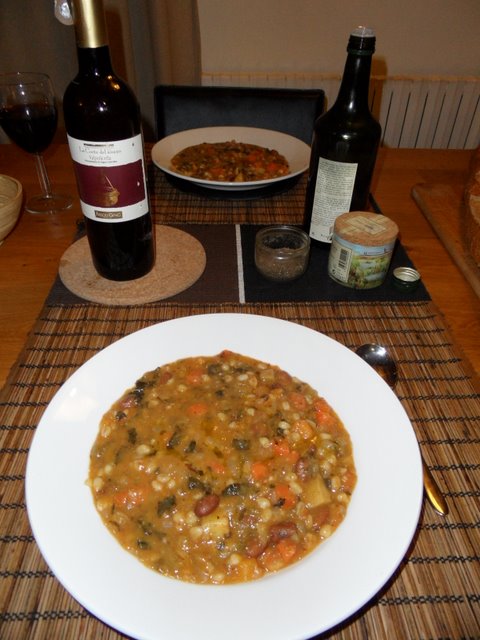
Once upon a time, we had a habit of spending a weekend somewhere in Tuscany at about this point in the year: to wander, to drink coffee, maybe to do a gallery or two ... and to eat. Well, okay, mostly to eat. But hey, come on, it was work: a lot of the inspiration for what I cooked at the resto came from Tuscany, and by that point in the year I was in need of a top up. Tiresome, huh?

The Tuscans are not called mangiafagioli (beaneaters) for nothing: beans play a huge part in the local cuisine. And they're sooooo good too: in the days when you could actually carry more than a spare pair of knickers on Ryanair we used to bring back kilos of them (beans, not knickers), along with several litres of newly pressed oil (if you once saw someone emptying a large suitcase at Stansted airport security and trying to explain convincingly why it was full of bubblewrap and not a lot else ... that was me). Lucca was our very favourite haunt; apart from being just a genuinely lovely little city, its oil and beans are second to none (Awww. I want to go, NOW!). It was in Lucca that I first ate zuppa di frantoiana - literally 'oil mill soup' - at a trattoria called Gigi. November is oil pressing time, and there are dishes featuring the new oil are on every menu. Gigi's zuppa was so good that we ate it twice, in quick succession, then I came home and did my best to recreate it.

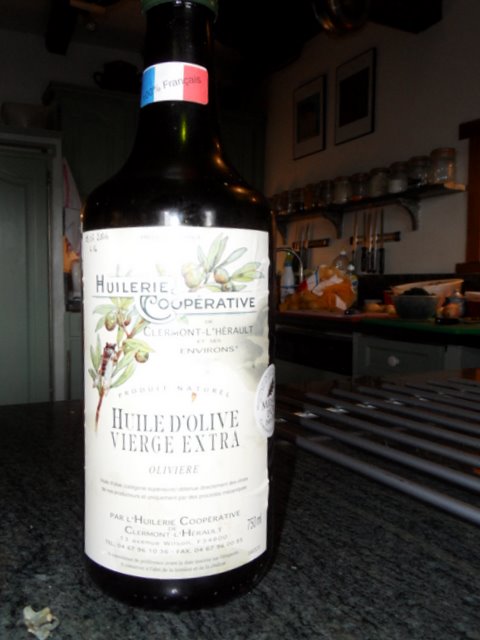
Today being a biting Tuscan-cold type of day seemed like a perfect opportunity to spend a few hours on zuppa duty, especially given that the alternative was yet another hands-and-knees afternoon waxing the newly restored terracotta tiles in the dining room. I couldn't manage the new oil - we buy our 'good' olive oil from the Coop in Clermont l'Herault which produces several varieties, but pressing doesn't take place until December at the earliest - but for the first time (beware - crow alert) I did manage to use a lot of our own vegetables - everything but potatoes, celery and garlic in fact, none of which we grow.

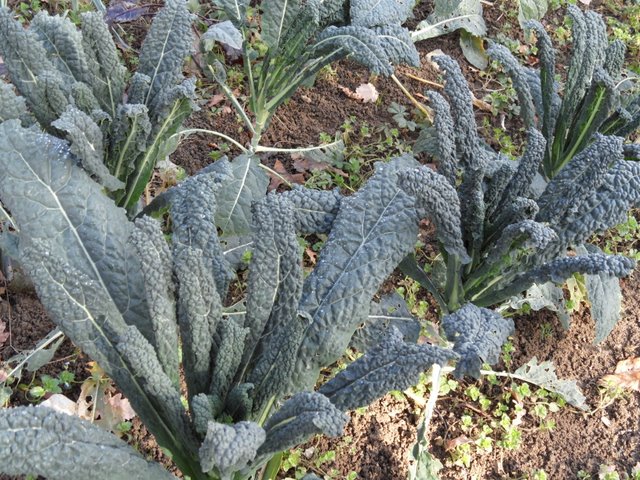
Cavalo nero (black Tuscan kale) growing on the potager


Amazingly, even the tomatoes are ours: we picked them green at the beginning of the month and they're ripening nicely on the windowsill. So, in case you too have a task that you'd like to avoid, here is the (sort of) recipe.

Zuppa de frantoiana

some onions and/or leeks, diced
some green celery, including the leaves, finely chopped
some carrots, chopped into smallish pieces
a few potatoes, ditto
some garlic, minced
some fresh herbs - rosemary, thyme, parsley, basil, that sort of thing - chopped
a couple of peperoncini or small dried red chili peppers, crushed
some cavalo nero (black Tuscan kale) or Savoy cabbage, shredded
some butternut squash or pumpkin or potimarron, peeled and chopped into small-to-medium pieces
a few fresh tomatoes, skinned and chopped
some vegetable stock
some pinto or cannellini beans, cooked
a rind of Parmesan if you have one
some wheat or spelt grains
some good olive oil

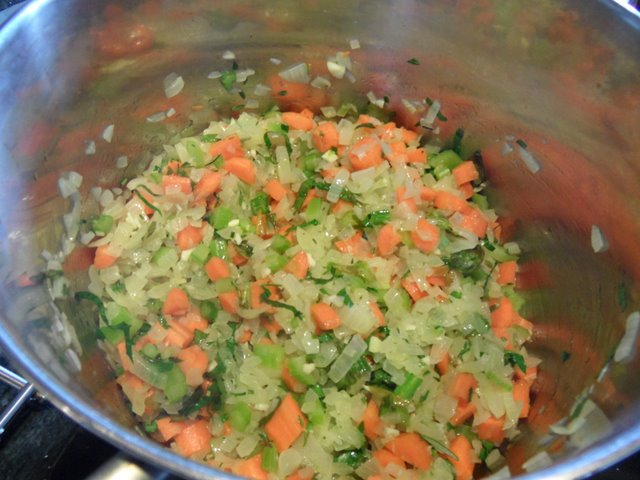
So, this is what I do. In a big pan, warm some olive oil and gently fry the onions for 5 minutes. Add the celery, fry for 5 minutes. Add the carrots, fry for 5 minutes. Add the potatoes, fry for 5 minutes. Add the herbs and peperoncini, fry for 5 minutes. Add the cavalo nero, pumpkin and tomatoes, fry for 5 minutes. I know this seems a bit OTT, but I've found it to be the best way of bringing out the flavour of each ingredient - if you add them all to the pan at once it's all a little bit more indistinct and subdued.


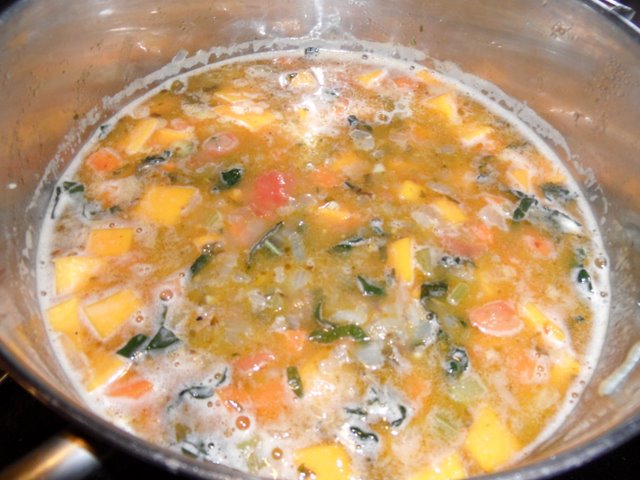
Purée half the beans either with some of their cooking water, or with some vegetable stock, and add them to the pan, with the Parmesan rind too if you have it. Add more vegetable stock to just cover the vegetables, then simmer over the lowest possible heat for an hour.


Add the wheat and simmer for another half an hour. At that point, add the rest of the beans and simmer for another 20 minutes or so. Stir in some olive oil and let the whole thing stand for a couple of hours. Reheat gently - it should now be nicely thick - check the seasoning, ladle into bowls and serve with a glug of good olive oil poured over each one.


Make at least twice as much as you can eat, because it'll be even better tomorrow ....

Sunday, 19 September 2010

On Sod and his law, and tomato gluts

Wouldn't you just know it? After yesterday's weather rant, today the sun shone in a cloudless sky, unpredicted by Metéo France. I, however, was indoors on glut management duties: Something Had To Be Done with the five kilos of tomatoes that had been sitting in their bowls looking accusing for several days. These are Agora tomatoes, from just two plants; I reckon we've eaten a good three kilos already, and there's still, assuming the blight doesn't get them, a good three kilos to ripen: that makes around 11 kilos of fruit from two 60 centime plantlets. Bargain. This is (and I'm frantically touching every wooden object I can find while crossing all my fingers and toes - not an elegant sight) the first year we've not had late blight; we've harvested well from our two cherry tomato plants too, though quite not so well, sadly, from the Cornue des Andes that were so productive last year.

And so I have quite literally been slaving over a hot stove. First I made a large batch of tomato sauce. Everyone has their own recipe for tomato sauce: this is mine.

Rich tomato sauce

3 kilos of ripe tomatoes, chopped
6 large onions, chopped
4 cloves of garlic
a rind of Parmesan (the hard bit that usually gets thrown away. Or in our case given to the dog)
a medium size tin of tomato purée
red wine
balsamic vinegar
one red chili pepper, deseeded and chopped finely
a handful of fresh herbs - I used rosemary, thyme, marjoram and basil, finely chopped or ripped

Fry the onions slowly in some olive oil, over a medium to low heat, until they're translucent (don't let them colour). When they're there, add the garlic and continue cooking for another 4 to 5 minutes. Add the tomatoes, and stir them around, then let them break down slightly in the warm oil. When they're starting to release their juices, stir in the tomato purée, a couple of tablespoons of balsamic vinegar, the chili pepper and the herbs; add the Parmesan rind, bring the pan to a fast simmer and then add a slug of red wine - half a good glass at least. Keep up the fast simmer for 30 seconds or so to 'cook' the wine, then turn the heat down so that the pan is simmering much more slowly.

And then wait. The sauce needs to reduce to about half its starting volume, by which time it will be thick and intensely flavoured: this can take up to three hours, or even more, depending on the tomatoes. Stir occasionally, and as the mixture gets thicker stir more often and keep a wary eye on it - it can catch, and there'll be tears and tantrums (or maybe that's just me. You're probably much more controlled).

When it's ready, season the sauce to your taste. Then you can do any number of things with it: it's obviously a great pasta sauce in its own right, and because it's thick and rich it makes a good sauce to use for pizza too, or just to serve with meat or fish, or to bake crêpes in. Or we'll often add things to it: black olives and capers and maybe a few anchovy fillets, or bacon, or chorizo, or more chili peppers, or ... If you're more refined than I am you can put the whole lot through a mouli (sieve) to make passata (or indeed you might have skinned the tomatoes first. I don't. Life's too short). Then eat/freeze/bottle/whatever.

While the sauce was reducing, I  made some chili-tomato jam, one of my all-time favourite relishes.

Tomato-chili jam

2 kilos of tomatoes, chopped
6 hot red chili peppers - I use Cayenne - deseeded and finely chopped
12 cloves of garlic, chopped
a large piece - 8 cm or so - of root ginger, peeled and finely chopped
1 kilo demarara sugar
250ml red wine vinegar
4 tablespoons balsamic vinegar

Blend (as in - in a blender or food processor ...) half the tomatoes with the chili, ginger and garlic and put the resulting purée into a large pan with the rest of the tomatoes and all the other ingredients. Bring to the boil, reduce to a simmer and cook until the mixture is reduced to half its volume - anything between an hour and three hours. Stir regularly, and as it gets more jam like, hover over it like a hawk. Burnt chili jam is not nice. And after a while check to see whether you've got the balance of sweet and sour to your liking - if not, adjust it as needed.

When you think it might be ready, spoon out a little onto a cold plate, as you would for a regular jam; you should be able to draw the tip of a knife through it without leaving a wet vinegar-y liquid behind. Then ladle into hot, sterilised jars. Great with - well, almost anything, really. Make more than you (think you) want, because trust me, it's addictive.

Glut management continues this week, in between staircase varnishing and balustrade painting (yuk), with figs and crab apples and quinces. That means - and who needs Metéo France? - that it will without a doubt be warm and sunny. You read it here first.

Sunday, 25 July 2010

Life after sawdust, and a taste of garlic

No matter how awful you think sanding a huge floor and a half is going to be, it's always ... worse. Given that John only has to look at a sanding machine for gouges the size of a ditch to appear miraculously in the wood, his contribution was limited to collecting the machine from the hire shop, and following me around holding its power cable. It was, of course, Muggins here who had to spend a twelve-and-a-half hour day wrestling with the thing, followed by the same the next day on my hands and knees, sanding all (51 metres worth ... groan) the edges.

I'll spare you more pictures of me in tellytubby overalls and the orange Etap headgear thingie I picked up from the Tour de France caravane; suffice it to say that three days and seventeen showers later the job's finished, with 'just' the more artistic bits - as in at least seven days on my hands and knees - to come. Fortunately the weather shone on us, so to speak: after the recent long and very hot spell, it proceeded to absolutely p*%! down, without break or let up (but with thunder, lightning and the usual array of power cuts), for 48 hours, during which time it was so dark that you could be forgiven for thinking that the sun had migrated to warmer climes.

Even floor-sanding tellytubbies have to eat, though, and when you've got sawdust in every orifice the need for feelgood food that will cut through all the crap becomes paramount. And so there was nothing for it but an ag and og.

Ag and og (or spaghetti aglio e olio, to be more precise) is so much a part of me that I've just had to rack my brains to think how I first came upon it or to remember when it wasn't a part of my life. In fact, I was introduced to it by an ex-partner-turned-friend, who arrived in our relationship with a little cook book, now sadly I think out of print, called something like Lotsa Pasta and Oodles of Noodles (yes, honestly) which contained a great, if rather garlickly-challenged, ag and og. Then I went to Italy, and there was The Proper Thing, from which is derived our current version. Ag and og is the ultimate convenience food, designed for those times when you really want something with a bit of oomph and pzazz but don't know what it is. When you don't want to feel clogged with cholesterol. When you're too knackered, or just can't be bothered, to fiddle around with lots of preparation or lots of ingredients. It does it for me, always and without fail. Here it is:

For two people:

6 to 8 big, fat, juicy cloves of garlic
a decent glug - half a small cup - of really good extra virgin olive oil
2 servings of pasta of your choice - long and thin works better than short and round, and anything with egg in it is a no-no

Peel the garlic cloves and cut them in half if they're really large, removing any green shoot-y bits from the centre. Put them with the oil into a saucepan and warm gently. Now, how you do this bit is really the key to the whole dish: you don't want to fry them - what you're doing is letting the warmth of the oil draw the flavour from, and at the same time gently soften, the garlic. If you go at it like a bull in a china shop you'll end up with brown, bitter, horrible garlic and it'll end in tears, you mark my words. Reckon on it taking 20 to 25 minutes at the lowest or next-to lowest hob setting. As the cloves soften you can break them up a bit in the pan with a wooden spoon; they should end up slightly golden, lightly caramelised, meltingly soft and highly aromatic (sorry to drool, but it really is that good ...). Cook the pasta, toss it in the oil and garlic, add a tablespoon of dried crushed chilli pepper, season, and serve, sprinkled with a little parsley, and with good bread for serious mopping. And wear an apron.

Oh, and for another taste of garlic, you might like to have a look at Keith Eckstein's impressive 'blog on blogs' that someone has just pointed me to. Keith has set himself the task not just of listing, but also reviewing blogs about living in France. As it happens, he's just reviewed this one. And I like his style: he really makes an effort to get underneath each blog (and blogger) and find out what makes it tick. And even if he does seem to have an obsession with 2CV driving, lingerie wearing nuns, he knows how to use apostrophes.

Sunday, 15 November 2009

The best laid plans ...

This afternoon was marked up for a Serious Start on the first wash of L'Atelier's walls. With pigment, that is - yellow ochre from Provence, and sienna earth from Italy, if you're interested - not with St Marc, the ubiquitous lessive that cleans everything (except plaster dust, of course) and has been a constant feature of my life over the last two weeks as we've attempted to clean up the chantier. That, however, was before John came in with 3 kilos of Rosé-des-Prés (a kind of posh field mushroom).

Now there's only so much fungus that two people can eat at any one time. Especially when they've just been munching their way through the two and a half kilos he brought home three days ago - but, hey, downshifting is downshifting, and foraging is ... fun, and free food. So while we've set aside some to cook for dinner this week, there was nothing for it but to set to and look at how to preserve the rest.

Bottling, I decided, was out. Too complicated, and seems to involve boiling oil. Hmm. Drying? Well, one of the many projects on my list is to make a drying cabinet, but that will have to wait (to use a phrase that seems to form an increasing part of my vocabulary) until all this is over and life is back to normal again ... Some of the smaller mushrooms I flash fried in olive oil with a little garlic and parsley then froze; the rest I decided to turn into a duxelle.

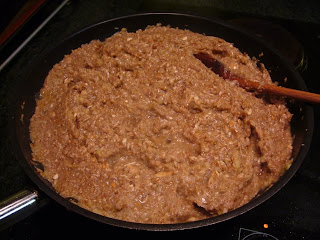
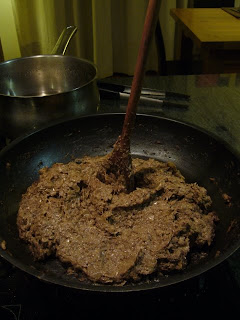
A duxelle is a glorious thing: while the volume reduces, the flavour and intensity increases. If you've never tried it, do - it's very simple, even if it does tie you to the stove for a while. You simply chop finely, mince or - if, like me, life's too short - pulse in the Magimix a good quantity of mushrooms and around a fifth of their weight of onions; fry the onions first in olive oil until they're transparent and start to take on a little colour; then add the mushrooms and stir it all around. At this point you find you have a pan full of wet, unappetising mush, which looks like this:


What you're aiming to do now is to gently simmer out all the liquid until the mixture starts to 'fry'. This will take - er - over two hours if the mushrooms are very fresh (well, I never said it would be fast, did I?). As time goes on, you need to stir the pan more and more often to stop the mixture sticking and burning; you're aiming to reduce the volume usually by around two thirds. Eventually you'll end up with a sort of pâté thick enough for a wooden spoon to stand up in; now season it, and you're done.


So then what? Use it for stuffing; add it to soups and stews (especially good with Puy lentils); add some chopped parsley, garlic and pangritata, then spread it on bruschetta; make beef Wellington; spread it over the pastry base of a mushroom tart before adding the rest of the filling; drape it around pasta; use it as a relish ...

We haven't, so far, done very well at finding any of the big names such as cepes or chanterelles or morilles or girolles nor sadly (and I say this at the risk of tarnishing my already somewhat ropey reputation) the more - er - magical varieties. But that's because we've not had the time to go out looking for them beyond our own back yard, so to speak. When all this is over ...

Monday, 7 September 2009

Glut gluttony

So, the rentrée has rentréed, The Perfectionist and Pink Van Man (aka the builders) are back, the sun still shines, and we're still barrowing loads of hardcore around the garden. (Was there ever a time when I didn't? Will there ever be one? Sigh). We're in the process of creating what we intended to be a car parking area. Note the past tense there, because once we'd cleared it of the inevitable toot and rubbish and old tree roots and nettles and rocks and half a metre thickness of moss and ivy, we suddenly saw it with new eyes: a lovely leafy, shady space with an equally lovely view south towards Col de la Crouzette. Much too good for a car park, methinks. So in a rare display of swift non-Libran decisiveness, I've converted it into a 'zone Zen'. More about that in due course - watch this space, as they say. Or rather, that one.

And in spite of - or maybe because of - the long, hot and dry summer we've been having here, our garden continues to throw food at us: glutting courgettes (yes, still) have been joined by aubergines and tomatoes and peppers and potimarron. The potimarron have been put to bed tucked up in straw, ready to feed us through the winter, while I exhaust every crevice of my creative brain (or at least what's left of it after yet another day shi - er, hardcore shovelling) to come up with Interesting Things To Do with all the rest.

Two stars of the dinner show have emerged this summer. We've enjoyed them both so much that we've eaten them again and again, and so thought you might like them too. Here they are.


A courgette soup ...

Actually, it's not really a soup - more like a lightweight broth, in the Italian style, which means that with some good bread it's good enough to eat for dinner and not as an entrée. For two people, you'll need:

Two or three new potatoes, in small cubes; 500 grams or so of courgette, ditto; a biggish onion, finely chopped; 2 cloves of garlic and a couple of sprigs of thyme, ditto; half a glass of white wine; 300ml vegetable stock; 200ml milk; and - erm - 4 pieces of La Vache qui Rit (Laughing Cow) cheese (I know, I know, but humour me here).

Fry the onion in butter until it's soft, then add the garlic, potato, thyme and a bit of black pepper and cook very gently, with the lid on, for a good 15 minutes or so. This is what the Italians call the soffrito stage: often skipped or skimped, it's what really draws the flavour out of the base ingredients, so don't rush it. Then add the wine, bring to the boil, reduce the heat again and cook for another 5 minutes. Add the stock and the courgette, bring to the boil, then reduce the heat and simmer for around 15 minutes. Add the milk, then the cheese, stirring until it melts. Season. Don't ask how I came to have a few bits of Vache qui Rit lurking at the back of the fridge, but trust me: there's something about the lactic flavour of the cheese in this soup which is so seriously addictive that I unfailingly eat more of it than is good for me ....


... and an aubergine tart

This, for me, is pure, unadulterated summer comfort food; it contains just about every one of my to-die-for summer ingredients - olives, aubergines, tomatoes, anchovies, basil, mozzarella. And it's easy enough to put together after a hot day's shovelling. To make four good portions you'll need:

A ready-rolled flaky pastry case; 2 very fresh aubergines; 2 large tomatoes, a tablespoon of tapenade, some shavings of gruyère, a ball of mozzarella; and a dozen anchovies in oil. I'm addicted to Collioure anchovies, which are my summer treat, but anything that comes in a jar will be fine.

Cut the aubergines down their length into half-centimetre thick slices. You can, if you feel inclined and have the time, do the salting-and-rinsing thing, but to be honest I usually don't, because I haven't, and I'm not convinced it would make a blind bit of difference. Then fry them until they're golden on both sides. I suppose you could grill them if you have a thing about frying, but nice though grilled aubergines might be, they never acquire that lovely silky texture that a really good fried aubergine has and which for me is the essence of this tart. So I fry them in a mixture of olive and rape seed oil, which is the best combination I've come up with after years of experimenting (during most of which I pooh-poohed rape seed oil. Wrong).

Then simply put the tart together: lay out the pastry in a large metal flan tin - I use the type with the removable bottom, prick the base lightly, then spread the tapenade over it. Cut the aubergine slices in half across the (short) middle, and lay out half of them in circles. Slice the tomatoes thinly and lay half of them over the aubergines. Throw on some shaved gruyère and some torn up basil leaves. Then repeat the whole thing so you have another, identical, layer. Lay out the anchovies in a clock formation, then cover the whole thing with slices of the mozzarella. Bake at 220 degrees Celsius (200 degrees in a fan oven) for around 25 minutes, until the mozzarella is golden.
Here it is before ...


and after ...


And that, gentle reader, was my 100th post on Blogger! Thank you to all of you for your presence, your support, your comments, your emails, your humour. None of which I expected when I set out eighteen months ago just to write for the sheer pleasure of writing, whether anyone read it or not. So here's raising a glass of Minervois with you all to the next 100 ...

Friday, 31 July 2009

Why did the imam faint?

Once upon a time, an imam married the beautiful daughter of an olive oil merchant, whose dowry contained twelve jugs of the best, richest olive oil. She had a talent for cooking, and prepared many special dishes for her new husband. One night, she cooked a special dish of aubergines cooked in olive oil, and the imam enjoyed it so much that he asked her to cook it every night. For twelve days they feasted on the dish, but on the thirteenth night it didn't appear on the table. "Wife!" said the imam. "Where is the dish you usually cook for me?" "I couldn't make it tonight," said his wife, "because we ran out of olive oil. The imam fainted.

It's a great story, and like all great stories has endless variations. In one, the imam fainted with pleasure when he tasted the dish; in another, he fainted when he realised how costly it was in olive oil. According to a fascinating conversation I came across on LanguageHat, this last would fit with a popular stereotype of village imams, who are often seen as stingy killjoys, as in this wonderful Turkish expression: "You won't get food out of an imam's house, nor tears out of a corpse's eyes".

My own inclination though, having tasted various versions of this dish, is that he did indeed swoon with pleasure. There's a word for it in French, too: se pâmer, which according to Le Robert Micro means 'to faint right away; to be almost paralysed by a strong emotion or sensation'. Hmm. Shall have to find a suitable occasion to try that one out ... But anyway, back to aubergines. Ours have been fruiting for two or three weeks now, but yesterday was the first time they had deigned to produce more than two at the same time. So, demands of the pickaxe notwithstanding, it was time to make the imam faint.

For me, Turkey is right up there as one of the most enticing cuisines in the world, along with Italy and South India. What they all have in common is the ability to draw big flavour from the simplest of ingredients, together with a respect for vegetables as diva in their own right, not just as part of the chorus (are you listening here, France?). One of the most used (and oiliest) cook books on my shelves is Classic Turkish Cooking, by Ghillie Bhasan, who is the only person I know with the ability to make me yearn to eat bulls' testicles. But although she does have an Imam Bayeldi recipe, it's not, exactly, the one I use. I spent years on a quest to replicate the version I ate at a small restaurant in Akyaka, where if you're lucky it will turn up on the counter (no menu here) as one of mamma's specials. This is as close as I can get without actually wearing the headscarf. Here it is: Slow Food in action.


Imam Bayeldi

4 very fresh aubergines, cut in half lengthways
3 large onions, quartered and thinly sliced
8 cloves of garlic, finely chopped
three dessertspoons demerara sugar
5 large tomatoes, chopped
2 tablespoons dried currants
a teaspoon of allspice
sea salt
juice of a lemon
rather a lot of olive oil

This makes enough for four people, or two people for two days. It's really not worth doing less, as it's, frankly, a bit of a faff (but worth it).

Sprinkle the cut side of the aubergine with salt and set aside for half an hour or so to extract any bitter juices. Rinse and dry, make three horizontal cuts in the flesh (don't go through the skin), then drizzle very generously with olive oil and bake in a ceramic baking dish at about 180 degrees Celsius for half an hour.

Meanwhile, prepare the stuffing: fry the onions and garlic in a decent amount of oil, slowly, until they're completely transparent. Add the currants, allspice and a dessertspoon of the sugar and continue to fry until they are just starting to caramelise slightly. At this point, add the tomatoes and another dessertspoon of the sugar, turn the heat up a bit and cook for 10 minutes until all the juices have been released - it should all look a bit soup like at this point. Sprinkle the mixture with a good half teaspoon of salt, and simmer until most of the liquid has evaporated - around 40 minutes, maybe longer depending on the tomatoes, but keep an eye on it - it can burn. It should now look dark and rich. Attempt to avoid eating it all; instead, spoon it onto the aubergines, stuffing as much as you can down into the slits.

Pour over half a cup of water mixed with more olive oil (see?) and the remaining dessertspoon of sugar, cover the dish with foil, then bake for two hours at around 170 degrees Celsius, basting every half an hour or so with the liquid. Remove the foil for the last half hour or so of cooking. Squeeze some lemon juice over it and then let it cool for at least half an hour before eating it (I know, I know, but it is possible, honestly ...). Actually, it's even better the next day ...


This version would be found more often in eastern Turkey; in the Mediterranean west it would more often be cooked with a mixture of herbs (parsley, basil and dill) instead of the currants and allspice. We ate ours last night with some fried halloumi, courtesy of - wait for it - Lidl in Saint Girons, which also keeps us well supplied with 2 year old Parmesan, prosciutto, feta, stuffed vine leaves, marinated anchovies and all sorts of other odd delights, and a salad of courgette (what else!), mint and our first yellow cherry tomatoes. I'm still standing, but only just.

Wednesday, 3 September 2008

We have aubergines ...

... and yes, there is a goddess. After the tomato tragedy, it's just brilliant to be able to pick our first aubergines; I tried to grow them once in north Norfolk - the plants grew leaves well enough, but when they realised I wanted fruit as well they just laughed at me, and promptly died.


Actually, I have a bit of a love hate relationship with aubergines. When they're well cooked, they're sublime - the very best aubergine dish I ever ate was in Akyaka in south-west Turkey, in a restaurant called The Golden Roof. It was so simple - a version of Imam Bayeldi - but the dish was so full of flavour and melted so gloriously in your mouth that it was quite impossible to eat it with your eyes open. In fact I can quite see why the imam fainted. On the other hand, there can be little more disgusting than an improperly cooked aubergine. I have a friend whose aubergine dishes - in particular her baked aubergine - fill me with dread and an impending sense of doom as they appear onto the table and I realise that once again I'm going to have to munch my way through something that manages to be both slimy and crunchy at the same time. (I suspect that if the imam were eating with us he'd faint again, though this time for wholly other reasons ...).

Anyway, when I've had my fill of grilling my very own aubergines on the plancha, it'll be this aubergine ragù that I'll be making next. In one form or another it was always one of the most popular dishes at our restaurant, converting many an aubergine-sceptic in the process (it's amazing what a no-choice menu can do). Here it is:

Aubergine ragù

For every two people you'll need:

one medium sized aubergine
one onion and 2 cloves of garlic, chopped
a few springs of thyme
a couple of teaspoons each of cumin and fennel seeds
a couple of teaspoons of ground coriander seeds
3 or 4 peperoncini (small red chillies), finely chopped or ground, or better still, some Turkish pepper flakes if you can get hold of them
5 or 6 fresh tomatoes, chopped small (or a tin of chopped tomatoes)
2 teaspoons of tomato purée - sun-dried tomato purée is especially good
a large glass of decent red wine (and another one to drink while you cook!)
a pinch of saffron threads

This is a really easy thing to cook and is invariably delicious, with one proviso - that you don't rush it. You want to extract maximum flavour from every single ingredient, so s-l-o-w is the word. Really push those onions; wait till those aubergines are golden; let the sauce reduce properly. No corner cutting.

Grind the saffron threads in a pestle and mortar and add a little warm water; it will infuse while you prep the rest. Chop the aubergine into smallish dice, coat it in olive oil, then either roast it in a medium hot oven until it's golden (about 15 minutes), or pan fry it. Aubergine soaks up oil like nobody's business, but don't be tempted to keep on adding more - after a little while it will give it all back up again and all will be well. Meanwhile cook the onions, with the thyme leaves, for ten minutes or so in a little olive oil, add the garlic and cook for two or three minutes then turn up the heat and add the spices (not the saffron) and cook for yet another couple of minutes. Add the tomatoes, red wine and tomato purée, boil for a minute or so to burn off the alcohol then let the sauce simmer for an hour, slowly, until it's thickened and reduced by two thirds. Add the aubergine and cook gently for another twenty minutes or more to blend the flavours. Finally, add the saffron infusion and cook for just another two minutes.

The result is an intriguing, Moorish-ish, Turkish-ish blend of eastern and western flavours, though if you don't fancy that you can vary the seasonings however you like. I especially like this with farinata, a divine Ligurian flatbread made with chick pea flour and water and baked at a scarily high temperature; you could serve it with pasta, or rice, or just about anything. And it keeps incredibly well - in fact it's better the next day, and even better the day after that.

Serve it to your right-on veggie friends and they'll kiss your feet. Serve it to dyed in-the-wool carnivores and they won't turn a hair (but for heaven's sake don't tell them their dinner was vegan ...).

Saturday, 14 June 2008

On thirteen moons, and chutney

There's something distinctly wrong with the weather today. It hasn't rained.


Ariège, like much of south-western France, has had some pretty spectacular storms this week. The track leading to Grillou and our neighbours' house is all but washed away, the ground is un-standable-on, the electricity's been off more times than I've had hot dinners, the broad beans are horizontal, and the sheer force of the almost continuous rain has been so intense that it's even come through the roof more than once. In fact I was feeling pretty sorry for myself until I discovered yesterday that a friend's house had been quite seriously flooded during Wednesday evening's epic performance. Now I'm just tired of it, and want the sun to come out. Someone told me that it's all because this year has 13 moons; I've just looked it up - 2008 does indeed have 13 new moons, but only 12 full moons. Does that make a difference, I wonder? My 'gardening by the moon' book (yes, I do, and yes, it does. Work, that is) tells me that the weather often changes around 3 days after either a full or a new moon, which means it could change around the solstice. Watch this space for more revelations from the cutting edge of science ...

Anyway, while chaos was reigning around me, I amused myself making some cherry chutney. No, I've never made it before, and no, I didn't use a recipe, but the wonderful thing about chutney is that you can wing it - unlike jam, which demands perfection and tends to throw its dummy on the floor at the slightest provocation. And very well it turned out, too. So here's (roughly) what I did:

Spiced cherry chutney


1 1/2 kilos of cherries, stoned and cut in half
2 large onions, chopped
1 tart apple
250g sultanas
200g raw cane sugar
150 ml red wine vinegar
150ml balsamic vinegar
2 sticks of cinnamon
4 peperoncini (small Italian dried red peppers)
1 1/2 teaspoons Szechuan pepper
1/2 teaspoon black cardamom seeds
6 whole cloves
1 teaspoon grated nutmeg
1 teaspoon curry powder
1 teaspoon salt
12 leaves fresh mint, chopped

Grind the whole spices (not the cinnamon) together with the salt. Then tip all the ingredients into a big pan - a jam pan is perfect - and bring the mixture up to the boil. Check the flavour - balance of sweet-sour-hot, balance of spices - and adjust to your taste. Then boil the mixture for an hour covered, plus another 45 minutes uncovered. It wants to have a good bit of vigour but not too much - neither gentle simmer nor raging torrent, but somewhere in between.

Towards the end of the cooking time, sterilise some jars by putting them in the oven at around 150 degrees C for 20 minutes. The chutney is ready when it's thick and glossy, with not too much liquid left - if it looks a bit thin, give it a bit more heat for a few minutes to reduce it. When it's stopped bubbling, spoon it into the hot jars. Put the jar lids into a bowl and cover them with boiling water to sterilise, dry them with a paper towel then screw them on. You'll have about 4 or 5 smallish jars.

The idea now is that you leave your chutney well alone for at least 3 months - purists would say 6 - to give it time to mature. But you won't.

Friday, 25 April 2008

The grilloux are back!

At last the weather has returned to being 'vraiment tee-shirt', as the normally dour forecaster on Radio France Inter described it this morning. It's been unseasonably cold and rainy since Easter - or at least it feels as though it has. Why the sudden change? Nothing whatsoever to do with the anti-cyclone over the Atlantic. No, it's quite clearly because we've finally got round to buying and setting up our water recuperators. Voilà.

So yesterday evening we had dinner outside, for the first time this year. I'm a creature of the outside at heart - I'm sure I was never meant to live inside four walls - and the weather over most of this winter and early spring has meant that we've managed to have breakfast and/or coffee and/or lunch in the garden probably two days out of three. But dinner ... well, that's a seasonal milestone. We ate to a bright red sunset over the mountains, followed by the twilight chorus of the birds; the stars came out, the frogs croaked, and then the grilloux started chirping. And we ate one of my favourite things:


Roast aubergine and chick pea tagine


Actually this is a slightly simpler version of a dish I used to cook for the restaurant. Its flavour, though, belies its simplicity. For 4 people you need:

3 aubergines, diced into 2cm squares
2 red peppers, ditto
3 onions and 3 cloves of garlic, chopped
half a lemon, diced into tiny cubes
a handful of dried apricots, chopped
2 tablespoons of (each) coriander seed, cumin seed, fennel seed
a tablespoon of black peppercorns
one stick of cinnamon
half a teaspoon of black cardamom seeds
2 whole star anise
about a tablespoon of (each) ground ginger and sweet paprika
about a teaspoon of (each) harissa (or cayenne pepper) and turmeric
a tin of diced tomatoes
2 tablespoons of tamarind paste
a large tin (600gm) of chickpeas, or soak and cook your own if you've got time (I didn't).

Roast the aubergine and peppers at around 190C for 45 minutes, until they're slightly charred - this is what really brings out the flavour. Meanwhile grind the whole spices; if you've time to dry roast them first, even better. Add the ground spices, plus a teaspoon of sea salt, to make an aromatic mixture. Fry off the onions and garlic, then add the spice mix and fry for a minute. Add the lemon and the dried apricots and fry for another two or three minutes, then add the tin of tomatoes, bring to a simmer, then add the tamarind paste and the chickpeas. Add some water (about as much as you can get into the empty tomato tin) and cook for ten minutes or so, by which time the roast veg should be ready. Add these to the pan and simmer everything together very gently for at least half an hour to blend the flavours.

We ate this last night just with some simple buttered couscous, a dish of harissa and some preserved lemon (I would have added some fresh coriander, but ours is refusing to grow for some reason). But a couple of chargrilled merguez or lamb steaks would really set it off ...