Showing posts with label birds. Show all posts

Monday, 26 November 2012

Grillou crosses the Pyrenees (1)

There's not much - almost nothing, in fact - that I miss from north Norfolk, but apart from the wonderful hot and buttery toasted teacakes at The Owl in Holt (sigh), I do miss the birds and the big skies of the marshes. Grillou is brilliant for birds - we have to keep remembering, for example, not to take for granted the fact that we have red and black kites flying over the garden pretty much every day - but there's something about wetland birds that reaches the twitcher in me that other birds just can't reach.

And so it was that I unanimously decided that we'd spend our holidays this year near the Ebro Delta in Catalonia, one of southern Europe's great wetlands (of course the fact that we'd be within spitting distance from the Priorat wine area may just have swayed the choice a little ...!). We're still getting used to the fact that we can be in Spain in less than an hour and a half, just about twice the time it used to take us to drive to our nearest town of Norwich; at the beginning of November we set off on a leisurely five hour drive through the dramatic scenery of the southern Pyrenean foothills, down onto the Lleida plain, up again into the craggy olive-growing mountains of southern Catalonia and then down to the banks of the Ebro, where we'd rented an apartment for a couple of weeks.


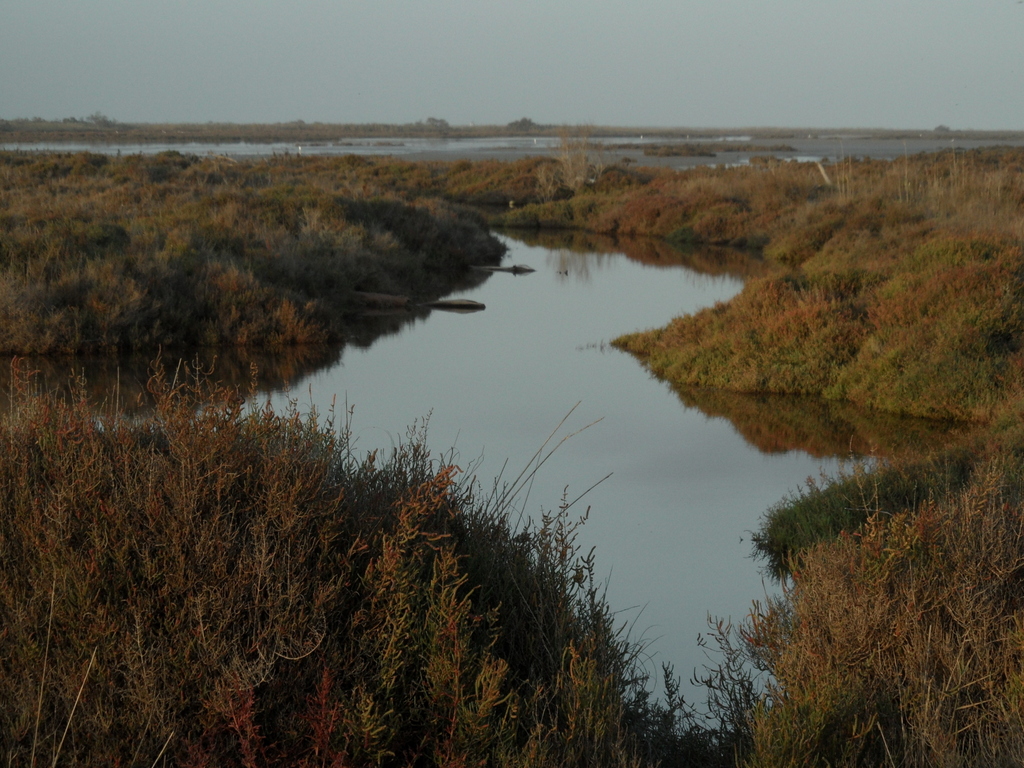
We didn't get teacakes, but we did get big skies and birds, including thousands of flamingoes (now you don't find those in Norfolk :) ) as well as some species that were new to us, like the red crested pochard and black-necked grebe. We also got great walking, clementines straight off the tree, wonderful wines, fabulous scenery, amazing sunsets, and some - um - fairly crappy weather ( if we'd stayed at home we'd have had nigh on wall-to-wall sunshine and 20+ degrees; although we had some good days it was relatively chilly and on occasion positively torrential). It's a great region that combines within a relatively small area three of my favourite things: birds, mountains (albeit little ones) and sea. Oh, and wine :), though I may have mentioned that already. So here and in the next post or three I'll share some photos and a taste of a part of Europe very different from our lovely Ariège.


A misty dawn over the Ebro

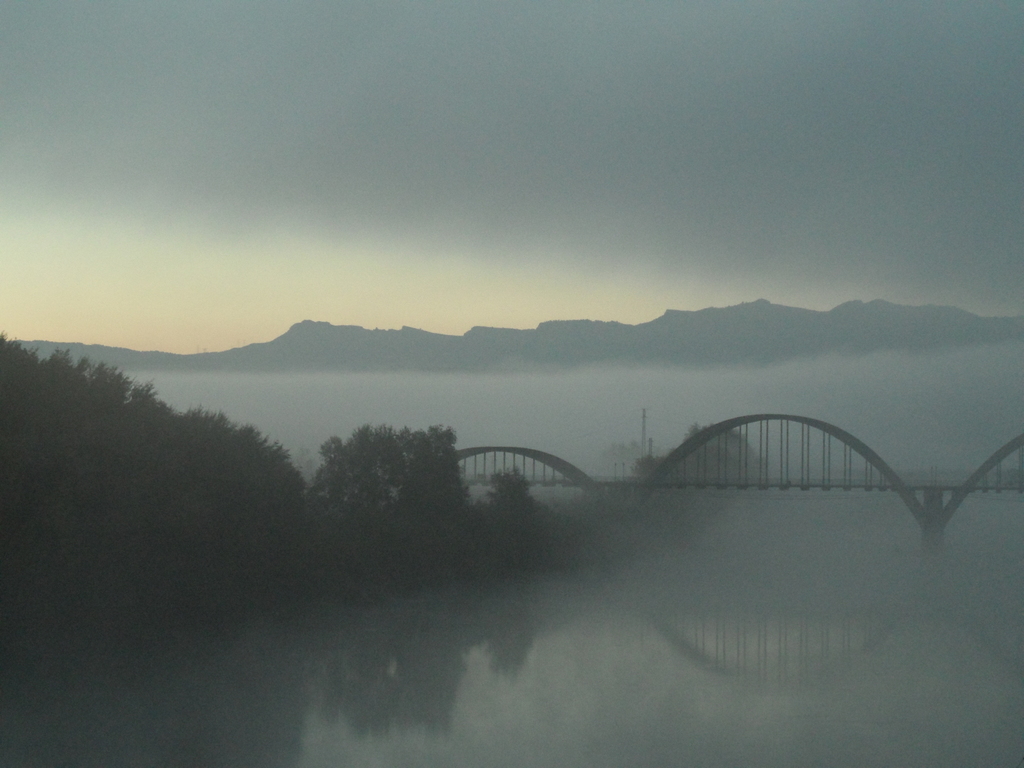
Our apartment was in the town of Mora d'Ebre, in the historic part which runs right along and behind the river. To be honest, the town itself isn't much to write home about, but it's well placed for exploring, the river banks are lovely, and this was the view we woke up to each day: 

From the balcony of our apartment
Bridge over the Ebro in the mist


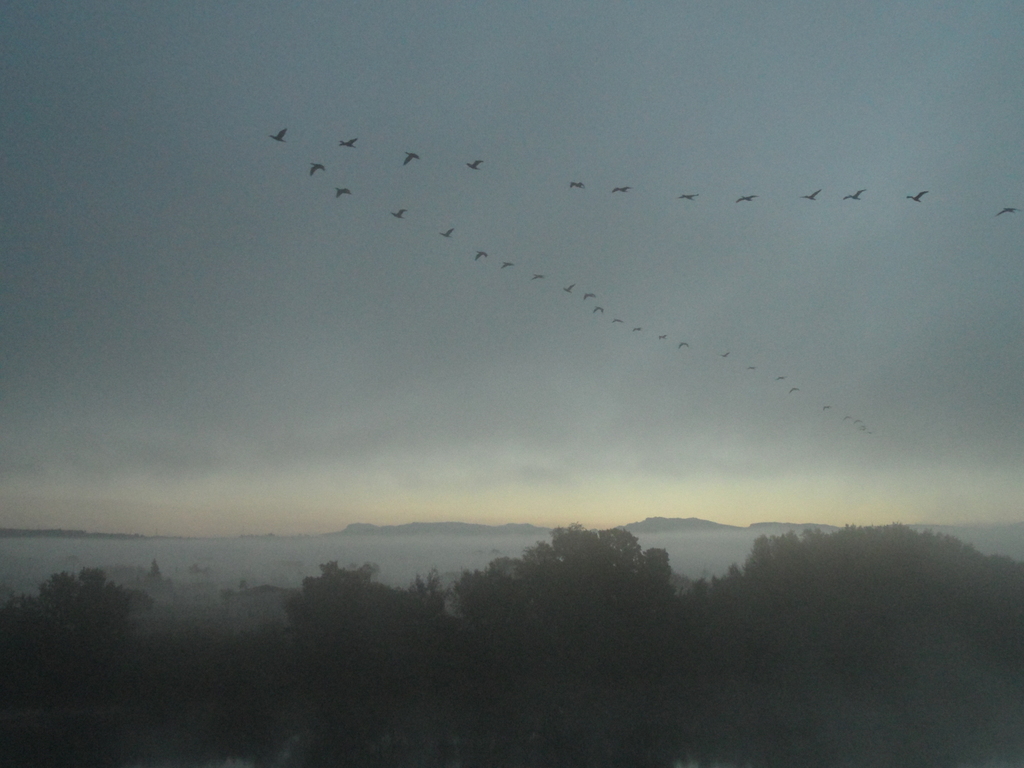
Cormorants on their way up river

Looking up river

First hint of sunrise

Risen!

Tuesday, 28 June 2011

On heat

It's hot. And that's official.

Like the rest of the country, we're in the midst of a heatwave: temperatures have hit 38 degrees in the shade over the last two days. A couple of cooler days forecast for Wednesday and Thursday, and then more hot and sunny weather; this will, we're told, be the pattern for the rest of the summer, with temperatures distinctly higher than average. Good news for the ratatouille bed in the potager which was planted so late: it's already showing signs of catching up.

A treat yesterday, when the sun was blazing down in the middle of the day and the thermometer was showing 52 degrees in the sun: quite by chance I watched our baby black redstart leave the nest. He (or she. Here we go again) fluttered down onto the grass, looked around, and then bowed several times. Redstarts, if you haven't seen them, bow all the time, like robins only more so; I just didn't expect them to start so young. They're also intensely curious birds: an hour or so later I found him sitting in the brico shed calling furiously for food.


You could say that the heat is slightly less good news for us as we continue to clear the rock garden, but hey - what's a bit of sweat when you're having fun? And it does mean that during the hottest part of the day we get to take refuge inside and get on with all the interminable finishing jobs, like framing pictures and hemming curtains and sorting out all the kitchen equipment for L'Atelier. (Never, dear renovator, ever underestimate just how long this stage will take you. Why is it that I could tile an entire shower in the time it takes to frame and hang just one picture? And that's without the arguments about whether there's a speck of dust under the glass or whether it's straight or not). But we are getting there (even if - sigh - the water still isn't connected: plumber has been, plumber has gone, plumber hasn't finished, plumber is coming back. Just don't ask when).

It's been a particularly frustrating couple of weeks in that I've been getting lots of contacts from some really interesting people - mostly readers of this blog, as it happens - who've wanted to come and stay this summer, and because of everything you already know about I'm still having to say no, which frankly is a bit upsetting. Not for the money, though that would indeed be quite nice, but because without exception they've all sounded like people I would enjoy having around, and because I just have a whole big feeling that Grillou is now ripe for people to be here. It's the first time I've felt that as an actuality rather than as a potential, which means I think that something has shifted on an energy level (look away now if you don't believe this stuff) and therefore that we're on course for all to be well.

Monday, 20 June 2011

Nature rules OK

It's that time of year.

Want to cut back the bay tree on the terrace? Can't. Blackbird still nesting in it - her third brood.

Want to clean the gutters? (All right, 'want' might be just a tiny bit of an exaggeration ...) Can't. Blue tit nest in hole just underneath.

Want to put new light up on L'Atelier's terrace? Can't. Black redstart feeding young in nest right next to the door, here:


Readers with a photographic memory (pun unintended) might recognise this niche as one rejected by The Most Persistent Wren On The Planet three years ago (oh my god!!!!! Three years!!!!!!!!!!) ....

Not that we're short of things to do. The gardens are in their Forth Bridge mode at the moment: just keeping the grass and the brush and the weeds down takes around 18 hours a week (a horrified friend recently declared that "nothing, but nothing, would induce your thoroughly unpleasant looking timetable on me. Tower block in Toulouse rather than that"). Not only that, but we've embarked on some mega-clearing of previously long-overgrown areas in the rock garden, discovering in the process some long lost natural rockery beds that were probably last tended by the family we've met who lived here in the fifties.

All in all, between that and the day job, there's not a huge amount of time left just at the moment to spend working indoors, though slowly slowly curtains are being hung, light fittings and pictures are going up, furniture is being waxed and polished and patina'd, and by the end of this week (I have everything crossed here. And I mean everything) we should finally have water connected to our guest accommodation. I have a feeling that the first time one of us takes a shower in either of the new shower rooms an awful lot of wine is going to be drunk to celebrate ....


Our latest visitor to the garden arrived this week in the shape of an arctia villica: a Cream Spot Tiger Moth. I first spied him (her?) on the night of the eclipse, sitting placidly on top of the terrace lights watching all the other moths going bananas as usual. I swear s/he had a superior look in his/her eye ...


The next day, amazingly it (I give up on gender) was sitting on a blade of grass not very far away; it remained unphased even when I clambered round close by in an ungainly fashion to take pictures. 


It even tilted itself at an angle so I could photograph its belly. Now how vain is that?


Pretty though.

Monday, 24 January 2011

Payback time!

Serves me right for gloating about spring-like weather. This morning it was so cold that the water in my wet tile cutter froze right up. As I was using it. Hmm.

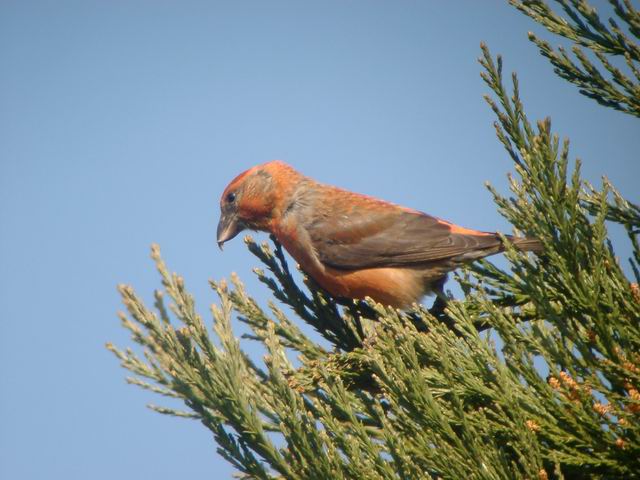
There was a compensation though: drinking coffee in the sun at lunchtime, we watched a flock of a dozen or so Common Crossbills perched on the roof of the porcherie, just five metres or so away from where we were sitting. They stayed for quite some time, chattering and singing and flying up to the nearest fir tree and back. Common they may be called, but it was a first for me. Lovely.


Saturday, 27 November 2010

A tale of two Grilloux ...

8.30am: a world white with hard frost: minus 6 degrees.

12.30pm: lunch on the terrace: 20 degrees in the sun. On the shady side of the house: still zero; central heating still on anti-frost setting.

A blackbird singing, in blissful defiance of the season.

Monday, 22 November 2010

Silver linings

Yesterday was a thoroughly unpleasant day: cold (very cold), wet (very wet) and dark (very dark). There's a wonderful French word, much loved by weather forecasters: maussade. It means dull and dismal; it also means sullen. (Don't you just love the idea of the weather being sullen? Perfect word.) And the fact that I was putting the seven hundredth and fifty-ninth coat of paint on yet another of our panelled glazed doors did nothing to assuage my mood.

But there was a silver lining: cranes. Halfway through the afternoon a strange and loud trumpeting noise drew my attention. Wah! Geese! yelled the ex-Norfolk me to anyone who'd listen, before realising that the only geese you're likely to see in Ariège are on your dinner table. Flocks of hundreds, even thousands, of flying geese - we'd get them over the house almost daily in the wnter - are about the only thing I miss from the Norfolk days, especially the Brents with their growly 'rruckk' call. I racked my paint-befuddled brain and realised that they must be cranes.

And cranes they were. Huge V shapes of them, common cranes (grues cendrées) on their way across the Pyrénées to spend their winter in warmer climes. Ariège is not on the main crane route, which is much farther west, but birding friends here have told me that we can expect to see them every so often. To see a big flock flying over our house was a huge treat. To see a second flock following at dusk was an even bigger one. But to hear, and then glimpse, a third, flying right over the chimney pots at midnight on the night of the full moon, was something unforgettable: in spite of the bitter cold, in spite of the lashing rain, in spite of being half undressed for bed, I ran outside to the track and watched, and listened.

The picture is not, I confess, mine. But this is what I saw:


And today I stumbled upon this video, captured by a local person at St Lizier, just a few kilometres down the road.


An ah -so moment.

Friday, 2 July 2010

Butterflies and other animals

In true capricious 2010 fashion, the weather has this week finally caught up with the fact that it's summer and has been teetering on the brink of a full-blown canicule, with shade temperatures hitting the upper thirties and staying there until well after dark. Maybe not the best for heavy outside work, but pretty nice nevertheless (and there's always a worthy substitute, like lounging around on a sun bed with a book. Oh, all right then - like getting on with the inside work ...). The loveliest thing about it though has been the absolute explosion in the butterfly population that we've seen over the last few days.

Ariège is well known for its butterflies, and living here, up at 500 metres in the woods, we seem to get more than our fair share. To be honest, I wish I was better at identifying them - I know of people who are perfectly well able to point at something 50 metres away and name it as a Small Pink-Spotted One-Legged Maui Dancer Thrice Removed, but I'm not (yet) one of them. Having said that, I've got to know the more common (in Ariège terms, that is) ones over the last couple of years. What follows is a quick-and-dirty list of the ones I've seen flying around Grillou over the last 48 hours, partly so that I can show off my new found skills, but mostly so that (shameless plug number 73/10) you can see just how rich nature is here in our little woodland clearing:

Scarce Swallowtail, Swallowtail, Marbled White, Clouded Yellow, Purple Emperor, Common Blue, Purple Hairstreak, Holly Blue, Brown Argus, Red Admiral, White Admiral, various Ringlets, various Fritillaries, various Skippers, Peacock, Black-Veined White, Small White, Large White, Orange Tip, Brimstone, Cleopatra, Wood White, Small Copper, Common Blue, Chalk Hill Blue, Comma, Small Tortoiseshell, Large Tortoiseshell, various Graylings ... plus various others so far unidentifiable.

This is the Scarce Swallowtail, one of my favourites:


And this: not a butterfly, and not a hummingbird (though it sounds like one) ...


It's a Humming Bird Hawk Moth, with the coolest proboscis on the planet.

And while I'm at it, I can't resist this picture of the only bird I know that speaks its name: the upupa epops (hoopoe). This one has taken up residence just down our track, from where it spends its day yelling 'oop-oop-oop' (or 'poo-poo-poo' as my French bird book would have it) at anyone who'll listen ... and it's hard not to. Just recently it's taken to walking in front of my car as I come home from work, and after we've travelled the requisite 100 metres together it always flies up to the same branch to let me pass ...


Aren't they just ridiculously wonderful?

Sunday, 20 December 2009

The blue tits' hot tub, and other stories

Just to keep the record straight, I guess I may as well add my voice to the thousands of other bloggers who are commenting on the current weather. Yes, it's a little chilly, and we're still surrounded by icy snow. In fact the temperature here hasn't risen above freezing now for a week, with the honourable exception of lunchtime today when the sky turned sapphire blue and the sun came out (though round the corner in the shade it stubbornly stuck at precisely 0 degrees ...). And so, never ones to be outdone by a bit of weather, we ate lunch outside, in it but surrounded by snow. Very nice it was too. I even took my fleece off. That's the south of France for you.

As we ate, we were joined by an exceptionally large contingent of militant blue, great and marsh tits, who were demonstrating in true French style for better food. They already have fat balls, seeds and a cranberry fat cake (!), but they obviously remember last year's cold winter when we took to buying them kilos of cantal jeune. It won't be long before they're tapping at the window again when their supplies have run out ... The best bit though was when we topped up the bird bath with warm water: within a couple of minutes it was literally full of blue tits scudding round enjoying the warmth, then leaping out and rolling in the snow before landing back in the warm water again, chirping with delight all the while. Blue (and other) tits are fascinating and surprisingly clever little things: if you doubt me, try and get hold of a book by Len Howard called Birds as Individuals, written in the 1950s. She - for Len was a woman - literally lived with her birds, many of whom lived and nested inside her Sussex cottage; she knew them all individually and shared their daily lives to the point where she was almost one of them. It's a wonderful book; although I couldn't imagine taking living with birds to the degree that she did (twenty great tits roosting on the curtain rail? Um - perhaps not) we did, when in Norfolk, have a large contingent of blackbirds who all, as individuals, became a part of our family while, in a strange way, we became a part of theirs. They would think nothing of sitting on my desk as I tried to make a phone call, or perching behind me on my garden chair as I ate breakfast, or flying round the house to look for me if there were no sultanas (their favourite food, which we bought by the 3 kilo bag, five at a time ...) on the step, or bringing us their disabled offspring for adoption. I miss them - we have several pairs of blackbirds here, but so far they're all true 'wild' birds and much shyer, although I think I detect a slight increase in fearlessness this year from one of the females (do I? Or is it just wishful thinking?).

When it snows, we're effectively snowed in: our chemin rural, like most such animals here, isn't treated or cleared, and the last bit of it that joins the road to the village entails negotiating a short but sharp drop. Or climb, depending whether you're coming or going . At the end of the drop - or beginning of the climb (yes, I'm on fine form today ...) - which negotiates several bends and a camber, there's a very narrow bridge, a ditch, and a 90 degree turn onto the road. Put all that lot together and you have a formula guaranteed to send even a 4x4 into a tailspin - as it did a couple of days ago when a friend decided to visit. He beat a hasty and not unscathed retreat. If the worst comes to the worst, we can walk to the village and back - a pleasant, if slippery, round stroll of 6 kilometres. But mostly we're just happy to accept our temporary confinement, and wait for the snow and ice to melt or someone to take pity on the occupants of the three houses on the chemin and bring a tractor up here, whichever happens the sooner. It's all part of the ah-so-ness that comes with living somewhere like Grillou - and indeed it's the very thing that we came here to find. And one day perhaps you will, too.

Tuesday, 12 May 2009

Feathery tales

For anyone fascinated by birds (and how can you not be?), early May is a particularly awesome time to be at Grillou. The Main Attraction, of course, is the almost continuous song, from dawn to dusk and beyond: blackbirds, thrushes, robins, blackcaps, various finches and warblers, nightingales, tits, wrens and dunnocks are the prima donnas, whereas the chorus is provided by the cuckoos, woodpeckers, turtle doves and hoopoes, and sporadic acts of drama by buzzards, black and red kites, the occasional eagle and other raptors. At this time of year it's all very in your face, to use that inelegant expression: the wrens have a habit of sneaking up behind you and suddenly bursting into energetic song; every morning, from before dawn, a blackbird sings just a couple of metres from our bedroom; and I opened the bathroom windows yesterday morning to be confronted by a nightingale in full flood in the maple tree less than an arm's length away (he just looked at me, grinned, and carried on as if I wasn't there ...). And so on.


A black kite in motion

I've always enjoyed watching birds - caught it, I think, from my mother, who would sit quite literally for hours watching the tits at the feeders just outside our living room window (much to the incomprehension of my dad who could never understand why she didn't want to be 'doing something'). But I'm not a twitcher. When we lived in Cley next the Sea, on the marshes of the north Norfolk coast, we'd encounter endless twitchers, busy with their bird lists and their special pagers alerting them to sightings and more kit than I'd take on a month's camping holiday. It's all a bit close to trainspotting for my liking, and it certainly doesn't do anything to bring you into relationship with particular birds so that you can find out what makes them tick. Because if I've learned one thing from my years of watching birds, it's that birds - like people, or dogs, or horses - are individuals.

Take, for example, one of our male blackbirds - the one who (now) sings outside the bedroom. Whereas most blackbirds here start to sing properly in early March, this one remained resolutely mute, to the point where we decided that he had a speech impediment. While all the others around him were practising what would become this year's fave phrases, he would sit silently and listen: head tilted, mouth open, looking quizzical, as if to say "how do you do that?" One day we found him under a bush, engaged in a hugely complex subsong - an unstoppable under-the-breath stream of twitters, babbles, hums, calls, and good old blackbird operatics. Several days of subsong ensued. Spring advanced. And then finally, as it was getting dark one evening, I spied him sitting in a branch close to the terrace, looking exactly as I remember feeling when I was eight years old and about to jump off the high diving board for the first time. (He did much better than me. I cowered on the top of that board for five hours ...). Sure enough, a few minutes later, he let rip with a song phrase.


An enlightened master

He did the same the next evening, and the next, graduating from one to several bars. After a week, he was unstoppable: he sang from the same tree and from dawn to dusk, his song incredibly complex and varied, barely stopping to find food. But then things started to change. A week ago, he began singing in what I can only describe as an obsessional way, repeating just the same 2 bar, 8 note phrase in a near continuous loop for 15 hours a day: perfect pitch, perfect timing, perfect rhythm. After a day or two it became tedious. After four or five, it became meditative, like a mantra. It's behaviour that you'll never find in a bird book. I reckon he's a reincarnated enlightened master.

I could also tell you endless stories about a manic depressive wren, or a female chaffinch who taught herself over several days to fly up to and cling on to a long-coveted fat ball, or a cuckoo who sings half the night and has such a loud, resonant call that he must surely come equipped with his own echo chamber, or Turdus Tedious, the Most Boring Thrush in the World. But they'll have to wait. Or better still - shameless plug for our forthcoming guest acommodation - come and stay with us in one of our Birdsong Weeks next May ...

Thursday, 19 March 2009

Spring cleaning

The last couple of weeks have been almost outrageously hot. "Sun bed! Book! Beer! Swim!" demands my still-Anglo-Saxon body. It may learn, one day, that what we used to call a heatwave in England is perfectly normal weather here, and doesn't mean that it's on holiday (though I confess that I did succumb to the sunbed for a couple of hours this afternoon).

I don't know what the spring equivalent of an Indian summer is, but that's what we're having and jolly nice it is too. We haven't seen a cloud for many days, and the clarity of the blue spring light lasts all day and just takes the breath away. The sight of Mont Valier through the trees, still deeply snow covered against the blue sky, is nothing short of awesome. Everything is growing at an unbelievable rate: where a week ago was bare earth, we now have five yellow tulips, perfectly in flower, and the onion plants I planted out last weekend have grown several centimetres. Azaleas are in flower all over the garden. Blossom is ready to burst. The birds are as noisy as on a May morning - save, that is, the blackbird who has chosen our land as his territory, who I'm beginning to think has a speech impediment. Yesterday we heard, and then saw, a Great Spotted Cuckoo fly over the house - a new bird for us both, and a bit of a rarity here. 

Ad we've been spring cleaning. It never ceases to amaze me just how much work it takes to keep Grillou's garden looking natural and semi-wild. There are times when I think it must be easier to have one of those dreadful English style gardens with flat lawn and flower beds, and indeed I occasionally yearn for one - usually after several hours of bramble or ivy-and-moss removal, and admittedly for just three seconds at a time, after which the real me returns. 

Tomorrow, at precisely 12.43 French time, is the Spring Equinox - the day when the sun moves across the celestial equator, rising exactly in the east and setting exactly in the west. It's the true first day of spring; the day when the winter darkness gives way to warmth and new light. Celebrated in almost all traditional cultures, it's yet another seasonal landmark that many of us today have lost touch with. But it's a day to celebrate new growth, new ideas, new enthusiasms, and the beginnings of new projects. 

Me? I'll be on a plane, headed for north-east England; I'm spending a week on an intensive tiling training course, leaving John to carry on the spring cleaning here. I'm a reasonable tiler; being the insufferable perfectionist that I am I can make a pretty good job of a simple floor or wall. But this is Grillou, which doesn't do simple. And with nearly 200 square metres of tiling to be done over the next few months, it's clear that a little more theory and technical know-how won't go amiss if the finished product is going to look as good as it should. Having searched high and low for training in France without success (artisans here tend to learn over years as apprentices, or via a 3 year BAC professionel), there was only one option - a week in England, notably in South Shields, home to one of the three most highly rated professional courses. 

To tell the truth, I'm a bit daunted. Not at the idea of the course, though it'll be interesting being the token woman (!), but at leaving our lovely plants and birds and butterflies and blossom and mountains and most of all our silence for a week in the land of traffic and concrete. I didn't quite realise until this evening, when I took a last walk around the garden, how incredibly attached I've become to Grillou in just two years. I'll miss friends, the simplicity of life here, the Pyrénées, and of course the weather. But hey, there are compensations. South Shields is the curry capital of the north-east ...

See you all in a bit over a week!

Friday, 13 March 2009

Yellow

Today was - well, just so gloriously yellow:

These were out in force ...


And these ...


And this ...


He was singing his heart out all day ...


... while he (she?) and dozens like him (her? How do you tell?) flew in every direction ...


The first of these appeared ...


... and the sun shone, though I couldn't get a picture of that. But it was still 33 degrees Celsius in the sun at 5pm ...

Friday, 27 February 2009

Signs of spring

So my dummy-on-the-floor tantrum ("I want spring and I want it now") of last week has paid off; for four days the weather here has been just beautiful - cloudless blue skies, and more than warm enough to work outside all day in shorts and tee shirt. And work we have. Brambles have been cleared, the new potager has been tilled, several tonnes of ivy have been yanked off walls and rocks, and a lorry load of plants has been planted, including three new fruit trees. I can barely stand up straight, but hey, it beats the soil pipe ...


Suddenly, and as if by magic, nature is responding to the onset of spring. Trees and shrubs are springing into bud. Yellow and purple crocuses and bright yellow narcissi are in flower all over the garden. It's impossible to walk across the grass without treading on a carpet of sweet violets. There are lizards, and bright yellow brimstone butterflies, everywhere. We have, after the long months of silence, birdsong: the robins, wrens, tits, finches, thrushes, nuthatches and many others are in full voice as they compete for mates and territory; even the blackbirds, traditionally more reticent in starting their song, are trying out a few of this year's phrases when they think no-one's listening.


But most extraordinary of all: we have nightingales already. Singing nightingales. Just before sunset tonight, as I slumped in an exhausted and undignified heap at a table in the willow garden to watch the sun go down, I heard their unmistakeable song from the woodland just a couple of metres behind me. Having convinced myself that I wasn't hallucinating, and that it really wasn't a thrush impersonating a nightingale (it wasn't), I sat back and enjoyed their performance - there were three of them - for more than half an hour.

The light is returning.

Wednesday, 31 December 2008

Mussels, flamingos and sheer desperation

Last Sunday was John's birthday. Why he has to have a birthday three days after Christmas I don't know - wouldn't you think that his parents could have stopped in mid - er - conception and spared him all those years of not getting proper presents ("We've bought you an Extra Large Christmas Pressie this year, dear"), not to mention spared me the vexed question of how to celebrate this year's Big One? Well, yes, they could have, but they didn't. Mean, eh?

We don't usually bother very much with birthdays, it has to be said - best not to notice the years rolling by - but this was one of those milestone birthdays that you really can't ignore. So a short sharp surprise trip was in order. In typical Libran fashion I ummed and aaahed for several weeks trying to decide where to go, but in the end three things made the decision for me: mussels, flamingos and sheer desperation. So it was off to the Aude coast and the villages of Bages and Peyriac sur Mer, two of the most atmospheric (and photogenic) places I know.


Yes, this is the same Languedoc coast that was developed into resortland in the 1960s when the government decided that the working classes should be able to afford to go to the beach too - though not, heaven forfend, to the Côte d'Azur where they went themselves. So they sprayed the beaches to get rid of the mosquitos (as they still do every year, though it doesn't work), created a number of purpose-built resorts for the mass market ... and the mass market duly came, and still comes, in ever-increasing droves. Don't get me wrong, it's not as gross as it sounds - we even go there ourselves (!) ... some of the beaches are more reminiscent of Australia than France, many of the resorts have been decently laid out with lots of space and greenery, and it is more egalitarian and, I think, more welcoming than the celebrity sands of the Côte d'Azur. And here and there you can still find pockets that remain much as they have been for centuries, like the snappily titled Parc Naturel Régional de la Narbonnaise en Méditerranée, of which Bages and Peyriac form a part.


Both villages are right on the edge of saltwater lagoons, which means that the light is just dreamy, and the bird life fantastic.


I poddled round with my camera, getting seriously stuck in the mud at one point, although it was worth it to get shots like these:


And of course we saw these:


and ate these:


What more could you want? Well, actually, some decent weather would have been nice: we drove there through blizzards and howling gales which were the subject of an Alerte Orange (severe weather warning), and although the snow melted fast the skies remained resolutely grey and menacing until Monday, when they opened and promptly dropped several centimetres of rain in a few hours. When we got home, we discovered that it had been warm and sunny here in Ariège all the time ... so much for the bloody Med.

Monday, 27 October 2008

A what-the-hell weekend in Luchon

What do you do when the clocks are about to change (and you know you'll go into mournful mode for several months), Metéo France are for once confidently predicting three clear and sunny days, and you've finally finished renovating the kitchen and the salon that you started a year ago? You make an instananeous what-the-hell decision to go away for the weekend, of course.

It took us just half an hour on Friday morning from the what-the-hell moment to actually driving away down the track with boots, binos and books (and not a lot else) stashed in an ungainly fashion in the back of the car. Even now, two years on, the idea of a weekend away still holds a rare thrill: during the resto years weekends went by in a blur of bookings, bed changes and fourteen hour days behind the stoves. (Bizarrely, it still has the power to induce more than a touch of guilt too, as though we really ought to be slogging away doing something. Isn't the human psyche strange?) But guilt or no guilt, we decided to head off to Luchon, in the far south of the French Pyrénées just a few kilometres from the Spanish border, and just over an hour and a half (on the twiddly route) from Grillou.
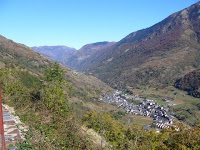
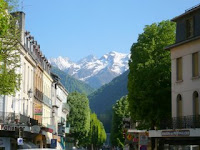


Luchon is a kind of reinvented spa town; if you've ever visited a 'traditional' thermal resort here you'll know that they're not exactly renowned for their - er - dynamism. Whilst still heaving with curistes in season, Luchon promotes itself as a centre for walking and snow sports as well and so attracts a livelier sort of crowd than just the dressing gown and slippers brigade. In fact it has a strangely metropolitan vibe for these parts, with people gathering at the cafés at apéro time, and in particular on Sunday morning, to drink wine and coffee, read the papers, do the crossword and watch everyone else doing the same thing. A bit Toulouse-meets-Harrogate, with which it's twinned. We loved it. Part old mountain village, complete with narrow streets, steep rooves and wooden balconies; part Belle Epoque spa town, very elegant with tree and café-lined allées for endless promenades, parks and sumptous villas.

In true Slow Weekend style, we spent a decent amount of time just hanging out (drinking wine and coffee, blah blah blah), aided and abetted by the Foire de Toussaint which took over the town on Saturday during which we were, amongst other things, force-fed endless (and free) morsels of locally produced beef and lamb (and wine, of course) with no hint of a sales pitch, or even anyone to buy from. In fact I was struck by the overall generosity of the place, unusual perhaps for somewhere so dependent on tourism. Just remember, should you go there and should you dine there (and you will), to order much less than you think you can eat, otherwise you'll end up like me staggering womanfully round the town until midnight on Friday after an extraordinary dinner of potiron soup, omelette aux girolles, organic trout from Lac Oô with almonds and seventeen thousand vegetables, including the best chips I've ever eaten (cooked in duck fat, apparently) and a crème caramel with a hint of wintergreen. Oh yes, and it cost 15 euros, at the little one star Logis de France we stayed at, Les Deux Nations, that's been run by the same family since 1917.

When we weren't eating or drinking or people-watching, we:
Had a quick trip to the Val d'Aran over the Spanish border to (a) stock up with manzanilla, which I can't do without and (b) see what it was like (over developed and overpriced in parts, on the to-be-explored list in others);

Walked, most memorably from the 1700 metre high Port de Bales above the Vallée d'Oueil where we stumbled on the most fantastic 360 degree views, including the Maladeta massif, the highest part of the Pyrénées where there are still (but only just as the climate changes) four glaciers and Aneto rises to over 3400 metres.


Watched a group of around forty griffon vultures wheeling overhead; had an eyeball to eyeball encounter with an alpine chough; saw two flocks of snow finches, several alpine accentors and two golden eagles: all birds that people travel for miles and for years to see ... and there they were.

Had our breath taken away, not for the first time, by the clarity of the light and the autumn colours.
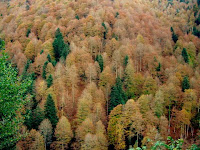
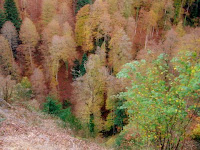


Sometimes I just have to pinch myself and tell myself that I really live here.
Sunday, 19 October 2008

Meanwhile, back at the ranch ...

... life goes on. Markets might be chaotic, recession predicted and pronounced throughout the western world, but still the veg grows, floors need to be tiled, leaves need to be raked, seeds need to be sown, walls need to be knocked down, and difficult decisions need to be taken.

One of the reasons we fell for Grillou was its trees; we're both archetypal treehugging types, and a decade of tree-sparse North Norfolk plus half a year in deforested Aude had left its mark. So it's particularly hard to find ourselves now in the role of executioner. But nevertheless, starting next week out will come the chainsaw and down will come several ancient plum trees (actually little more than a collection of lichen held up by some rotting bark. The blossom was pretty though), half a dozen or more young ash trees, a big old sprawling walnut that keeps on doing its best to sprawl into the salon, six light-eating leylandii (enough said) and - most difficult of all - four beautiful maple trees.

I'm not good at dealing with damage and destruction. Actually, that's a bit of an understatement: I'm almost neurotically unable to deal with it. If I break something accidentally I'm unconsolable; if someone else does it I'm apoplectic. When my ex-partner once sat on and broke the much-loved pink sunglasses that I'd left on the driver's seat when we were staying overnight in Beaumont sur Sarthe (see how I remember the finest detail? I'm ashamed to admit that I can even tell you what we'd eaten the night before ...), I stomped off so far that it took him hours to find me and we nearly missed the ferry. For heaven's sake, even knocking out a wall or an old kitchen is traumatic. So you can begin to imagine how angst-ridden has been the decision to cut down our trees.

The maples act like a line of defence against all comers, sitting as they do along much of the west-facing front of the house, right outside the main front door. The walnut does the same at the south end, along with a lovely old ash tree that has been spared but is up for radical beheading next week. The plum trees defend the east face. While the maples remain, energy will stay stuck, and while we might issue an invitation to be here, Grillou won't. So go they must. And in the process a lot more light will reach the house, so that this rather dark and dingy corner...


will turn into something more like this (without the ridiculously big maples on the left) ...


For any other tree lovers out there, here's a glimpse of three of our favourites: the willow, that stands guard over its own bit of garden and the 'hot' potager:


and two of our centenary oaks, much loved by all our birds but especially favoured by the black woodpecker:


So let the destruction commence. But best keep away from me for a while though. Especially if I've got the chainsaw in my hand ...

Sunday, 14 September 2008

Farewell to summer

Unlike the last couple of years, when wall-to-wall sun and warm temperatures in Ariège have lasted pretty much through to November (I swam in Lac Mondély in October last year), Metéo France's prognosis for this autumn is - well, autumnal. So when we spotted a miniature grey-free gap last week, we threw the tent into the car and within an hour were gone, this time towards Banyuls sur Mer in Roussillon for a couple of days coastal walking.

Banyuls is an old wine town just 12 kilometres from the Spanish border, where the last vestiges of the Pyrénées meet the Mediterranean. It has great character, a kind of faded elegance and a very cheap municipal campsite! I'd hate to be there in August, but outside la belle saison it's a charming place - laid back but still very much alive, unlike some of the big purpose built resorts where the shutters go down on the first day of September. People go there to taste and buy wine, to eat fish, to swim and snorkel, to walk the coast path that winds its way in and out and up and down amongst the criques and most of all, it seems, just to stroll around, watching everyone else do the same thing. We did all of those things, and managed to fit in a trip to Cadaqués as well.


Cadaqués

Cadaqués was once a small shabbyish fishing village in a setting of spectacular natural beauty on the Costa Brava, close to the Cap de Creus; it was immortalised by Salvador Dalí, who had a house there, and during the 60s and 70s became a remarkable arty-hippy hangout where happenings happened. Until, that is, it got discovered by Barcelona's beautiful people, and Americans, and became chic. Cadaqués is undeniably attractive, but to be honest I found it to be just a teensy bit up itself and I would, I think, have much preferred it in its shabby-but-not-chic days. It's also the only place I've ever been where you're required by municipal decree to pay for parking by the minute (it's 0.03567 euros per minute or part thereof. I'm not kidding). We didn't though, because I'm mean and because I have a fully functioning built-in rip-off detector; instead we found a dingy kind of disused wide alleyway thing that was full of old French cars and the kind of travellers' vans that have tipi poles on the top, so we parked there. For free. And in a back street restaurant that was heaving with local workers and French visitors, we managed to find some affordable salad and sardines, along with a lively debate about the sorry state of the Parti Socialiste with a couple from the Auvergne. So all was not lost.

Being a lover of simple things, though, perhaps the best bit of the trip for me was on Cap Béar, close to Banyuls, watching a Bonelli's Eagle circling and hovering on the air currents for almost an hour - a truly lovely sight. The same night, a storm of mammoth proportions regaled us with almost continuous thunder and lightning for over four hours; in its wake rose the tramontane. The tramontane is the local wind, the Languedoc version of the Mistral, which erupts every so often and gusts at anything up to 90 km an hour, usually for at least four days. It's not pleasant, and is said to drive the locals mad. Which makes daily life, not to mention camping, a constant battle and is one reason why we chose not to live there. So with some sadness (and not a little hilarity, given the manic-ness of the wind) we packed up and came home.


Looking south from Cap Béar

And arrived back here to a different season. There are fallen leaves everywhere, there's snow on Mont Valier and the evenings seem shorter, somehow. Last night we drew the curtains for the first time since March.

Monday, 1 September 2008

Slow Walking on the Plateau de Beille

We've just spent a couple of days camping and walking in Haut Ariège, on the Plateau de Beille and in the Haute Vallée d'Aston nearby. And very lovely it was too.


Although it's only just over an hour from home, this part of Ariège is so different from our 'end' that it feels as though you've travelled a lot farther. With a few exceptions, such as the valleys of Vicdessos and Oriège, most of the habitation is centred around the Ariège river, which runs from its source high in the mountains close to Andorra northwards towards Tarascon, Foix and eventually joins the Garonne 164 kilometres later. South of Tarascon, the valley sides are so steep that the houses and farms cluster close to the river; unlike the west of Ariège, where farmhouses and granges dot the slightly more gentle and greener slopes surrounded by large swathes of land, in Haut Ariège people live much closer together. We spent not a little time fruitlessly househunting in this part of the department before it dawned on us that the terrain simply didn't offer the kind of house that we wanted. The N20, the road to Andorra, runs parallel to the river, and - how can I put this? - it ain't quiet. On an average weekend it feels as though all of Toulouse and half of Tarn et Garonne are en route to Andorra to fill up with cheap pastis and cigs. In fact they probably are.

For all that, it's a spectacular area, and once you leave the N20 behind is as silent as you could wish for. The Plateau de Beille is a high altitude plateau, better known for being the Pyrénées' most important cross country skiing area and a frequent stage finish for the Tour de France. Now I'm not a skier, and haven't been one since a memorable school skiing trip during which I entered into the kind of relationship with a T-bar that's really best not described. But the walking is great. You can drive up to the ski station, which means it's one of the few walking areas where you can start walking at an altitude of 1800 metres. We're Slow Walkers, not peak baggers; we’re not interested in how fast we can cover a path, how much height we can gain or how many kilometres we can walk, nor are we up for scary scrambles, precarious footholds or anything that needs crampons. Slow Walking is about taking time to be in and contemplate our surroundings with all our senses; to stand and stare just as often as we want to; and to enjoy the simplicity of walking without the need for challenging goals. So the Plateau is our kind of high altitude walking: no ropes, no vertigo, no scree, but still enough ascent and descent to feel that you've had a decent workout, plus 360 degree views of lots of the big peaks in France, Spain and Andorra. There was one point where we could see both Canigou and Mont Valier, which if you know your Pyrénéan geography you'll realise is quite remarkable.

On the second day we walked in the Haut Valléé d'Aston, where so many flowers were still out that it almost felt like spring.


We gathered bilberries and wild raspberries, spent over half an hour watching a golden eagle circling then perching in a tree not far above us, walked through clouds of butterflies, and I spotted my first ever Black Wheatear.


The sun shone, the cow bells on the estives (high summer pastures) rang loud, I came across the most beautiful beech tree, and the river soothed our hot feet. Am I making you envious? Good.