Showing posts with label mountains. Show all posts

Monday, 13 September 2010

Up among the orris

The swansong to our holiday week saw us making a very last minute decision to take our Quechua pop-up tent away for a couple of nights, to Vicdessos. It was the first camping trip of the year, as evidenced by the ridiculous amount of time and tantrums it took us to dismantle the infamous tent that takes only 15 seconds to put up; we go through this every year, along with half our fellow campers, before we realise that in spite of Decathlon's pretty pictures on the bag it's just not possible to put both blues to both browns before you do that funny twisting thing (if you have a similar tent you'll know exactly what I'm talking about) and you just have to wing it, or ask for help. Still, it's all good for campsite solidarité. At least it would have been, if we'd had any fellow campers to be solid with. This time, in spite of fantastic weather, we were alone, apart from a few semi-permanent caravanners who spent most of their time cleaning their cars and hosing their awnings (or was it the other way round?)

Vicdessos and its twin village Auzat sit up against both the Spanish and the Andorran borders, and at the foot of Montcalm, 3007 metres high and often known as the 'roof' of Ariège. Although only just over an hour from Grillou the scenery here is very different - the valleys are narrow, edged in by tall, rocky peaks, and habitation tends to be gathered together in hamlets, some of which, like Mounicou, remain very traditional indeed. A lot of the walking here is of the 'sportive' rather than the Slow variety - but not all. We chose to explore Le Chemin des Orris, up above the man made Etang de Soulcem.

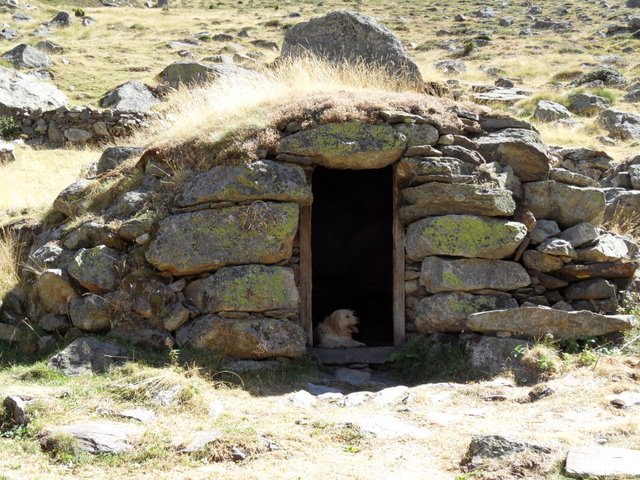
An orri is a low, round shepherds' hut found up on the estives - the summer high pastures - built entirely of dry stone (ie no mortar) and often topped with turf, or sometimes with slate. The design hasn't changed since the Middle Ages, when various confreries or guilds (some of which still exist today) were given the right to construct them on land owned by the local count, or king, or whoever; in some places - and we were in one of them - the orris were grouped into small hamlets, often around a communal courtyard. Until early last century, they would be occupied through the summer months not just by the shepherd but also by a part of his family, while the rest of the family remained down in the valleys to look after the crops; they would be used not just for habitation but also for cheesemaking, for the shepherd was also a fromager. Les Orris de Carla, closest to the lake at Soulcem, were in use until 1968.

To make sense of orris you need to understand the concept of transhumance. The transhumance is the leading of livestock - cows, sheep and horses - from their winter homes in the valleys, along roads, paths and mountain trails, up to the high mountain pastures - the estives. The system evolved during the Middle Ages and is still widely practised here in Ariège today, where it's not only a part of the farming calendar but also now a form of pastoral tourism: many people gather each May or June to follow the transhumance journeys up to the estives, which have become festive and convivial occasions as well as serious work. These days, some farmers have grouped themselves into associations which hire seasonal shepherds and cowherds to look after the animals, whereas others merely pay occasional visits to their livestock, often on a shared rota basis with colleagues. Pretty much wherever you walk in the mountains in the summer you'll come across animals; a few of the estives are fenced, though mostly the animals roam semi-wild, simply being led from one grazing area to another every so often by the shepherd or farmer. The sound of bells is an integral part of any walk in the high pastures.

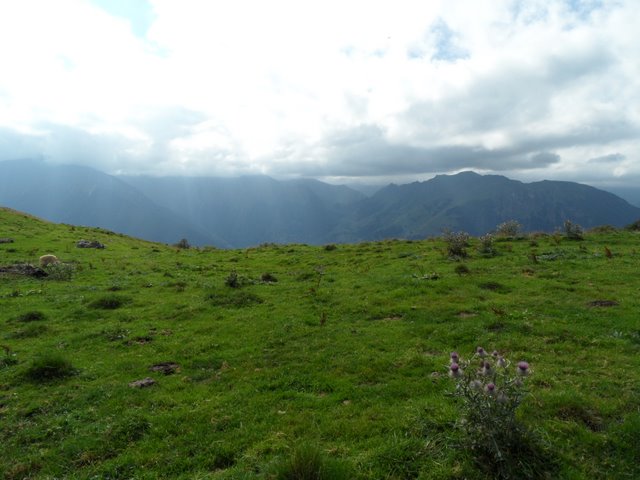
The pastureland above Soulcem is stuffed full of orris, some of which have been recently restored. Sadly, six more groups of them were flooded when the lake was formed by the creation of a huge barrage. A lovely, and simple, walk takes you from the parking area at the end of the étang - at around 1200 metres - along the valley, either on the piste on the east side of the water or boulder hopping along the streams on the other. Longer and more challenging walks take you up and over the peaks to either side (it's quite possible to walk to both the Andorran, and the Spanish, borders), or in a circle up to a grassy shoulder.

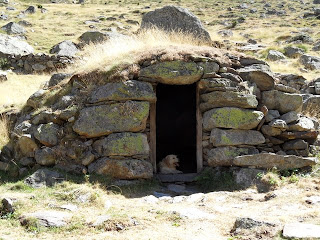
This is one of the Orris de Carla, complete with new occupant:


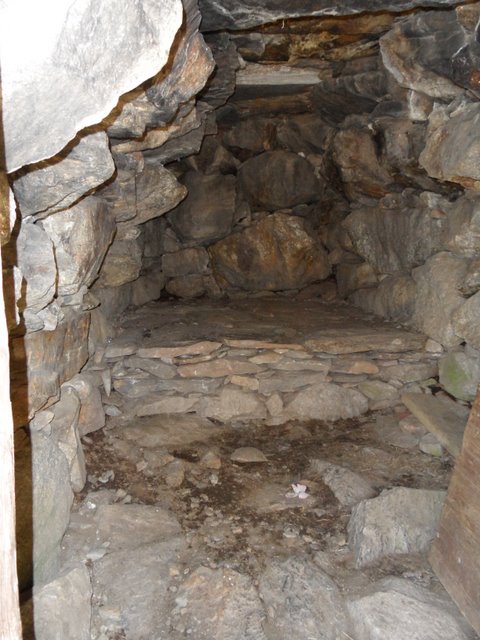
Inside one of the orris - the stone platform at the back would have been used for sleeping, covered in leaves and moss:


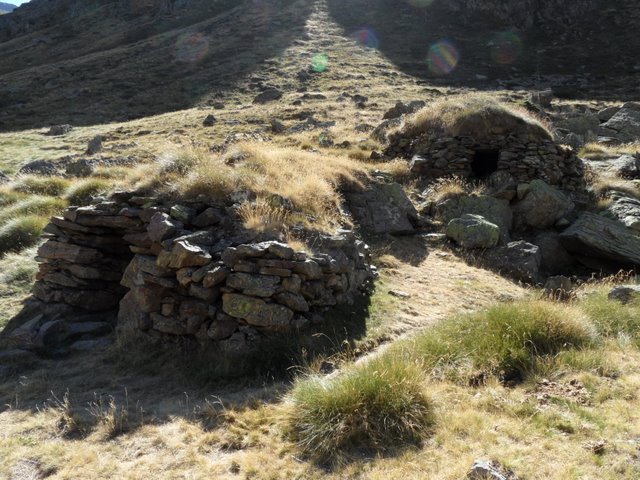
Part of a hamlet of orris higher up the valley. This one had an enclosure, and another piece of ground that looked as if it may have been used to grow things.


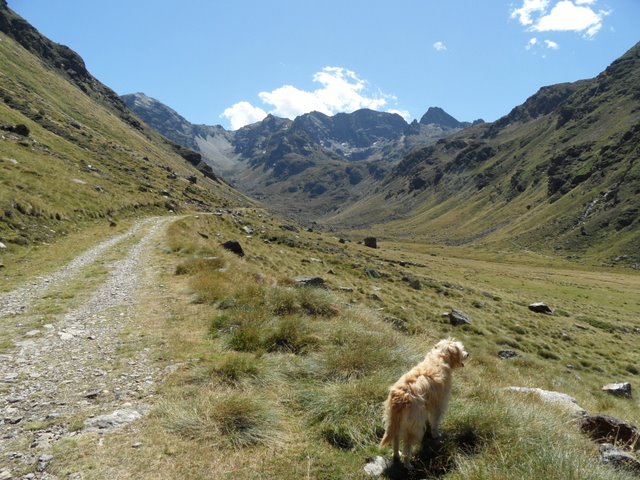
The piste leading from the étang is wide and accessible, though you still get a real feel of being in a high mountain area. Here it feels almost Alpine in character.


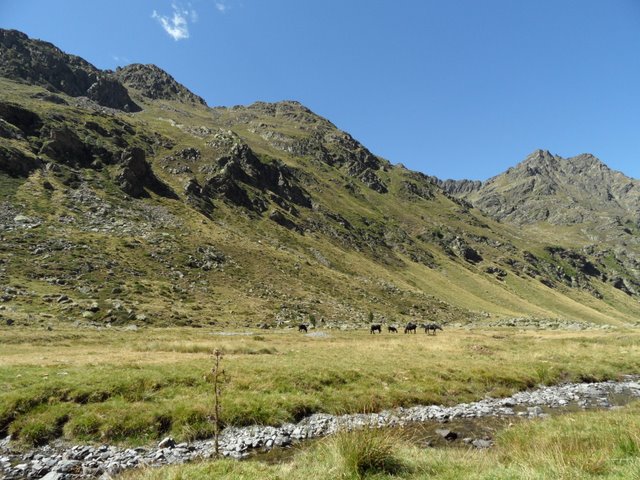
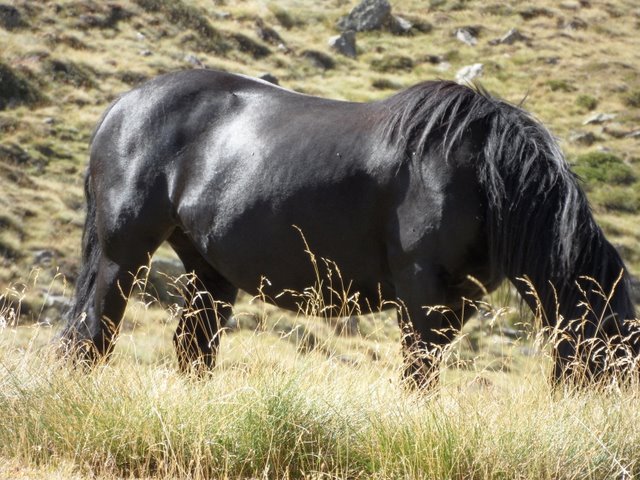
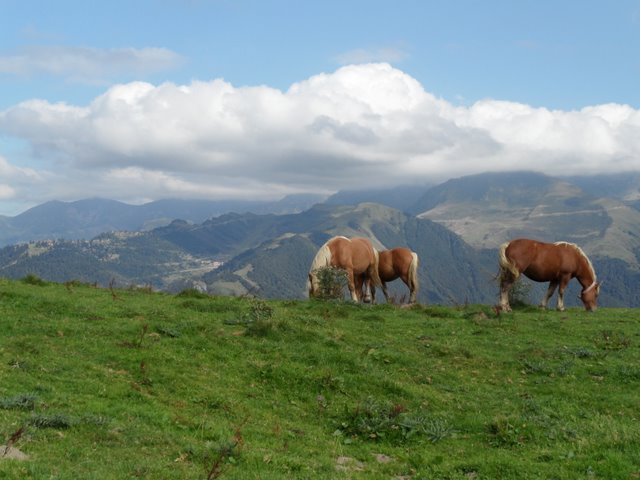
Down on the valley floor, where a herd of Mérens horses were grazing. Mérens are a native breed of Ariège, and are believed the be the closest descendants of the wild horses of prehistoric times.


They are beautiful creatures. Just down the road from Grillou, at La Bastide de Sérou, is the Centre National de Mérens, where you can discover the breed in every which way.


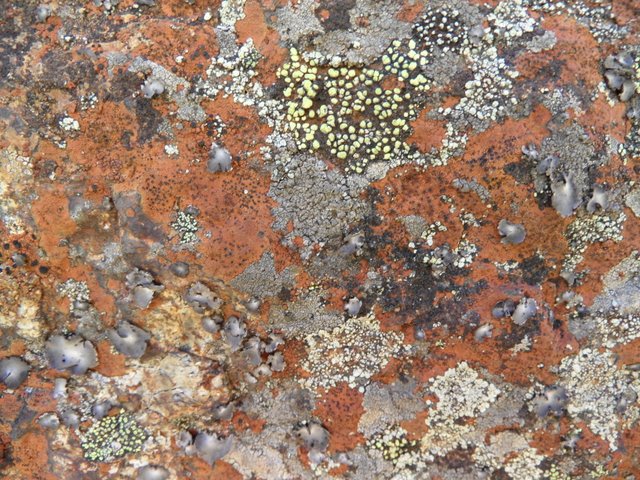
Fantastic lichen formations on the rocks ....


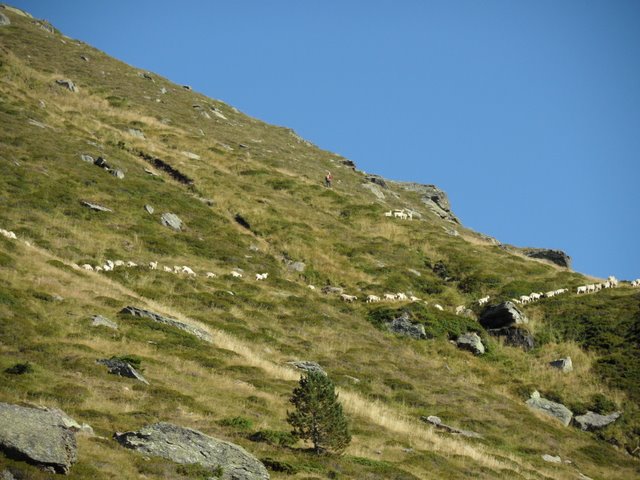
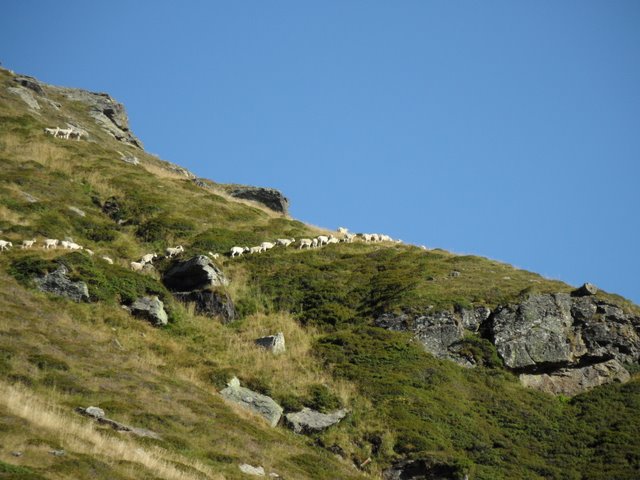
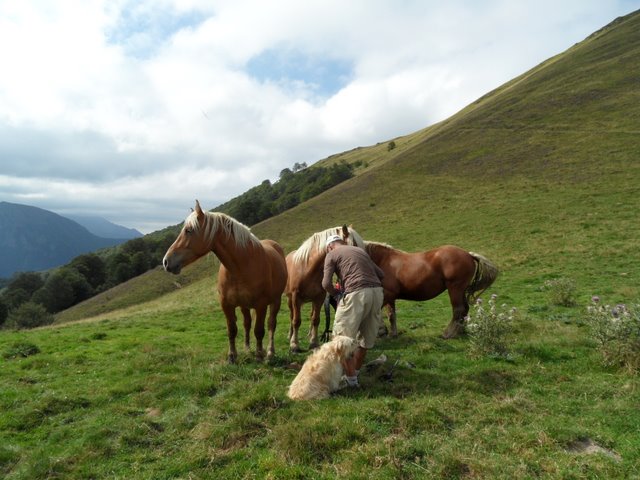
Much higher up the path on the grassy mountainside we encountered a shepherd moving a huge herd of sheep from one grazing area to another. We sat quietly and watched for a long time; the communication between him and his dog, a Border Collie, was almost mystical - none of the arm waving and almost constant yelling of One Man and His Dog (a series of TV programmes popular in the 1980s that set British sheep farmers and their dogs in competition with each other in various sheep dog-y exercises), but just eye contact and the occasional trill or other sound. If you click on the picture to enlarge it, you'll just see the shepherd standing on a rocky outcrop.


The other breed of dog that does this work is the Berger des Pyrénées. Our own dog is (mostly) one of these, though we've no idea whether he comes from a working family as he was originally taken in having been abandoned. However - and I'm aware that this may sound far fetched to some - when we were up in those high mountain pastures it was as if something was calling to him from a collective unconscious ... the way he looked, and listened, and thought ... a particular sort of alertness, a sort of intelligence, that was new. It was as if he was thinking "Hang on a minute ... I know something about this ... I've been here, before ...".




Sunday, 29 August 2010

The blogger's return

This is the time of year when fellow bloggers write lamenting their lack of summer postings, claiming (variously) holidays, traumas, an endless round of summer socialising, or just The Unforeseen Passing of Time. I'd better do the same, given my absence from your screens for longer than I'm happy about: I can't, though, claim any of those reasons - just the usual trying to fit three jobs into days designed for only one. It's all a bit déja vu-ish, really - summer in our restaurant days was always a time of eighteen hour days, too. Ah so. This too shall pass.

This week, however, we're taking a holiday. In Ariège. We decided to do something that ironically we've never done: to be tourists in our own département. And to do all the things that we enjoy doing when we're on holiday - like walking, and sitting on café terraces with cold beers and a book, and watching birds, and exploring out of the way villages, and having picnics, and trying out lots of local restaurants, and just sitting in the sun looking at a great view - here, within an hour or two of home. Partly so that we can put together some Slow Walks and Slow Routes for next year's guests, partly so that we can experience what it feels like to be a visitor here so that we get a better sense of how to help other people have a great holiday ... but mainly, admittedly, just to have a good time ourselves, away from our various day-and-half-the-night filling jobs.

And so to kick off, after coffee and croissants at Seix, we spent most of today walking up above Ustou around Le Tuc de Peyre Mensongère. Getting to the start of the walk was 'interesting', and perhaps not for the faint hearted, as it entailed a 10 kilometre drive up a lumpy, bumpy forest piste (and no, we don't have a 4x4 ...). And I do have to admit that we wouldn't perhaps have spent quite so much time walking if we hadn't first completely mistaken the route and schlepped up - that's up as in height, not in distance - several hundred metres of a look-alike path that actually ended up by going ... nowhere (not entirely our own fault though, that the barrier on the piste had been moved 2 kilometres downhill and that the walk directions still worked, albeit defectively, in spite of that ...). But it was a fantastic walk, even if we did cover twice the distance we should have done, and the views were amongst the best you could hope for, even if it was slightly cloudy: south and west, to the high peaks on the Spanish border just a few kilometres away; east, to Mont Valier and the reserve; north, to the Petites Pyrénées, Saint Girons and even our home ground, the Séronais.


On the plateau just below Le Tuc we encountered three horses (Comtois, I think?) that were obviously up on the estive for the summer, one of whom took a real shine to John, nuzzling his arm, trying to get into his rucksack, and following him around for a long time. But the very best bit was the hour we spent sitting watching a flock of griffon vultures wheeling over head, and coming to sit on rocky outcrops just a little way above us. There must have been thirty or forty birds. It was a rare sight, and truly extraordinary.


And so how else to finish the day but with an apéro and dinner back down in Seix, on the terrace at the Auberge du Haut Salat, a lovely, friendly, traditional place overlooking one of the main squares that cooks simple food, excellently, because it uses good ingredients: a wonderful buffet for entrée, followed by lamb cutlets with a tian of courgettes (there's no escaping them, anywhere! But it was good.) and slow cooked potatoes, and then a to-die-for (possibly literally, but what a way to go ...) chocolate tart.

And now to bed, and to pore over the maps to plan tomorrow.

Saturday, 11 July 2009

Saint Girons pushes the bike out

Our local town - or at least what passes for one in this part of the world - is Saint Girons, whose moniker is 'Capital of the Couserans'. When we first visited several years ago we were not, it has to be said, immediately wowed. It was a very hot and thundery afternoon, we'd been travelling for hours, and it was Monday, a day which much of rural France has not yet recognised. We wandered the old town, strolled along the river under the plane trees, admired the pink marble pavements, sat with a long apéro in the Bar de L'Union, and ate well at Le Bouchon. And yet. We moved on the next day as planned with something of a 'yes, but'.

Returning some time later, we began to find out that Saint Girons is a place that, if you give it half a chance, will get its hooks into you slowly. (Which it did, and continues to do, to both of us.) It doesn't have the medieval cuteness of, say, Mirepoix, nor a landmark chateau like that of Foix, or the lovely romanesque art and architecture of Saint Lizier just a couple of kilometres away. It does have some lovely old corners, complete with peeling stucco and ancient shutters, plus some wonderful and unreconstructed shopfronts (as a Francophile friend from England said "It's just so - well, French ..."); it has some surprisingly good shops, once you've found them; it attracts a bunch of more-than-usually interesting people; it has three rivers and views of the mountains. But more than all this, it has atmosphere.


And today it had atmosphere redoubled in trumps, because for the first time it hosted the finish a Tour de France stage finish. The Tour passes through Ariège pretty much every year; last year we watched it at our local col. Saint Girons has previously hosted two stage departures, but never a finish, so it was a Very Big Thing Indeed for our little town. We had, of course, to be there. As I think did everyone from within a hundred kilometre radius ...

It was a gorgeous, sunny, hot, tar-melting day. You couldn't walk a pace in the town centre without falling over a bicycle in some form of other:


After a Napolitaine and a pichet of rosé under the awning of our favourite pizzeria, we joined the throng making its way to the arrival area. As we crossed the bridge over the river, my jaw dropped: in front of us was the biggest media circus I've ever seen. It must have covered tens of hectares, with TV channels from round the world vying for the title of biggest microphone, most powerful dish, longest broadcasting van, fattest lens, loudest mouth, least tasteful kit. Then there were the team headquarters and vehicles, hospitality tents, sponsors' stalls and all the rest ...

We eventually found ourselves a spot about a hundred metres upstream, as it were, from the finishing line, and within site of one of the big screens so that we could watch the race as it progressed. It was not yet 3pm; we still had over two hours to go, but very soon the crowd was three deep. The temperature rose; we all took turns cooling off in a tiny strip of shade just behind us. We were entertained by a continuous stream of sponsors roller-skating up and down, plying us with their promotional stuff; I'm ashamed to report that we came away with five hats, four coasters, three pom poms, a flag, a bandeau, a rattling balloon and six sachets of washing liquid. Most prized of all, however, were the bottles of Vittel water that fortunately were being distributed in abundance.

The caravane, of course, was as ridiculously kitsch as ever:


Hmm. Nice - er - view.


And then we heard, and saw, the helicopters which announced the imminent arrivals of the riders; four riders had broken away from the peloton and it seemed likely that we were in for a sprint finish. We weren't disappointed.


It was almost a French victory but sadly Sandy Casar broke too early and was passed almost in front of our eyes by a Spaniard - all in the blink of an eye. Two minutes later the peloton arrived, and then it was all over. Well, almost. A Basque rider arrived 46 minutes late, to great applause. Then the poor guy was disqualified because the maximum permitted delay is 45 minutes ...

Obviously the official post mortems are yet to come, but it seemed to my amateur eye that our little town acquitted itself rather well, something that although we've only been here for two years makes me feel absurdly proud. The France Télévision broadcast of the race as it made its way through Ariège, seen from the helicopters, was utterly delicious - all rich greens and blues and staggering views - and can have done no harm at all to our department's reputation: if I didn't live here already it would have had me packing my gear into a removal van tomorrow.

But I do live here. And I love it. Can you tell?

Thursday, 19 March 2009

Spring cleaning

The last couple of weeks have been almost outrageously hot. "Sun bed! Book! Beer! Swim!" demands my still-Anglo-Saxon body. It may learn, one day, that what we used to call a heatwave in England is perfectly normal weather here, and doesn't mean that it's on holiday (though I confess that I did succumb to the sunbed for a couple of hours this afternoon).

I don't know what the spring equivalent of an Indian summer is, but that's what we're having and jolly nice it is too. We haven't seen a cloud for many days, and the clarity of the blue spring light lasts all day and just takes the breath away. The sight of Mont Valier through the trees, still deeply snow covered against the blue sky, is nothing short of awesome. Everything is growing at an unbelievable rate: where a week ago was bare earth, we now have five yellow tulips, perfectly in flower, and the onion plants I planted out last weekend have grown several centimetres. Azaleas are in flower all over the garden. Blossom is ready to burst. The birds are as noisy as on a May morning - save, that is, the blackbird who has chosen our land as his territory, who I'm beginning to think has a speech impediment. Yesterday we heard, and then saw, a Great Spotted Cuckoo fly over the house - a new bird for us both, and a bit of a rarity here. 

Ad we've been spring cleaning. It never ceases to amaze me just how much work it takes to keep Grillou's garden looking natural and semi-wild. There are times when I think it must be easier to have one of those dreadful English style gardens with flat lawn and flower beds, and indeed I occasionally yearn for one - usually after several hours of bramble or ivy-and-moss removal, and admittedly for just three seconds at a time, after which the real me returns. 

Tomorrow, at precisely 12.43 French time, is the Spring Equinox - the day when the sun moves across the celestial equator, rising exactly in the east and setting exactly in the west. It's the true first day of spring; the day when the winter darkness gives way to warmth and new light. Celebrated in almost all traditional cultures, it's yet another seasonal landmark that many of us today have lost touch with. But it's a day to celebrate new growth, new ideas, new enthusiasms, and the beginnings of new projects. 

Me? I'll be on a plane, headed for north-east England; I'm spending a week on an intensive tiling training course, leaving John to carry on the spring cleaning here. I'm a reasonable tiler; being the insufferable perfectionist that I am I can make a pretty good job of a simple floor or wall. But this is Grillou, which doesn't do simple. And with nearly 200 square metres of tiling to be done over the next few months, it's clear that a little more theory and technical know-how won't go amiss if the finished product is going to look as good as it should. Having searched high and low for training in France without success (artisans here tend to learn over years as apprentices, or via a 3 year BAC professionel), there was only one option - a week in England, notably in South Shields, home to one of the three most highly rated professional courses. 

To tell the truth, I'm a bit daunted. Not at the idea of the course, though it'll be interesting being the token woman (!), but at leaving our lovely plants and birds and butterflies and blossom and mountains and most of all our silence for a week in the land of traffic and concrete. I didn't quite realise until this evening, when I took a last walk around the garden, how incredibly attached I've become to Grillou in just two years. I'll miss friends, the simplicity of life here, the Pyrénées, and of course the weather. But hey, there are compensations. South Shields is the curry capital of the north-east ...

See you all in a bit over a week!

Tuesday, 25 November 2008

It's snowing!


Well, well, well. It's snowing. Now this is a Grillou I haven't seen before.

I love snow. It turns me into a big kid with a new toy. It makes me want go out and kick around in it and make snowwomen and throw snowballs. I wish I were a skier, but if you've been reading this blog for a while you'll know all about my legendary skiing prowess (I do want to get some raquettes - snowshoes - this year though). But when we woke up this morning and looked out of the window and saw everything covered in snow - proper snow, I mean, not that horrible wet stuff that disappears as soon as you puff at it - all I really wanted to do was go out and walk in it. I made a valiant attempt to go on working, I really did. But given that today's delectation was the scraping of thirty year old cork tiles from the walls of our downstairs loo, my willpower very soon simply gave up on me. I mean, what can you do when your garden looks like this:


So out we went to walk a bit of the GR78, La Voie du Piémont Pyrénéen, which runs across country just a few minutes walk away from Grillou and is part of the Chemin de St Jacques de Compostelle. While not one of the four major Chemins, it's a superb walk of, in total, around 450 kilometres (140 in Ariège) that runs through the Corbières, the Couserans, the Comminges and the Bigorre regions to join up with the Arles to Oloron-Ste Marie route at St Jean Pied de Port in the Basque country. Phew. (That was for the sentence, not the walk). It's a classic Slow Walk, and definitely destined, I think, to be as much of a guest favourite as it is one of ours. One day, perhaps, we'll do the whole thing instead of piecemeal bits.
The light was fantastic at times:


After descending from Grillou into the valley, the chemin climbs gradually back up to around 500 metres and the views open out to the south and west, giving some lovely views (well, usually!) over the high peaks and some nearby hamlets:


The strange thing is that having walked 3 kilometres or so along the chemin, Grillou is less than a kilometre away (over to the left on the picture above) ... but you can't see it. We've walked the paths and woods all around the house now, and come to the conclusion that Grillou must be one of the only houses that nobody can see, from anywhere ...
On the way back there's a great view of Rimont, our village, in the distance, with the Pyrénées behind (almost hidden in the snowy mist):


More snow tomorrow. Yippee!

Monday, 27 October 2008

A what-the-hell weekend in Luchon

What do you do when the clocks are about to change (and you know you'll go into mournful mode for several months), Metéo France are for once confidently predicting three clear and sunny days, and you've finally finished renovating the kitchen and the salon that you started a year ago? You make an instananeous what-the-hell decision to go away for the weekend, of course.

It took us just half an hour on Friday morning from the what-the-hell moment to actually driving away down the track with boots, binos and books (and not a lot else) stashed in an ungainly fashion in the back of the car. Even now, two years on, the idea of a weekend away still holds a rare thrill: during the resto years weekends went by in a blur of bookings, bed changes and fourteen hour days behind the stoves. (Bizarrely, it still has the power to induce more than a touch of guilt too, as though we really ought to be slogging away doing something. Isn't the human psyche strange?) But guilt or no guilt, we decided to head off to Luchon, in the far south of the French Pyrénées just a few kilometres from the Spanish border, and just over an hour and a half (on the twiddly route) from Grillou.


Luchon is a kind of reinvented spa town; if you've ever visited a 'traditional' thermal resort here you'll know that they're not exactly renowned for their - er - dynamism. Whilst still heaving with curistes in season, Luchon promotes itself as a centre for walking and snow sports as well and so attracts a livelier sort of crowd than just the dressing gown and slippers brigade. In fact it has a strangely metropolitan vibe for these parts, with people gathering at the cafés at apéro time, and in particular on Sunday morning, to drink wine and coffee, read the papers, do the crossword and watch everyone else doing the same thing. A bit Toulouse-meets-Harrogate, with which it's twinned. We loved it. Part old mountain village, complete with narrow streets, steep rooves and wooden balconies; part Belle Epoque spa town, very elegant with tree and café-lined allées for endless promenades, parks and sumptous villas.

In true Slow Weekend style, we spent a decent amount of time just hanging out (drinking wine and coffee, blah blah blah), aided and abetted by the Foire de Toussaint which took over the town on Saturday during which we were, amongst other things, force-fed endless (and free) morsels of locally produced beef and lamb (and wine, of course) with no hint of a sales pitch, or even anyone to buy from. In fact I was struck by the overall generosity of the place, unusual perhaps for somewhere so dependent on tourism. Just remember, should you go there and should you dine there (and you will), to order much less than you think you can eat, otherwise you'll end up like me staggering womanfully round the town until midnight on Friday after an extraordinary dinner of potiron soup, omelette aux girolles, organic trout from Lac Oô with almonds and seventeen thousand vegetables, including the best chips I've ever eaten (cooked in duck fat, apparently) and a crème caramel with a hint of wintergreen. Oh yes, and it cost 15 euros, at the little one star Logis de France we stayed at, Les Deux Nations, that's been run by the same family since 1917.

When we weren't eating or drinking or people-watching, we:
Had a quick trip to the Val d'Aran over the Spanish border to (a) stock up with manzanilla, which I can't do without and (b) see what it was like (over developed and overpriced in parts, on the to-be-explored list in others);

Walked, most memorably from the 1700 metre high Port de Bales above the Vallée d'Oueil where we stumbled on the most fantastic 360 degree views, including the Maladeta massif, the highest part of the Pyrénées where there are still (but only just as the climate changes) four glaciers and Aneto rises to over 3400 metres.


Watched a group of around forty griffon vultures wheeling overhead; had an eyeball to eyeball encounter with an alpine chough; saw two flocks of snow finches, several alpine accentors and two golden eagles: all birds that people travel for miles and for years to see ... and there they were.

Had our breath taken away, not for the first time, by the clarity of the light and the autumn colours.


Sometimes I just have to pinch myself and tell myself that I really live here.